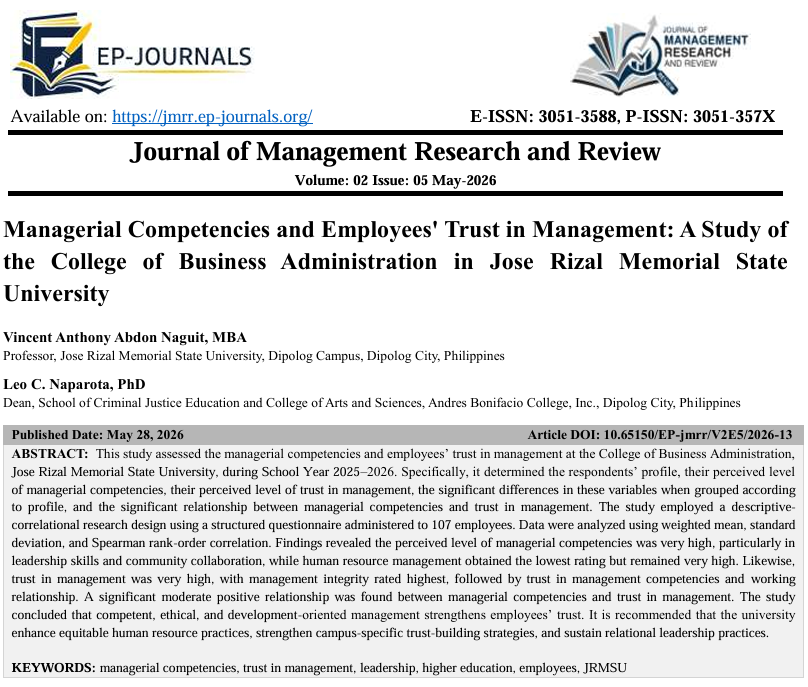
Managerial Competencies and Employees' Trust in Management: A Study of the College of Business Administration in Jose Rizal Memorial State University
DOI:
https://doi.org/10.65150/EP-jmrr/V2E5/2026-13Keywords:
managerial competencies, trust in management, leadership, higher education, employees, JRMSUAbstract
This study assessed the managerial competencies and employees’ trust in management at the College of Business Administration, Jose Rizal Memorial State University, during School Year 2025–2026. Specifically, it determined the respondents’ profile, their perceived level of managerial competencies, their perceived level of trust in management, the significant differences in these variables when grouped according to profile, and the significant relationship between managerial competencies and trust in management. The study employed a descriptive-correlational research design using a structured questionnaire administered to 107 employees. Data were analyzed using weighted mean, standard deviation, and Spearman rank-order correlation. Findings revealed the perceived level of managerial competencies was very high, particularly in leadership skills and community collaboration, while human resource management obtained the lowest rating but remained very high. Likewise, trust in management was very high, with management integrity rated highest, followed by trust in management competencies and working relationship. A significant moderate positive relationship was found between managerial competencies and trust in management. The study concluded that competent, ethical, and development-oriented management strengthens employees’ trust. It is recommended that the university enhance equitable human resource practices, strengthen campus-specific trust-building strategies, and sustain relational leadership practices.
References
1) Abun, D., Bumanglag, A. P., Lazaro, J. R., Serrano, C. A., & Encarnacion, M. J. (2022). The effect of managerial competencies on employees’ trust in the management. Divine Word International Journal of Management and Humanities, 1(1), 22–40.
2) Aiken, L. R., & Susane, W. (2001). Psychological testing and assessment (11th ed.). Allyn & Bacon.
3) Alebiosu, J. O., Salau, O. P., Atolagbe, T. M., Daramola, O. A., Lawal, A. F., Igba, I., & Akinbiyi, F. (2022). Predicting the impact of managerial competencies on the behavioral outcomes of employees in selected manufacturing firms in Nigeria. Sustainability, 14(19), 12319. https://doi.org/10.3390/su141912319
4) Aroca, J. A. S. (2022). Teachers’ professional development and intelligent ways of training. International Journal of Educational Research and Practice. https://www.ncbi.nlm.nih.gov/pmc/articles/PMC9862909/
5) Aziza, D. F., & Nadia, F. N. D. (2023). Trust in management, change resistance and work engagement on startup employees in Indonesia. Jurnal Ilmiah Psikologi Terapan, 11(2). https://doi.org/10.22219/jipt.v11i2.26074
6) Connie, C., Kristiawan, M., Rusly, M., Hutami, S., & Viona, E. (2025). A systematic review of managerial competencies in global higher education. Edelweiss Applied Science and Technology, 9(5), 595–606.
7) Gopalan, N., Beutell, N. J., & Alstete, J. W. (2023). Can trust in management help? Job satisfaction, healthy lifestyle, and turnover intentions. International Journal of Organization Theory & Behavior, 26(3), 185–202. https://doi.org/10.1108/IJOTB-09-2022-0180
8) Jafari, S. (2024). Decision-making strategies in the allocation of educational resources. Journal of Resource Management and Decision Engineering, 3(2), 41–48.
9) Karataş, S. (2024). Teachers’ perceptions regarding effective school characteristics and effective leadership qualities. SAGE Open.
10) Karhapää, S.-J., Savolainen, T., & Malkamäki, K. (2022). Trust and performance: A contextual study of management change in private and public organisation. Baltic Journal of Management, 17(6), 35–51. https://doi.org/10.1108/BJM-06-2022-0212
11) Lazaro, J., Bumanglag, A., & Serrano, C. (2022). The effect of managerial competencies on employees’ trust in the management. Divine Word International Journal of Management and Humanities, 1(1), 23–40.
12) MDRC. (2021). School-community partnerships: How districts can use partnerships to support student services.
https://www.mdrc.org/work/publications/school-community-partnerships
13) Melgar, D. D., & Ching, D. A. (2022). Managerial competencies and practices as predictors of service quality of public elementary schools in the Division of Cabuyao, Laguna. IIARI Conference Article, 2(2).
14) Men, L. R., Qin, Y. S., & Jin, J. (2022). Fostering employee trust via effective supervisory communication during the COVID-19 pandemic: Through the lens of motivating language theory. International Journal of Business Communication, 59(2), 193–218.
15) Peña, R. D. (2023). Human resource management practices and organizational commitment among teachers. E-Journal.
16) Refugio, C., Galleto, P., & Torres, R. (2019). Competence landscape of grade 9 mathematics teachers: Basis for an enhancement program. Cypriot Journal of Educational Science, 14(2), 241–256.
17) Torre, T., & Sarti, D. (2020). The “way” toward e-leadership: Some evidence from the field. Frontiers in Psychology, 11, 554253. https://doi.org/10.3389/fpsyg.2020.554253
18) Tonich, T. (2021). The role of principals’ leadership abilities in improving school performance through school culture. Journal of Social Studies Education Research, 12(1), 47–75.
19) Wertz, K. (2022). Fostering employee trust via effective supervisory communication during the COVID-19 pandemic: Through the lens of motivating language theory. Technical Communication, 69(3).
20) Willis, J. (2019). Resource allocation strategies to support the Four Domains for Rapid School Improvement. WestEd/ERIC.
https://files.eric.ed.gov/fulltext/ED602981.pdf
21) Wziątek-Staśko, A., & Ryszewska, M. (2024). Manager competence model in the context of employee trust.
Downloads
Published
Issue
Section
License
Copyright (c) 2026 LEO NAPAROTA (Author)

This work is licensed under a Creative Commons Attribution 4.0 International License.