The Application of Artificial Intelligence in Personalized Learning in Vietnamese Higher Education: Current Situation and Implementation Model
DOI:
https://doi.org/10.65150/EP-jmrr/V2E5/2026-12Keywords:
personalized learning, digital transformation, higher education, implementation model, artificial intelligenceAbstract
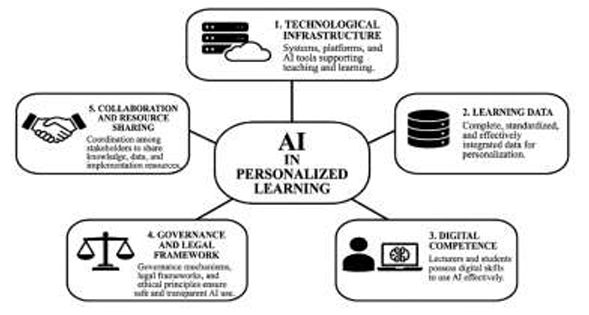
This study investigates the application of artificial intelligence (AI) in personalized learning within Vietnamese higher education in the context of digital transformation. Based on a literature review and comparative analysis, the research clarifies the current status of AI implementation in personalized learning at universities, while identifying major barriers related to technological infrastructure, learning data, digital competence, governance–legal mechanisms, and stakeholder collaboration. The findings reveal that several solutions—such as AI-integrated learning management systems, learner-support chatbots, and learning analytics tools—have been initially adopted. However, these efforts remain fragmented, lack standardization, and have yet to form a coherent approach. Accordingly, the paper proposes an AI implementation model consisting of five components: technological infrastructure, learning data, digital competence, governance–legal mechanisms, and multi-stakeholder collaboration. This model can serve as a reference framework for Vietnamese higher education institutions in developing AI adoption roadmaps to enhance the effectiveness of personalized learning and promote sustainable digital transformation in education.
References
1) OECD. (2021). AI and the future of skills, volume 1: Capabilities and assessments. OECD Publishing.
https://doi.org/10.1787/5ee7f0d9-en
2) World Bank. (2020). Realizing the future of learning: From learning poverty to learning for everyone, everywhere. World Bank Publishing. https://openknowledge.worldbank.org/entities/publication/realizing-the-future-of-learning
3) Holmes, W., Bialik, M., & Fadel, C. (2019). Artificial intelligence in education: Promises and implications for teaching and learning. Center for Curriculum Redesign.
4) 3.Siemens, G., & Baker, R. (2012). Learning analytics and educational data mining: Towards communication and collaboration. In Proceedings of the 2nd International Conference on Learning Analytics and Knowledge (pp. 252–254). ACM.
https://doi.org/10.1145/2330601.2330661
5) Luckin, R., Holmes, W., Griffiths, M., & Forcier, L. (2016). Intelligence unleashed: An argument for AI in education. Pearson Education.
6) OpenAI. (2023). GPT-4 technical report. arXiv. https://arxiv.org/abs/2303.08774
7) Ministry of Education Singapore. (2020). EdTech masterplan 2030. Ministry of Education Singapore. https://www.moe.gov.sg
8) Ministry of Education and Training of Vietnam. (2022). Digital transformation in Vietnamese higher education. Ministry of Education and Training. https://moet.gov.vn
9) UNESCO. (2021). AI and education: Guidance for policy-makers. UNESCO Publishing.
https://unesdoc.unesco.org/ark:/48223/pf0000376709
10) 8.Redecker, C. (2017). European framework for the digital competence of educators: DigCompEdu. Publications Office of the European Union. https://doi.org/10.2760/159770
11) 9.Floridi, L., & Cowls, J. (2019). A unified framework of five principles for AI in society. Harvard Data Science Review, 1(1), 1–15. https://doi.org/10.1162/99608f92.8cd550d1
Downloads
Published
Issue
Section
License
Copyright (c) 2026 Tran Thi Ngat (Author)

This work is licensed under a Creative Commons Attribution 4.0 International License.