Instructional Leadership and Teaching Competence: A Study of Master Teachers in Dapitan City National High School
DOI:
https://doi.org/10.65150/EP-jmrr/V2E6/2026-07Keywords:
instructional leadership practices, teaching competence, curriculum content and pedagogy, planning assessment and reporting, professional development, Schools Division of Dapitan City, PhilippinesAbstract
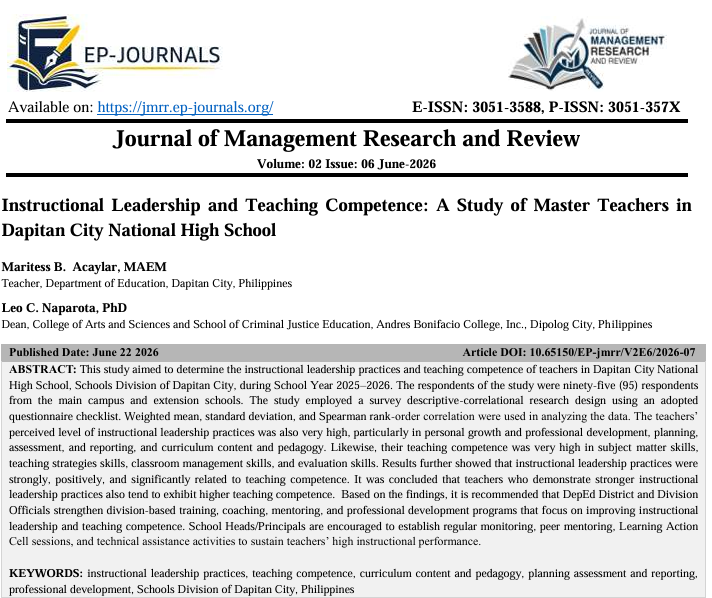
This study aimed to determine the instructional leadership practices and teaching competence of teachers in Dapitan City National High School, Schools Division of Dapitan City, during School Year 2025–2026. The respondents of the study were ninety-five (95) respondents from the main campus and extension schools. The study employed a survey descriptive-correlational research design using an adopted questionnaire checklist. Weighted mean, standard deviation, and Spearman rank-order correlation were used in analyzing the data. The teachers’ perceived level of instructional leadership practices was also very high, particularly in personal growth and professional development, planning, assessment, and reporting, and curriculum content and pedagogy. Likewise, their teaching competence was very high in subject matter skills, teaching strategies skills, classroom management skills, and evaluation skills. Results further showed that instructional leadership practices were strongly, positively, and significantly related to teaching competence. It was concluded that teachers who demonstrate stronger instructional leadership practices also tend to exhibit higher teaching competence. Based on the findings, it is recommended that DepEd District and Division Officials strengthen division-based training, coaching, mentoring, and professional development programs that focus on improving instructional leadership and teaching competence. School Heads/Principals are encouraged to establish regular monitoring, peer mentoring, Learning Action Cell sessions, and technical assistance activities to sustain teachers’ high instructional performance.
References
Aiken, L. S., & West, S. G. (1991). Multiple regression: Testing and interpreting interactions. Sage Publications.
Arombo, C. M. (2023). Master teachers-school heads designate’s instructional competencies, instructional leadership practices and challenges. Psychology and Education: A Multidisciplinary Journal, 15(9).
Baldera, P. R. (2025). Instructional leadership in practice: A qualitative exploration of public elementary master teachers’ identity formation and influence in the Philippines. Educational Process: International Journal, 18, e2025482. https://doi.org/10.22521/edupij.2025.18.482
Blömeke, S. (2022). Opening up the black box: Teacher competence, instructional quality, and students’ learning progression. Learning and Instruction
Bozkuş, K. (2021). A systematic review of studies on classroom management. International Journal of Contemporary Educational Research, 8(1), 251–262.
Cohen, L., Manion, L., & Morrison, K. (2014). Research methods in education. Routledge.
Creswell, J. W., & Guetterman, T. C. (2019). Educational research: Planning, conducting, and evaluating quantitative and qualitative research (6th ed.). Pearson.
Darling-Hammond, L., Hyler, M. E., & Gardner, M. (2017). Effective teacher professional development. Learning Policy Institute.
Department of Education. (2017). DepEd Order No. 42, s. 2017: National adoption and implementation of the Philippine Professional Standards for Teachers. Department of Education.
Guerriero, S. (Ed.). (2017). Pedagogical knowledge and the changing nature of the teaching profession. OECD Publishing.
Hallinger, P. (2025). A systematic state-of-the-art review of Asian research on instructional leadership using PIMRS. Education Sciences, 15(7), 817. https://doi.org/10.3390/educsci15070817
He, P., Guo, F., & Abazie, G. A. (2024). School principals’ instructional leadership as a predictor of teacher’s professional development. Asian-Pacific Journal of Second and Foreign Language Education, 9, Article 63. https://doi.org/10.1186/s40862-024-00290-0
Hellevik, O. (2019, March 13). Questionnaire surveys. The Norwegian National Research Ethics Committees. https://www.forskningsetikk.no/en/resources/the-research-ethics- library/methods/questionnaire-surveys/
König, J., Blömeke, S., Jentsch, A., Schlesinger, L., Felske, C., Musekamp, F., & Kaiser, G. (2021). The links between pedagogical competence, instructional quality, and mathematics achievement in the lower secondary classroom. Educational Studies in Mathematics, 107(1), 189–212. https://doi.org/10.1007/s10649-020-10021-0
Korpershoek, H., Harms, T., de Boer, H., van Kuijk, M., & Doolaard, S. (2016). A meta-analysis of the effects of classroom management strategies and classroom management programs on students’ academic, behavioral, emotional, and motivational outcomes. Review of Educational Research, 86(3), 643–680. https://doi.org/10.3102/0034654315626799
Kraft, M. A., Blazar, D., & Hogan, D. (2018). The effect of teacher coaching on instruction and achievement: A meta-analysis of the causal evidence. Review of Educational Research, 88(4), 547–588. https://doi.org/10.3102/0034654318759268
McCombes, S. (2019, August 20). Survey research: Definition, examples & methods (Rev. January 14, 2025). Scribbr.
Mendoza, J. J., & Bautista, S. C. (2019). Master teachers’ leadership practices, instructional competence and performance of senior high teachers in the city divisions of Laguna. Science and Education, 2(5), 107–122.
Nguyen, D., Ng, D., Luo, W., & Mansor, S. (2020). Exploring the relationships between instructional leadership and teacher competences: Singapore primary school teachers’ perceptions. International Journal of Leadership in Education. https://doi.org/10.1080/13603124.2020.1731765
Nwosu, L. I. (2022). A call to strengthen instructional leadership to support learner achievement during and post-COVID-19: A systematic literature review approach. International Journal of Learning, Teaching and Educational Research.
Organisation for Economic Co-operation and Development. (2019). TALIS 2018 results (Volume I): Teachers and school leaders as lifelong learners. OECD Publishing.
Pastore, S. (2023). Teacher assessment literacy: A systematic review. Frontiers in Education, 8, Article 1217167. https://doi.org/10.3389/feduc.2023.1217167
Refugio, C. N., Galleto, P. G., & Torres, R. (2019). Competence landscape of grade 9 mathematics teachers: Basis for an enhancement program. Cypriot Journal of Educational Sciences, 14(2), 241–256.
Downloads
Published
Issue
Section
License
Copyright (c) 2026 Leo C. Naparota, PhD (Author)

This work is licensed under a Creative Commons Attribution 4.0 International License.












