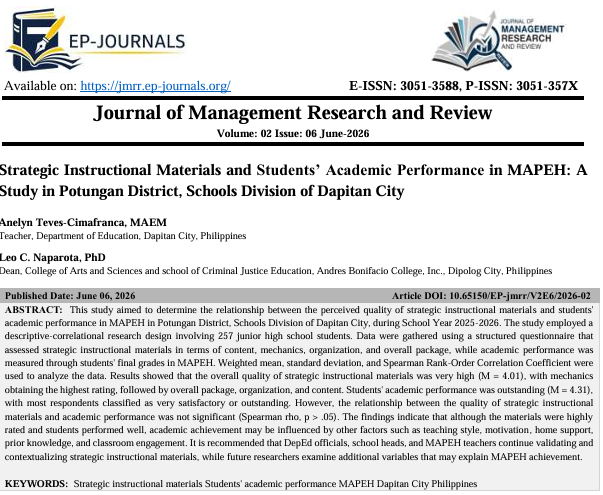
Strategic Instructional Materials and Students’ Academic Performance in MAPEH: A Study in Potungan District, Schools Division of Dapitan City
DOI:
https://doi.org/10.65150/EP-jmrr/V2E6/2026-02Keywords:
Strategic instructional materials Students' academic performance MAPEH Dapitan City PhilippinesAbstract
This study aimed to determine the relationship between the perceived quality of strategic instructional materials and students' academic performance in MAPEH in Potungan District, Schools Division of Dapitan City, during School Year 2025-2026. The study employed a descriptive-correlational research design involving 257 junior high school students. Data were gathered using a structured questionnaire that assessed strategic instructional materials in terms of content, mechanics, organization, and overall package, while academic performance was measured through students' final grades in MAPEH. Weighted mean, standard deviation, and Spearman Rank-Order Correlation Coefficient were used to analyze the data. Results showed that the overall quality of strategic instructional materials was very high (M = 4.01), with mechanics obtaining the highest rating, followed by overall package, organization, and content. Students' academic performance was outstanding (M = 4.31), with most respondents classified as very satisfactory or outstanding. However, the relationship between the quality of strategic instructional materials and academic performance was not significant (Spearman rho, p > .05). The findings indicate that although the materials were highly rated and students performed well, academic achievement may be influenced by other factors such as teaching style, motivation, home support, prior knowledge, and classroom engagement. It is recommended that DepEd officials, school heads, and MAPEH teachers continue validating and contextualizing strategic instructional materials, while future researchers examine additional variables that may explain MAPEH achievement.
References
1) Airasian, P. W., & Miranda, H. (2002). The role of assessment in the revised taxonomy. In L. W. Anderson & D. R. Krathwohl (Eds.), A taxonomy for learning, teaching, and assessing: A revision of Bloom's taxonomy of educational objectives (pp. 249-254). Longman.
2) Anderson, L. W., & Krathwohl, D. R. (Eds.). (2001). A taxonomy for learning, teaching, and assessing: A revision of Bloom's taxonomy of educational objectives. Longman.
3) Andrade, H. L., & Heritage, M. (2018). Using formative assessment to enhance learning, achievement, and academic self-regulation. Routledge. Bloom, B. S., Engelhart, M. D., Furst, E. J., Hill, W. H., & Krathwohl, D. R. (1956). Taxonomy of educational objectives: The classification of educational goals. Handbook I: Cognitive domain. David McKay Company.
4) Asian Development Bank. (2022). Education in the Philippines: Challenges and opportunities. Asian Development Bank. https://www.adb.org/publications/education-philippines
5) Breda, J. (2020). Physical activity and academic achievement: An umbrella review. International Journal of Environmental Research and Public Health, 17(16), 5972.
6) Brookings Institution. (2022). Improving instructional materials in basic education. Brookings. https://www.brookings.edu/
7) Carbonneau, N., Vallerand, R. J., & Lafrenière, M. A. K. (2023). Academic achievement across grades: Child and socio-familial characteristics. Journal of Educational Psychology, 115(2), 245-260.
8) Casiano, M. R., Dela Cruz, J. P., & Santos, L. M. (2024). Perceptions of senior high school students on instructional materials: A multi-profile analysis. Philippine Journal of Education Research, 12(1), 45-62. du Preez, J. (2025). Pedagogical and visual design principles for learning materials: A synthesis. Educational Technology Research and
9) Check, J., & Schutt, R. K. (2017). Research methods in education (3rd ed.). SAGE Publications.
10) Clark, R. C., & Mayer, R. E. (2016). E-learning and the science of instruction: Proven guidelines for consumers and designers of multimedia learning (4th ed.). Wiley.
11) Commission on Higher Education. (2023). Philippine higher education landscape. Republic of the Philippines. https://ched.gov.ph/
12) Council of Chiefs of State School Officers. (2021). Interstate Teacher Assessment and Support Consortium (InTASC) standards. CCSSO. https://ccsso.org/
13) Creswell, J. W., & Guetterman, T. C. (2019). Educational research: Planning, conducting, and evaluating quantitative and qualitative research (6th ed.). Pearson.
14) Department of Education. (2015). Grading system for Senior High School (DepEd Order No. 8, s. 2015). Republic of the Philippines. https://www.deped.gov.ph/wp-content/uploads/2015/04/DO_s2015_08.pdf
15) Department of Education. (2016). K to 12 Curriculum Guide: MAPEH (Physical Education). Republic of the Philippines. https://www.deped.gov.ph/wp-content/uploads/2019/01/PE-CG.pdf
16) Department of Education. (2019). Learning resource management and development system (LRMDS) standards. Republic of the Philippines. https://lrmds.deped.gov.ph/
17) Department of Education. (2020). Contextualized learning resource guidelines. Republic of the Philippines. https://www.deped.gov.ph/wp-content/uploads/2020/06/DM_s2020_076.pdf
18) Department of Education. (2021a). Quality assurance of self-learning modules (DepEd Memorandum No. 2021-042). Republic of the Philippines. https://www.deped.gov.ph/wp-content/uploads/2021/06/DM_s2021_042.pdf
19) Department of Education. (2021b). Evaluation rating sheets for Quarter 3 and 4 modules. Republic of the Philippines. https://lrmds.deped.gov.ph/
20) Department of Education. (2021c). Learning resource evaluation criteria. Republic of the Philippines. https://www.deped.gov.ph/
21) Department of Education. (2022). MAPEH performance indicators report. Republic of the Philippines. https://www.deped.gov.ph/mapeh-indicators-2022/
22) Department of Education. (2023). Learning resource materials quality standards. Republic of the Philippines. https://www.deped.gov.ph/
23) Department of Education. (2024). National learning recovery program report. Republic of the Philippines.
https://www.deped.gov.ph/nlrp-report-2024/
24) Department of Education. (2025). Junior High School curriculum implementation guidelines. Republic of the Philippines. https://www.deped.gov.ph/
25) EdTech Hub. (2023). Multimedia learning in low-resource contexts. EdTech Hub. https://edtechhub.org/
26) El Refae, G. A., Kaba, A., & Eletter, S. (2021). The impact of demographic characteristics on academic performance. International Journal of Educational Management, 35(4), 789-805. Fernández-García, C. M., Maulana, R., Opdenakker, M. C., & den Brok, P. (2019). Student perceptions of teaching effectiveness: Variation by personal and educational factors. Learning Environments Research, 22(2), 231-250.
27) Gagné, R. M., Wager, W. W., Golas, K. C., & Keller, J. M. (2005). Principles of instructional design (5th ed.). Wadsworth/Thomson Learning.
28) Garay Abad, R. (2025). Teachers' judgments of instructional material quality: Content relevance and appropriateness. Journal of Curriculum Studies, 57(1), 34-51.
29) Garay Abad, R., & Hattie, J. (2025). Holistic features in teacher judgments of instructional material quality. Teaching and Teacher Education, 135, 104321.
30) Ghai, A. (2022). Visual design and perceived usability of learning resources: The role of typography, layout, and graphics. Journal of Educational Technology & Society, 25(3), 112-126.
31) Global Partnership for Education. (2024). Learning assessment and instructional materials. GPE. https://www.globalpartnership.org/
32) Guo, W. (2020). Grade-level differences in students' perceptions of teacher feedback and self-regulated learning. Educational Psychology, 40(5), 589-605.
33) Ikram, M., Kenayathulla, H. B., & Uzair, M. (2023). Dimensions of education quality and student-related outcomes. Quality Assurance in Education, 31(2), 210-226.
34) INEE. (2023). Minimum standards for education: Learning materials. Inter-Agency Network for Education in Emergencies. https://inee.org/
35) International Bureau of Education. (2022). Curriculum alignment and learning resources. UNESCO IBE. http://www.ibe.unesco.org/
36) International Society for Technology in Education. (2024). ISTE standards for students. ISTE. https://www.iste.org/standards/students
37) Irambona, A. (2023). Instructional materials and learners' achievement: A comparative analysis. African Journal of Educational Studies, 18(1), 45-59.
38) Islam, M. S., Sultana, S., & Sharmin, N. (2021). Family income level as a factor influencing academic performance. International Journal of Educational Development, 85, 102463.
39) James, M., Todd, C., Scott, S., & Stratton, G. (2023). Physical activity and academic performance: A review of evidence. Journal of School Health, 93(2), 145-156.
40) Kalyuga, S. (2011). Cognitive load theory: How many types of load does it really need? Educational Psychology Review, 23(1), 1-19.
41) Mayer, R. E. (2001). Multimedia learning. Cambridge University Press.
42) Mayer, R. E. (2020). Multimedia learning (3rd ed.). Cambridge University Press.
43) Moreno, R., & Mayer, R. E. (2007). Interactive multimodal learning environments. Educational Psychology Review, 19(3), 309-326. Öksüz, H. İ., & Keskin, H. K. (2022). Readability and comprehensibility in instructional materials. Reading & Writing Quarterly, 38(4), 321-337.
44) Morrison, G. R., Ross, S. M., Morrison, J. R., & Kalman, H. K. (2019). Designing effective instruction (8th ed.). Wiley.
45) National Center for Education Statistics. (2023). Condition of education 2023: Enrollment trends. U.S. Department of Education. https://nces.ed.gov/
46) National Center for Education Statistics. (2024). Enrollment in postsecondary education: Age distribution trends. U.S. Department of Education. https://nces.ed.gov/
47) Organization for Economic Co-operation and Development. (2023). Education at a glance 2023: OECD indicators. OECD Publishing. https://www.oecd.org/education/education-at-a-glance/
48) Partnership for 21st Century Learning. (2023). Framework for 21st century learning. Battelle for Kids.
https://www.battelleforkids.org/networks/p21
49) Penuel, W. R., Gallagher, D. J., & Moorthy, S. (2024). Standards-aligned instructional materials: Engaging diverse learner interests and needs. Educational Researcher, 53(2), 89-102.
50) Philippine Statistics Authority. (2023). Annual poverty indicators survey. Republic of the Philippines. https://psa.gov.ph/apis
51) Philippine Statistics Authority. (2024). Family income and expenditure survey. Republic of the Philippines. https://psa.gov.ph/fies
52) RAND Corporation. (2023). Instructional materials and teacher effectiveness. RAND. https://www.rand.org/
53) Raosoft. (n.d.). Sample size calculator. http://www.raosoft.com/samplesize.html
54) Reiser, R. A., & Dempsey, J. V. (2021). Trends and issues in instructional design and technology (5th ed.). Pearson.
55) Research4Life. (2024). Instructional design and developing country contexts. Research4Life. https://www.research4life.org/
56) Schnotz, W., & Kürschner, C. (2007). A reconsideration of cognitive load theory. Educational Psychology Review, 19(4), 469-508.
57) Schunk, D. H. (2020). Learning theories: An educational perspective (8th ed.). Pearson.
58) SEAMEO INNOTECH. (2019). K to 12 curriculum review: Synthesis report. Southeast Asian Ministers of Education Organization. https://www.seameo-innotech.org/
59) SEAMEO INNOTECH. (2020). Curriculum support initiatives: Improving learning materials in Southeast Asia. SEAMEO Regional Center for Educational Innovation and Technology. https://www.seameo-innotech.org/
60) SHAPE America. (2014). *National standards & grade-level outcomes for K-12 physical education*. Human Kinetics.
61) Southeast Asian Ministers of Education Organization. (2023). Regional report on MAPEH education. SEAMEO. https://www.seameo.org/
62) Suarez, M. T., & Casinillo, L. F. (2020). Strategic instructional materials and student achievement in addressing learning gaps. Philippine Journal of Education, 98(2), 145-162.
63) Sweller, J. (1988). Cognitive load during problem solving: Effects on learning. Cognitive Science, 12(2), 257-285.
64) Sweller, J. (2020). Cognitive load theory and educational technology. Educational Technology Research and Development, 68(1), 1-16.
65) Sweller, J., Ayres, P., & Kalyuga, S. (2011). Cognitive load theory. Springer. Barbosa, A., Whiting, S., Simmonds, P., Scotini Moreno, R., Mendes, R., &
66) Teig, N., & Nilsen, T. (2022). Instructional clarity and support: Associations with student achievement. Studies in Educational Evaluation, 72, 101115.
67) UNESCO Institute for Statistics. (2024). Participation in tertiary education: Age group concentration worldwide. United Nations Educational, Scientific and Cultural Organization. https://unesdoc.unesco.org/
68) UNESCO Institute for Statistics. (2025). Global education statistics: Secondary school enrollment. United Nations Educational, Scientific and Cultural Organization. https://unesdoc.unesco.org/
69) UNESCO. (2021). Technology in education: A tool on whose terms? United Nations Educational, Scientific and Cultural Organization. https://unesdoc.unesco.org/
70) UNESCO. (2023). Global Education Monitoring Report 2023: Technology in education - A tool on whose terms? United Nations Educational, Scientific and Cultural Organization. https://unesdoc.unesco.org/ark:/48223/pf0000385723
71) UNESCO. (2024). Ensuring quality educational content: Teaching and learning materials for inclusive and meaningful education. United Nations Educational, Scientific and Cultural Organization. https://unesdoc.unesco.org/
72) UNESCO. (2025). Quality learning and learner engagement: The role of structured instructional materials. United Nations Educational, Scientific and Cultural Organization. https://unesdoc.unesco.org/
73) UNICEF. (2023). Child poverty and inequality: Long-term effects on health, learning, and nutrition. United Nations Children's Fund. https://www.unicef.org/reports/child-poverty
74) UNICEF. (2024). Access to quality learning in the Philippines: Barriers for low-income families. United Nations Children's Fund. https://www.unicef.org/philippines/reports/education-brief
75) UNICEF. (2025). State of the world's children 2025: Education and equity. United Nations Children's Fund. https://www.unicef.org/reports/state-of-worlds-children
76) Van Merriënboer, J. J. G., & Sweller, J. (2010). Cognitive load theory in health professional education: Design principles and strategies. Medical Education, 44(1), 85-93.
77) Wen, M., Su, S., & Li, X. (2020). Family income and school grades: Robust associations. Child Development, 91(3), 789-805.
78) What Works Clearinghouse. (2022). Instructional materials and student achievement. Institute of Education Sciences. https://ies.ed.gov/ncee/wwc/
79) World Bank. (2021). Learning poverty in the Philippines. World Bank Group. https://www.worldbank.org/en/country/philippines/publication/learning-poverty-philippines
80) World Bank. (2024). Global enrollment trends: Female tertiary enrollment exceeds male enrollment. World Bank Group. https://www.worldbank.org/en/topic/education
81) World Education Blog. (2023). Quality teaching materials and student outcomes. UNESCO GEM Report. https://worldeducationblog.org/
82) World Health Organization. (2022). Physical activity and young people. World Health Organization. https://www.who.int/news-room/fact-sheets/detail/physical-activity
83) Zhang, D., & Nunamaker, J. F. (2023). Multimedia learning and student engagement: A meta-analysis. Journal of Educational
Downloads
Published
Issue
Section
License
Copyright (c) 2026 Anelyn Teves-Cimafranca, MAEM, Leo C. Naparota, PhD (Author)

This work is licensed under a Creative Commons Attribution 4.0 International License.












