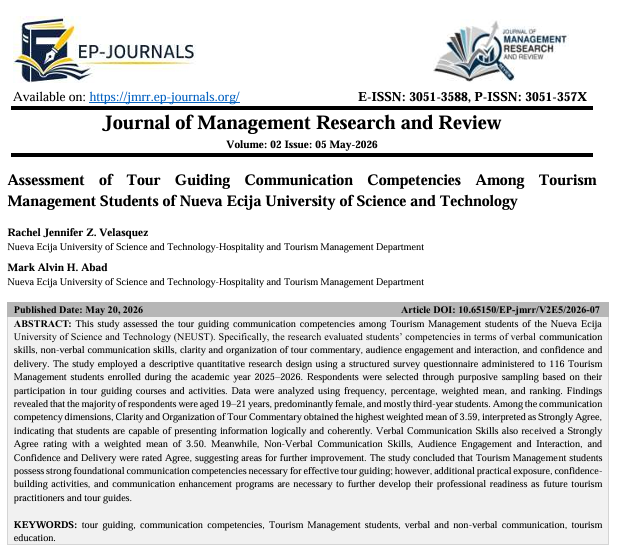
Assessment of Tour Guiding Communication Competencies Among Tourism Management Students of Nueva Ecija University of Science and Technology
DOI:
https://doi.org/10.65150/EP-jmrr/V2E5/2026-07Keywords:
tour guiding, communication competencies, Tourism Management students, verbal and non-verbal communication, tourism education.Abstract
This study assessed the tour guiding communication competencies among Tourism Management students of the Nueva Ecija University of Science and Technology (NEUST). Specifically, the research evaluated students’ competencies in terms of verbal communication skills, non-verbal communication skills, clarity and organization of tour commentary, audience engagement and interaction, and confidence and delivery. The study employed a descriptive quantitative research design using a structured survey questionnaire administered to 116 Tourism Management students enrolled during the academic year 2025–2026. Respondents were selected through purposive sampling based on their participation in tour guiding courses and activities. Data were analyzed using frequency, percentage, weighted mean, and ranking. Findings revealed that the majority of respondents were aged 19–21 years, predominantly female, and mostly third-year students. Among the communication competency dimensions, Clarity and Organization of Tour Commentary obtained the highest weighted mean of 3.59, interpreted as Strongly Agree, indicating that students are capable of presenting information logically and coherently. Verbal Communication Skills also received a Strongly Agree rating with a weighted mean of 3.50. Meanwhile, Non-Verbal Communication Skills, Audience Engagement and Interaction, and Confidence and Delivery were rated Agree, suggesting areas for further improvement. The study concluded that Tourism Management students possess strong foundational communication competencies necessary for effective tour guiding; however, additional practical exposure, confidence-building activities, and communication enhancement programs are necessary to further develop their professional readiness as future tourism practitioners and tour guides.
References
1) Ap, J., & Wong, K. (2020). Tour guiding as cultural mediation: Enhancing visitor experience and satisfaction. Journal of Tourism and Cultural Change, 18(4), 421–437. https://doi.org/10.1080/14766825.2020.1726543
2) Calinao, R., & Castro, J. (2023). Tour guiding education in the Philippines: Assessing communication and interpretive skills of students. Philippine Journal of Tourism Research, 12(1), 55–70.
3) Çetinkaya, Ç., & Öter, Z. (2021). Developing communication competencies of tourism students through practical training and simulated tours. International Journal of Hospitality and Tourism Education, 7(2), 112–125. https://doi.org/10.1080/10963758.2021.1876543
4) Creswell, J. W. (2021). Research design: Qualitative, quantitative, and mixed methods approaches (5th ed.). SAGE Publications.
5) Huertas, A. (2021). Communication competence in tour guiding: Verbal and non verbal skills for effective interpretation. Tourism Management Perspectives, 38, 100788. https://doi.org/10.1016/j.tmp.2021.100788
6) Mak, A., Wong, K., & Chang, L. (2022). Tour guide communication and tourist satisfaction: Evidence from international visitors. Journal of Travel Research, 61(6), 1507–1521. https://doi.org/10.1177/00472875211012345
7) United Nations World Tourism Organization. (2023). World tourism barometer and statistical annex: January 2023. UNWTO. https://www.unwto.org/world-tourism-barometer-january-2023
8) Weiler, C., & Black, K. (2021). The role of tour guides in visitor experience and destination interpretation. Channel View Publications.
Downloads
Published
Issue
Section
License
Copyright (c) 2026 Rachel Jennifer Z. Velasquez, Mark Alvin H. Abad (Author)

This work is licensed under a Creative Commons Attribution 4.0 International License.