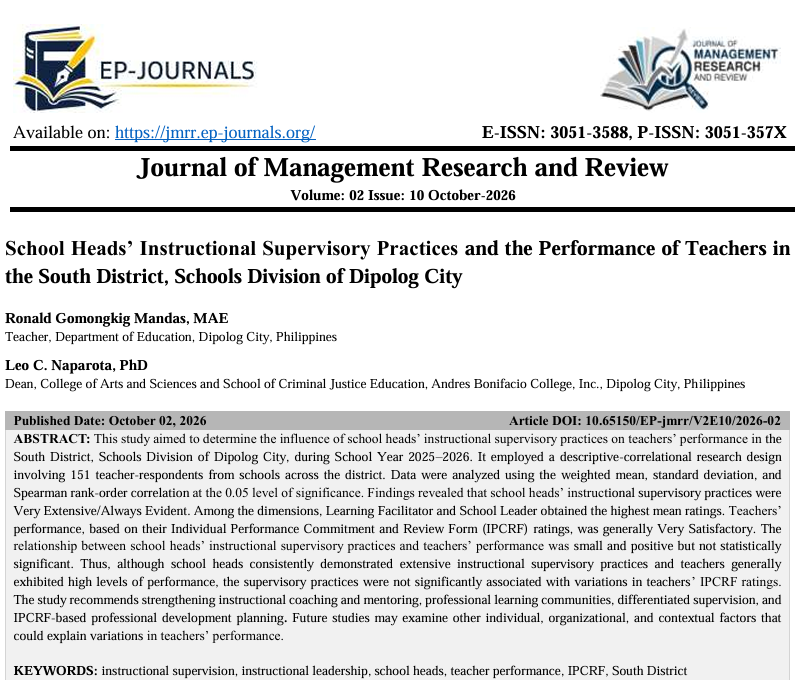
School Heads’ Instructional Supervisory Practices and the Performance of Teachers in the South District, Schools Division of Dipolog City
DOI:
https://doi.org/10.65150/EP-jmrr/V2E10/2026-02Keywords:
instructional supervision, instructional leadership, school heads, teacher performance, IPCRF, South DistrictAbstract
This study aimed to determine the influence of school heads’ instructional supervisory practices on teachers’ performance in the South District, Schools Division of Dipolog City, during School Year 2025–2026. It employed a descriptive-correlational research design involving 151 teacher-respondents from schools across the district. Data were analyzed using the weighted mean, standard deviation, and Spearman rank-order correlation at the 0.05 level of significance. Findings revealed that school heads’ instructional supervisory practices were Very Extensive/Always Evident. Among the dimensions, Learning Facilitator and School Leader obtained the highest mean ratings. Teachers’ performance, based on their Individual Performance Commitment and Review Form (IPCRF) ratings, was generally Very Satisfactory. The relationship between school heads’ instructional supervisory practices and teachers’ performance was small and positive but not statistically significant. Thus, although school heads consistently demonstrated extensive instructional supervisory practices and teachers generally exhibited high levels of performance, the supervisory practices were not significantly associated with variations in teachers’ IPCRF ratings. The study recommends strengthening instructional coaching and mentoring, professional learning communities, differentiated supervision, and IPCRF-based professional development planning. Future studies may examine other individual, organizational, and contextual factors that could explain variations in teachers’ performance.
References
1) Balyer, A., & Özcan, K. (2020). School principals’ instructional feedback to teachers: Teachers’ views. International Journal of Curriculum and Instruction, 12(Special Issue), 295–312.
2) Butcon, R. G., & Tudlasan, R. T., Jr. (2026). Instructional supervision of school heads and its relationship to teachers performance based on PPST domains. Excellencia: International Multi-disciplinary Journal of Education, 4(2), 184–231.
3) Claud, D. D., & Dalisay, J. P. (2024). Demographic profile, school heads’ supervisory practices, and teachers’ performance: Towards corresponding intervention program. Romblon State University Research Journal, 6(2), 72–80. https://doi.org/10.58780/rsurj.v6i2.208
4) Department of Education. (2015). Guidelines on the establishment and implementation of the Results-Based Performance Management System (RPMS) in the Department of Education (DepEd Order No. 2, s. 2015). https://www.deped.gov.ph/2015/02/06/do-2-s-2015-guidelines-on-the-establishment-and-implementation-of-the-results-based-performance-management-system-rpms-in-the-department-of-education/
5) Department of Education. (2024a). Instructional Leadership Training (ILT): Strengthening learning conditions for early literacy program (PD2024-0001-0115). https://www.deped.gov.ph/2024/10/04/instructional-leadership-training-ilt/
6) Department of Education. (2024b). Training on the MATATAG Curriculum for Kindergarten, Grade 1, 4 & 7 (K147) school leaders and teachers (PD2024-0002-0223). https://www.deped.gov.ph/2024/10/24/training-on-the-matatag-curriculum-for-kindergarten-grade-1-4-7-k147-school-leaders-and-teachers/
7) Department of Education. (2024c, January 24). DepEd, World Bank unveil teacher development project in Mindanao. https://www.deped.gov.ph/2024/01/24/deped-world-bank-unveil-teacher-development-project-in-mindanao/
8) Department of Education. (2025a). Interim guidelines for the Department of Education Performance Management and Evaluation System for teachers in the school year 2024–2025 (DepEd Memorandum No. 017, s. 2025). https://www.deped.gov.ph/category/issuances/page/56/
9) Department of Education. (2025b). Administration of the National Assessment for School Heads for fiscal year 2025 (DepEd Memorandum No. 069, s. 2025). https://www.deped.gov.ph/wp-content/uploads/DM_s2025_069r.pdf
10) Department of Education. (2025c). Guidelines on the multi-year Performance Management and Evaluation System (PMES) for teachers from school years 2025–2026 to 2027–2028 (DepEd Memorandum No. 089, s. 2025). https://www.deped.gov.ph/2025/10/01/october-1-2025-dm-089-s-2025-guidelines-on-the-multi-year-performance-management-and-evaluation-system-for-teachers-from-school-years-2025-2026-to-2027-2028/
11) Dicke, T., Stebner, F., Linninger, C., Kunter, M., & Leutner, D. (2018). A longitudinal study of teachers’ occupational well-being: Applying the job demands-resources model. Journal of Occupational Health Psychology, 23(2), 262–277. https://doi.org/10.1037/ocp0000070
12) Gagarin, W. M., Jr. (2026). Results-Based Performance Management System (RPMS)–Philippine Professional Standards for Teachers (PPST) implementation, school leadership and teacher’s performance towards a school human resource proposed development plan. The International Review of Multidisciplinary Research, 1(4), 633–641. https://doi.org/10.5281/zenodo.19894314
13) Godes, A. R., & Dioso, E. (2024). School head’s instructional supervisory practices and the performance of the teachers: A correlational study. Psychology and Education: A Multidisciplinary Journal, 23(7), 857–873. https://doi.org/10.5281/zenodo.13310054
14) Hasanodin, H. S., & Arazo, V. H. (2024). Competencies and performance of teachers in Balo-I District. Psychology and Education: A Multidisciplinary Journal, 20(4), 483–493. https://doi.org/10.5281/zenodo.11408002
15) Kolako, J. B. (2024). Principals’ classroom observation practices and their influence on teaching and learning in public secondary schools in Machakos Sub-County, Kenya. Universal Journal of Educational Research, 3(1), 24–34.
16) Kraft, M. A., Blazar, D., & Hogan, D. (2018). The effect of teacher coaching on instruction and achievement: A meta-analysis of the causal evidence. Review of Educational Research, 88(4), 547–588. https://doi.org/10.3102/0034654318759268
17) Skaalvik, E. M., & Skaalvik, S. (2020). Teacher burnout: Relations between dimensions of burnout, perceived school context, job satisfaction and motivation for teaching. A longitudinal study. Teachers and Teaching, 26(7–8), 602–616. https://doi.org/10.1080/13540602.2021.1913404
18) Tuico, E. V., & Callo, E. C. (2024). School heads’ direct supervision, attitudes and practices and teachers’ performance during the post pandemic era. International Journal of Multidisciplinary: Applied Business and Education Research, 5(12), 5228–5253. https://doi.org/10.11594/ijmaber.05.12.23
Downloads
Published
Issue
Section
License
Copyright (c) 2026 Ronald Gomongkig Mandas, MAE, Leo C. Naparota, PhD (Author)

This work is licensed under a Creative Commons Attribution 4.0 International License.