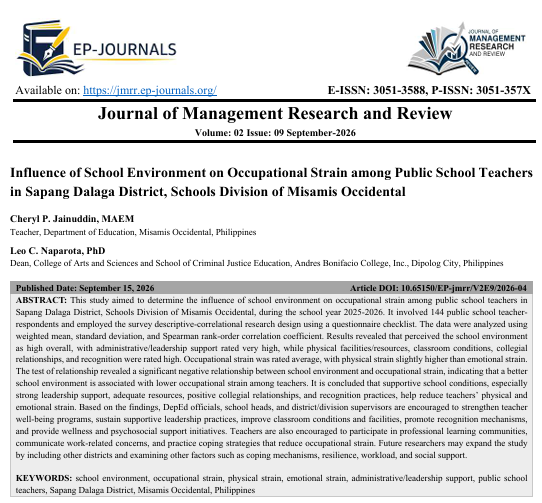
Influence of School Environment on Occupational Strain among Public School Teachers in Sapang Dalaga District, Schools Division of Misamis Occidental
DOI:
https://doi.org/10.65150/EP-jmrr/V2E9/2026-04Keywords:
school environment, occupational strain, physical strain, emotional strain, administrative/leadership support, public school teachers, Sapang Dalaga District, Misamis Occidental, PhilippinesAbstract
This study aimed to determine the influence of school environment on occupational strain among public school teachers in Sapang Dalaga District, Schools Division of Misamis Occidental, during the school year 2025-2026. It involved 144 public school teacher-respondents and employed the survey descriptive-correlational research design using a questionnaire checklist. The data were analyzed using weighted mean, standard deviation, and Spearman rank-order correlation coefficient. Results revealed that perceived the school environment as high overall, with administrative/leadership support rated very high, while physical facilities/resources, classroom conditions, collegial relationships, and recognition were rated high. Occupational strain was rated average, with physical strain slightly higher than emotional strain. The test of relationship revealed a significant negative relationship between school environment and occupational strain, indicating that a better school environment is associated with lower occupational strain among teachers. It is concluded that supportive school conditions, especially strong leadership support, adequate resources, positive collegial relationships, and recognition practices, help reduce teachers’ physical and emotional strain. Based on the findings, DepEd officials, school heads, and district/division supervisors are encouraged to strengthen teacher well-being programs, sustain supportive leadership practices, improve classroom conditions and facilities, promote recognition mechanisms, and provide wellness and psychosocial support initiatives. Teachers are also encouraged to participate in professional learning communities, communicate work-related concerns, and practice coping strategies that reduce occupational strain. Future researchers may expand the study by including other districts and examining other factors such as coping mechanisms, resilience, workload, and social support.
References
1. Agyapong, B., Obuobi-Donkor, G., Burback, L., & Wei, Y. (2022). Stress, burnout, anxiety and depression among teachers: A scoping review. International Journal of Environmental Research and Public Health, 19(17), 10706. https://doi.org/10.3390/ijerph191710706
2. Aiken, L. S., & Susane, G. (2001). West multiple progression. Sage Publishing, Inc.
3. Alzouebi, K., Abu Khurma, O., AlArabi, K., Al Mansoori, M., & Alamoush, I. (2025). School leadership and teacher stress: Unpacking the mediating role of job satisfaction and the employment status as a moderator. Acta Psychologica, 260, 105770. https://doi.org/10.1016/j.actpsy.2025.105770
4. Barrett, P., Treves, A., Shmis, T., Ambasz, D., & Ustinova, M. (2019). The impact of school infrastructure on learning: A synthesis of the evidence. World Bank.
5. Bleck, V., Weck, M., & Fickermann, D. (2022). Teachers’ emotional exhaustion before and during the COVID-19 pandemic: A latent change model. Frontiers in Psychology, 13, 887494. https://doi.org/10.3389/fpsyg.2022.887494
6. Bottiani, J. H., Duran, C. A. K., Pas, E. T., & Bradshaw, C. P. (2019). Teacher stress and burnout in urban middle schools: Associations with job demands, resources, and effective classroom practices. Journal of School Psychology, 77, 36–51. https://doi.org/10.1016/j.jsp.2019.10.002
7. Cohen, J. (1988). Statistical power analysis for the behavioral sciences (2nd ed.). Lawrence Erlbaum Associates.
8. Collie, R. J. (2021). COVID-19 and teachers’ somatic burden, stress, and emotional exhaustion: Examining the role of principal leadership and workplace buoyancy. AERA Open, 7, 1–15. https://doi.org/10.1177/2332858420986187
9. Creswell, J. W., & Guetterman, T. C. (2019). Educational research: Planning, conducting, and evaluating quantitative and qualitative research (6th ed.). Pearson.
10. Demerouti, E., Bakker, A. B., Nachreiner, F., & Schaufeli, W. B. (2001). The job demands–resources model of burnout. Journal of Applied Psychology, 86(3), 499–512. https://doi.org/10.1037/0021-9010.86.3.499
11. Dreer-Göthe, B. (2025). How appreciation predicts teachers’ job satisfaction, emotional exhaustion, and quitting intentions. Educational Studies. https://doi.org/10.1080/03055698.2025.2511915
12. Ekpoh, U. I. (2018). Teachers’ satisfaction with physical working environment: Imperative for effective service delivery. Journal of Education and Human Development, 7(1), 92–97. https://doi.org/10.15640/jehd.v7n1a11
13. Fowler, F. J., Jr. (2014). Survey research methods (5th ed.). SAGE Publications.
14. Fretes, G., Llurba, C., & Palau, R. (2023). Influence of teaching activities, environmental conditions and class schedules on teacher stress measured with a smartwatch: A pilot study. Journal of Technology and Science Education, 13(3), 775–787. https://doi.org/10.3926/jotse.2043
15. Hascher, T., & Waber, J. (2021). Teacher well-being: A systematic review of the research literature from the year 2000–2019. Educational Research Review, 34, 100411. https://doi.org/10.1016/j.edurev.2021.100411
16. Klassen, R. M., & Kim, L. E. (2019). Selecting teachers and prospective teachers: A meta-analysis. Educational Research Review, 26, 32–51. https://doi.org/10.1016/j.edurev.2018.12.003
17. Klusmann, U., et al. (2023). Teachers’ emotional exhaustion during the COVID-19 pandemic: Levels, changes, and relations to pandemic-specific demands. Teaching and Teacher Education, 120, 103876.
18. Maas, J., Schoch, S., Scholz, U., Rackow, P., & Keller, R. (2021). Teachers’ perceived time pressure, emotional exhaustion and social support: A longitudinal study. International Journal of Environmental Research and Public Health, 18(20), 10589. https://doi.org/10.3390/ijerph182010589
19. Madigan, D. J., Kim, L. E., & Zettler, I. (2023). Teacher burnout and physical health: A systematic review. Personality and Individual Differences, 207, 112146. https://doi.org/10.1016/j.paid.2023.112146
20. Martinez, J., & McAbee, S. (2020). School administrator support of teachers: A systematic review (2000–2019). Education Leadership Review, 21(1), 230–254.
21. Pillay, D., & Vieira, B. L. (2020). Noise, screaming and shouting: Classroom acoustics and teachers’ perceptions of their voice in a developing country. South African Journal of Childhood Education, 10(1), a681. https://doi.org/10.4102/sajce.v10i1.681
22. Refugio, C. N., Galleto, P. G., & Torres, R. (2019). Competence landscape of Grade 9 mathematics teachers: Basis for an enhancement program. Cypriot Journal of Educational Sciences, 14(2), 241–256. https://doi.org/10.18844/cjes.v14i2.4125
23. Schulze-Hagenest, T., et al. (2023). Teachers’ emotional exhaustion and job satisfaction: How much does the school context matter? Teaching and Teacher Education, 136, 104360. https://doi.org/10.1016/j.tate.2023.104360
24. Symbaluk, D., & Hall, R. (2024). Research methods: Exploring the social world in Canadian context. MacEwan University.
25. Xusheng, H., Xishan, H., Leyao, C., & Wenhao, Z. (2025). Gratitude in the classroom: How students’ gratitude expression shapes teachers’ professional well-being through teacher–student relationships and professional identity. Teaching and Teacher Education, 168, 105254. https://doi.org/10.1016/j.tate.2025.105254
Downloads
Published
Issue
Section
License
Copyright (c) 2026 Cheryl P. Jainuddin, MAEM, Leo C. Naparota, PhD (Author)

This work is licensed under a Creative Commons Attribution 4.0 International License.