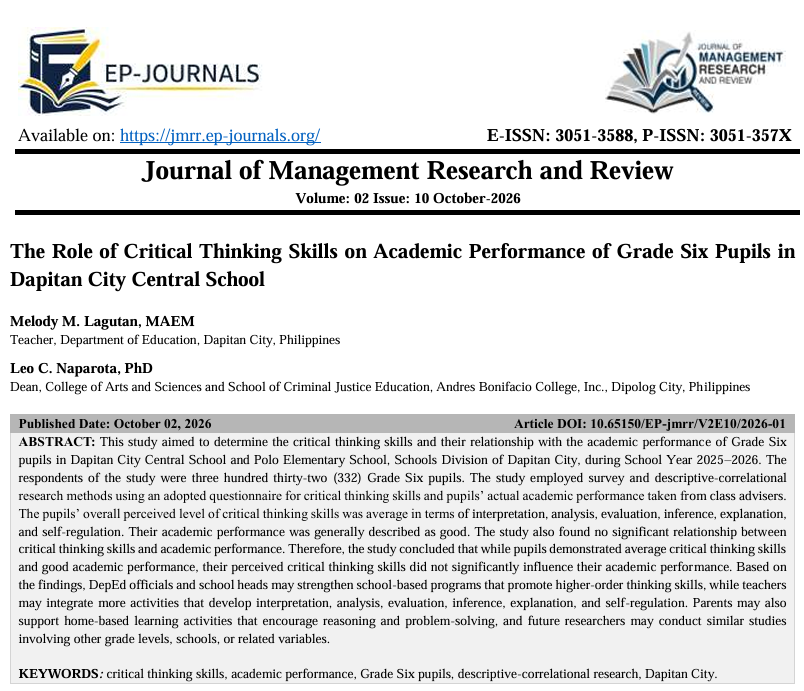
The Role of Critical Thinking Skills on Academic Performance of Grade Six Pupils in Dapitan City Central School
DOI:
https://doi.org/10.65150/EP-jmrr/V2E10/2026-01Keywords:
critical thinking skills, academic performance, Grade Six pupils, descriptive-correlational research, Dapitan City.Abstract
This study aimed to determine the critical thinking skills and their relationship with the academic performance of Grade Six pupils in Dapitan City Central School and Polo Elementary School, Schools Division of Dapitan City, during School Year 2025–2026. The respondents of the study were three hundred thirty-two (332) Grade Six pupils. The study employed survey and descriptive-correlational research methods using an adopted questionnaire for critical thinking skills and pupils’ actual academic performance taken from class advisers. The pupils’ overall perceived level of critical thinking skills was average in terms of interpretation, analysis, evaluation, inference, explanation, and self-regulation. Their academic performance was generally described as good. The study also found no significant relationship between critical thinking skills and academic performance. Therefore, the study concluded that while pupils demonstrated average critical thinking skills and good academic performance, their perceived critical thinking skills did not significantly influence their academic performance. Based on the findings, DepEd officials and school heads may strengthen school-based programs that promote higher-order thinking skills, while teachers may integrate more activities that develop interpretation, analysis, evaluation, inference, explanation, and self-regulation. Parents may also support home-based learning activities that encourage reasoning and problem-solving, and future researchers may conduct similar studies involving other grade levels, schools, or related variables.
References
1) Alsaleh, N. J. (2020). Teaching critical thinking skills: Literature review. The Turkish Online Journal of Educational Technology, 19(1), 21–39.
2) Batdı, V., Elaldı, Ş., Özçelik, C., Semerci, N., & Özkaya, Ö. M. (2024). Evaluation of the effectiveness of critical thinking training on critical thinking skills and academic achievement by using mixed-meta method. Review of Education, 12(3), e70001.
https://doi.org/10.1002/rev3.70001
3) Check, J., & Schutt, R. K. (2012). Research methods in education. SAGE Publications. https://doi.org/10.4135/9781544307725
4) Chusni, M. M., Saputro, S., Rahardjo, S. B., & Suranto. (2021). Student’s critical thinking skills through discovery learning model using e-learning on environmental change subject matter. European Journal of Educational Research, 10(3), 1123–1135.
https://doi.org/10.12973/eu-jer.10.3.1123
5) Creswell, J. W., & Guetterman, T. C. (2019). Educational research: Planning, conducting, and evaluating quantitative and qualitative research (6th ed.). Pearson.
6) Dwyer, C. P., Hogan, M. J., & Stewart, I. (2014). An integrated critical thinking framework for the 21st century. Thinking Skills and Creativity, 12, 43–52. https://doi.org/10.1016/j.tsc.2013.12.004
7) Er, Z. (2024). Examination of the relationship between mathematical and critical thinking skills and academic achievement. Pedagogical Research, 9(1), em0176.https://doi.org/10.29333/pr/14028
8) Facione, P. A. (2020). Critical thinking: What it is and why it counts (2020 update) [White paper]. Measured Reasons LLC/Insight Assessment.
9) Kuhn, D. (2019). Critical thinking as discourse. Human Development, 62(3), 146–164. https://doi.org/10.1159/000500171
10) Lei, H., Cui, Y., & Zhou, W. (2018). Relationships between student engagement and academic achievement: A meta-analysis. Social Behavior and Personality: An International Journal, 46(3), 517–528. https://doi.org/10.2224/sbp.7054
11) Masithoh, S., Widodo, W., & Mustaji. (2025). Profile of critical thinking skills in elementary school students. Journal of Innovation and Research in Primary Education, 4(3), 929–937. https://doi.org/10.56916/jirpe.v4i3.1469
12) Organisation for Economic Co-operation and Development. (2024). PISA 2022 results (Volume III): Creative minds, creative schools. OECD Publishing. https://doi.org/10.1787/765ee8c2-en
13) Orhan, A. (2022). The relationship between critical thinking and academic achievement: A meta-analysis study. Psycho-Educational Research Reviews, 11(1), 283–299. https://doi.org/10.52963/PERR_Biruni_V11.N1.18
14) Payan-Carreira, R., Sacau-Fontenla, A., Rebelo, H., Sebastião, L., & Pnevmatikos, D. (2022). Development and validation of a critical thinking assessment-scale short form. Education Sciences, 12(12), 938. https://doi.org/10.3390/educsci12120938
15) Schneider, M., & Preckel, F. (2017). Variables associated with achievement in higher education: A systematic review of meta-analyses. Psychological Bulletin, 143(6), 565–600. https://doi.org/10.1037/bul0000098
Downloads
Published
Issue
Section
License
Copyright (c) 2026 Melody M. Lagutan, MAEM, Leo C. Naparota, PhD (Author)

This work is licensed under a Creative Commons Attribution 4.0 International License.