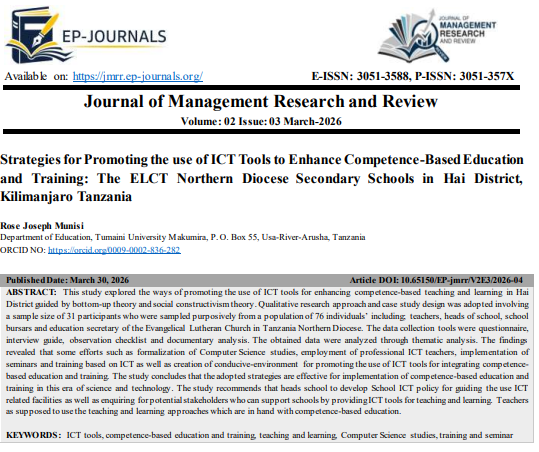
Strategies for Promoting the use of ICT Tools to Enhance Competence-Based Education and Training: The ELCT Northern Diocese Secondary Schools in Hai District, Kilimanjaro Tanzania
DOI:
https://doi.org/10.65150/EP-jmrr/V2E3/2026-04Keywords:
ICT tools, competence-based education and training, teaching and learning, Computer Science studies, training and seminarAbstract
This study explored the ways of promoting the use of ICT tools for enhancing competence-based teaching and learning in Hai District guided by bottom-up theory and social constructivism theory. Qualitative research approach and case study design was adopted involving a sample size of 31 participants who were sampled purposively from a population of 76 individuals’ including; teachers, heads of school, school bursars and education secretary of the Evangelical Lutheran Church in Tanzania Northern Diocese. The data collection tools were questionnaire, interview guide, observation checklist and documentary analysis. The obtained data were analyzed through thematic analysis. The findings revealed that some efforts such as formalization of Computer Science studies, employment of professional ICT teachers, implementation of seminars and training based on ICT as well as creation of conducive-environment for promoting the use of ICT tools for integrating competence-based education and training. The study concludes that the adopted strategies are effective for implementation of competence-based education and training in this era of science and technology. The study recommends that heads school to develop School ICT policy for guiding the use ICT related facilities as well as enquiring for potential stakeholders who can support schools by providing ICT tools for teaching and learning. Teachers as supposed to use the teaching and learning approaches which are in hand with competence-based education.
References
1) Adu, E. O., & Zondo, S.S. (2024). Enhancing teachers’ digital skills in teaching of economics in South Africa secondary schools. International Journal of Educational Research. https://doi.org/10.1016/j.ijedro.2023.100310
2) Assey, E.S. (2022). The strategies of improving effective implementation of the competence-based curriculum in secondary schools in Tanzania: The case of Tabora Region. Journal of Education and Practice, 6 (3), 13-33.
https://carijournals.org/journals/index.php/JEP/article/view/966(carijournals.org)
3) Cao, L., Rasul, M. S., & Omar, M. (2023). The challenges and factors influencing ICT integration for EFL teachers in China: A systematic review. International Journal of Learning, Teaching and Educational Research, 22(9). https://doi.org/10.26803/ijlter.22.9.25
4) Cohen, L., Manion, L., & Morrison, K. (2018). Research methods in education. New York: Routledge Taylor and Francis Group.
5) Creswell, J. W., & Creswell, J. D. (2023). Research designs: qualitative, quantitative and mixed methods approach (6th ed.). California: Sage Publication, Inc.
6) Creswell, J. W., & Plano, C. V. L. (2018). Designing and conducting mixed methods research. (3rd ed.). SAGE Publications.
7) Evangelical Lutheran Church in Tanzania (2024). Strategic plans 2024-2028. Northern Diocese, Moshi, Kilimanjaro.
8) Evangelical Lutheran Church in Tanzania (2024). School reports. Northern Diocese, Moshi, Kilimanjaro.
9) Goldhaber, A. B., Khuan, H., & Allysa, R. (2021). Impact of ICT Integration on Quality of Education among Secondary Schools in USA. Journal of Education, 4(6), 53-61. DOI: https://doi.org/10.53819/81018102t5015
10) Guba, E.G., & Lincoln, Y.S. (1989). Fourth generation evaluation. London: SAGE Publications.
11) Habiyu, G. W., & Njuguna, J. (2025). Influence of teachers’ supervision of teachers on academic performance in public primary schools in Mayole sub-county, Marsabit County, Kenya. Journal of Research Innovation and Implications in Education, 9(2), 1164-1173. https://doi.org/10.59765/jriie.9.2.107
12) Jaman, M., & Biswas, T. (2025). The Role of ICT Integration to Support and Enhance the Teaching- Learning Process in the Contemporary Education System. International Journal for Multidisciplinary Research, 7(4), 1-15. https://www.ijfmr.com/papers/2023/4/impact-of-ict-on-education.pdf
13) Kagambe, E., Kabasiita, J., Kisembo, UM., Kasiita, T., Muweesi, C., Kaweesi, M., & Nambiru, A. (2024). The Intergration of ICT for Effective implementation of the Competence-Based Curriculum among Secondary Schools in Kyaka II Refugee Settlement, Uganda. East African Journal of Information Technology, 7(1), 263-278. https://doi.org/10.37284/eajit.7.1.2205
14) Kagori, P. M., & Haule, E. L. (2025). School infrastructure for effective implementation of the Tanzania education and training policy 2014 (2023) edition in secondary schools: A case study of Mpimbwe District Council. East Africa Journal of Education Studies, 8(2), 923-938. https://doi.org/10.37284/eajes.8.2.3223
15) Kalinga, T. (2024). Teacher’s technological literacy for ICT integration to implement competence-based curriculum in public secondary schools in Tanzania. Educational Technology Quarterly, (2), 135-151. https://acnsci.org/journal/index.php/etq/article/view/708
16) Kangara, C. T. C., Gocha, M., Tsokota, T., & Marovah, T. (2022). Assessing readiness for teaching and learning using ICTs in Zimbabwean Secondary Schools in Gweru District, Zimbabwe. Research Square preprint. https://doi.org/10.21203/rs.3.rs-1652431/v1
17) Kasuga, W., & Kalolo, J. F. (2025). Competency-based curriculum in Tanzania: Charting dilemmas for successful implementation. Cogent Education, 12(1). https://doi.org/10.1080/2331186X.2025.2563711
18) Kumar, A., & Sharma, A. (2023). Observation method: A review study. Library Philosophy and Practice (e-Journal). https://digitalcommons. unl. edu/libphilprac.
19) Kuphanga, D. (2024). Questionnaires in research: their role, advantages, and main aspects.
https://www. researchgate.net/publication/378868278
20) Kutsyuruba, B. (2023). Document analysis. In J. M. Okoko, S. Tunison, &K.D. Walker (Eds.), Varieties of qualitative research methods: Selected contextual perspectives (pp. 139-146). Cham: Springer International Publishing.
21) Lipsky, M. (1980). Street-level bureaucracy: Dilemmas of the individual in public services. New York, NY: Russell Sage Foundation.
22) Manizabayo, P., & Kachchhap, S. L. (2025). Teacher preparedness, availability of teaching materials, and the implementation of competence-based curriculum. Pertanika Journal of Social Sciences & Humanities, 33 (1). https://doi.org/10.47836/pjssh.33.1.09
23) Mathias, K., Mwamakula, F., & Mhagama, M. (2023). Challenges facing Public Secondary Schools Teachers on Implementing Competence-Based Curriculum in Magu District, Mwanza-Tanzania. International Journal of Social and Development Concerns, 18, 45-56.https://ijsdc.org/journal/show/challenges-facing-public-secondary-school-teachers-on-implementing-competence-based-curriculum-in-magu-district-mwanza-tanzania
24) Mnisi, B. R., Mtshali, T. I., & Moses, M. (2024). Moving beyond the challenges of learning through technologies: The current status of ICT integration in South African schools. Journal of Education and E-Learning Research, 11(1), 128–134.
https://doi.org/10.20448/jeelr.v11i1.5396
25) Molla, S., & Seyoum, Y. (2022). Status of ICT Integration in Secondary Schools: Dire Dawa City Administration in Focus. Education Research International, 2022(1), https://doi.org/10.1155/8752809
26) Mpumuje, M. (2024). Information communication technology (ICT) integration in teaching and learning in selected rural secondary school in Burera District, Rwanda. African Journal of Empirical Research, 5(2), 453-461.
https://ajernet.net/ojs/index.php/ajernet/article/view/360
27) Msafiri, M. M., Kangwa, D., & Cai, L. (2023). A systematic literature review of ICT integration in secondary school education: what works, what does not and what next. Discover Education. 2 (44) https://link.springer.com/article/10.1007/s44217-023-00070-x
28) Mugyenyi. A. A & Mokoro D. K. (2022). Introduction to research methods with illustrated SPSS aided statistical analysis. JEMA Printers Arusha. ISBN 978-9987-674008.
29) Munisi, R. J. (2025). The elements of competence-based education and training in Tanzania education and training policy 2014 (2023) edition. Journal of Research Innovation and Implications in Education. 9 (4), 785-798. https://doi.org/10.59765/tr7w91
30) Murith, J., & Yoo, J.E. (2021).Teacher’s use of ICT in implementing the competence-based curriculum in Kenyan public primary schools: innovation and education, 3(1), 1-11. https://doi.org/10.1186/s42862-021-00012-0
31) Ndume, V. A., Kisanga, D. H., & Selemani, M. (2021). Integrating ICT in Tanzania secondary schools: Experience of Tanzania as it grows to second world economy. International Academic Journal of Education & Literature, 2(5), 81-95.
https://doi.org/10.47310/iajel.2021.v02i02.019
32) Nino, T. (2023). Constructivism as a theory of learning (foundations and significance). Basics of Learning the Latest Theories and Methods, 9, 228. International Science Group. https://doi.org/10.46299/ISG.2023.1.9
33) Ntsobi, M. P. (2022). Pedagogical integration of technology as an enhancement to teaching and learning in Gauteng public schools. https://osf.io/4v2p7/(AfricArXiv)
34) Owidi, S. O. (2025). Incorporating AI in Kenya's ICT education system: Are we ready to embrace this change inclusively? a systematic literature review. International Journal of Recent Research in Mathematics Computer Science and Information Technology, 12(1), 1-16. www.paperpublications.org
35) Pandey, A. (2021). Information communication technology tools. International Journal of Creative Research Thoughts, 9(9), 307-314. www.ijcrt.org
36) Richard, M. (2025). The implementation of the policy statements on teaching-learning resources to enhance competence based education in secondary schools: A case of the ELCT Northern Diocese in Hai District. Master Dissertation. Tumaini University Makumira, Arusha Tanzania.
37) Ruslin, R., Mashuri, S., Rasak, M. S. A., Alhabsyi, F., & Syam, H. (2022). Semi-structured interview: A methodological reflection on the development of a qualitative research instrument in educational studies. IOSR Journal of Research & Method in Education (IOSR-JRME), 12(1), 22-29. https://doi.org/10.9790/7388-1201052229
38) Sendagire, Y. (2023). Information and communication technology in the competence-based learning in lower private secondary schools of Nakasongola District, Unganda (Doctoral dissertation, Kampala International University, College of education, open distance and e-learning.)
39) Smyth, B. M., Martin, M. A., & Downing, M. (Eds.). (2025). The Routledge handbook of human research ethics and integrity in Australia. Routledge.
40) Tonwe, U. (2022). Role of Information and Communication Technologies (ICT) for promoting quality teaching and learning for excellence in Nigerian higher education institutions. African Journal of Educational Management, Teaching and Entrepreneurship Studies, 6, 96-109.https://ajemates.org
41) Tumaini, P. W., & Kiwonde, F. M. (2023). Information and communication technology towards improving teaching and learning processes in selected Hai District secondary schools. Huria Journal of the Open University of Tanzania 28 (2).DOI:10.61538/huria.v28i2.1139
42) UNESCO. (n.d.). Information and Communication Technology (ICT). https://en.unesco.org/themes/ict-education
43) United Nations. (2015). Transforming our world. The 2030 agenda for sustainable development. United Nations.
https://sdgs.un.org/2030.agenda
44) United Republic of Tanzania. (2023a). Education and training policy 2014, 2023 edition. Ministry of Education, Science and Technology. Government of Tanzania. https://www.moe.go.tz
45) United Republic of Tanzania. (2023b). Computer science syllabus for ordinary secondary education form I-IV. Tanzania Institute of Education. Ministry of Education, Science and Technology. Government of Tanzania. https://www.moe.go.tz
46) United Republic of Tanzania. (2016). National and information Communication technology policy. Ministry of Work, Transport and Communication. Government of Tanzania. https://www.ega.go.tz/uploads/publications/sw-1574848612-SERA%202016.pdf
47) Vygosky, L. S. (1999). The zone of proximal development: Critical assessments of leading psychologists: Routledge.
48) Yanto, E. S. (2023). The what and how of essential thematic analysis. The Qualitative Report, 28(11), 3120-3131.
https://doi.org/10.46743/2160-3715/2023.6744
49) Yin, R. K. (2018). Case study research and applications: design and methods. SAGE Publications.
50) Zhao, Q. (2024). Current state of ICT integration in English proficiency education in Chinese schools: A quantitative study. SHS Web of Conferences 199, 01021. https://doi.org/10.1051/shsconf/202419901021 ICLRC 2024
Downloads
Published
Issue
Section
License
Copyright (c) 2026 Rose Joseph Munisi (Author)

This work is licensed under a Creative Commons Attribution 4.0 International License.