Technology-Based Instructional Materials Utilization, Teaching Effectiveness, And Teachers’ Performance in Baylimango District, Schools division of Dapitan City
DOI:
https://doi.org/10.65150/EP-jmrr/V2E7/2026-07Keywords:
Technology-based instructional materials, technology integration, teaching effectiveness, teachers’ performance, IPCRF, Baylimango School District, Dapitan City, PhilippinesAbstract
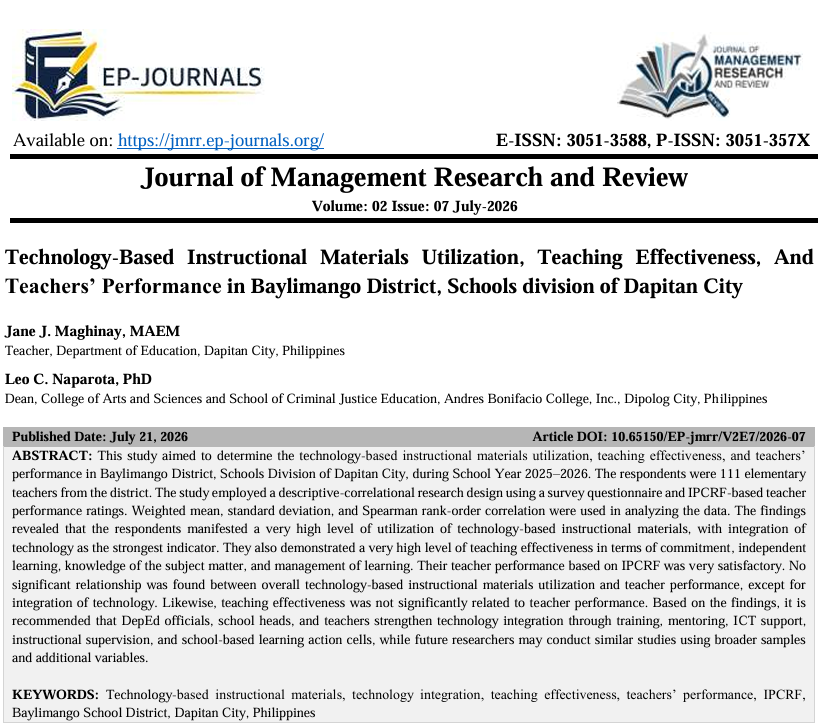
This study aimed to determine the technology-based instructional materials utilization, teaching effectiveness, and teachers’ performance in Baylimango District, Schools Division of Dapitan City, during School Year 2025–2026. The respondents were 111 elementary teachers from the district. The study employed a descriptive-correlational research design using a survey questionnaire and IPCRF-based teacher performance ratings. Weighted mean, standard deviation, and Spearman rank-order correlation were used in analyzing the data. The findings revealed that the respondents manifested a very high level of utilization of technology-based instructional materials, with integration of technology as the strongest indicator. They also demonstrated a very high level of teaching effectiveness in terms of commitment, independent learning, knowledge of the subject matter, and management of learning. Their teacher performance based on IPCRF was very satisfactory. No significant relationship was found between overall technology-based instructional materials utilization and teacher performance, except for integration of technology. Likewise, teaching effectiveness was not significantly related to teacher performance. Based on the findings, it is recommended that DepEd officials, school heads, and teachers strengthen technology integration through training, mentoring, ICT support, instructional supervision, and school-based learning action cells, while future researchers may conduct similar studies using broader samples and additional variables.
References
1) Abakah, E. (2023). Teacher learning from continuing professional development and the challenges of applying professional learning in practice. Professional Development in Education, 49(5), 840–855.
2) Aguarino, A. F. M., Galera, D., Valdez, E. L., Dolaypan, R., & Ollier, K. C. C. (2024). Correlates of teaching effectiveness of faculty members. Psychology and Education: A Multidisciplinary Journal, 21(3).
3) Agsalud, P. L. (2017). Teaching effectiveness of the teacher education faculty members in Pangasinan State University Asingan Campus, Philippines. Asia Pacific Journal of Multidisciplinary Research, 5(1), 16–22.
4) Akram, H., Abdelrady, A. H., Al-Adwan, A. S., & Ramzan, M. (2022). Teachers’ perceptions of technology integration in teaching-learning practices: A systematic review. Frontiers in Psychology, 13, Article 920317. https://doi.org/10.3389/fpsyg.2022.920317
5) Alzoraiki, M., Ahmad, A. R., Ateeq, A. A., Naji, G. M. A., Almaamari, Q., & Beshr, B. A. H. (2023). Impact of teachers’ commitment on sustainable teaching performance. Sustainability, 15, Article 4620.
6) Ammasi, J. R. (2024). Assessment and evaluation of teachers’ performance and professional development. Journal of Interdisciplinary Perspectives, 2(11), 290–303. https://doi.org/10.69569/jip.2024.0493
7) Baier-Mosch, F., Voss, T., Kleickmann, T., & Kunter, M. (2024). Classroom management competence and its role in effective teaching and learning. Teaching and Teacher Education, 137, Article 104394.
8) Bond, M., Buntins, K., Bedenlier, S., Zawacki-Richter, O., & Kerres, M. (2020). Mapping research in student engagement and educational technology in higher education: A systematic evidence map. International Journal of Educational Technology in Higher Education, 17, Article 2. https://doi.org/10.1186/s41239-019-0176-8
9) Cadag, C. E. (2024). The effectiveness of Individual Performance Commitment Review Form as an evaluation tool to improve teachers’ performance: Basis for technical assistance. International Journal of Multidisciplinary: Applied Business and Education Research, 5(2),724–747. https://doi.org/10.11594/ijmaber.05.02.30
10) Caoile, A. A., Baes, J. O., & Naparota, L. C. (2025). Technology integration, teaching effectiveness and teachers’ performance in Sirawai District, Schools Division of Zamboanga del Norte, Philippines. European Journal of Education Studies, 12(1). https://doi.org/10.46827/ejes.v12i1.5753
11) Chen, P.-S. D., Lambert, A. D., & Guidry, K. R. (2010). Engaging online learners: The impact of Web-based learning technology on college student engagement. Computers & Education, 54(4), 1222–1232. https://doi.org/10.1016/j.compedu.2009.11.008
12) Clark, S., & Newcomer, L. L. (2023). Classroom management and the development of effective learning environments. Intervention in School and Clinic, 58(5), 299–307.
13) Creswell, J. W., & Guetterman, T. C. (2019). Educational research: Planning, conducting, and evaluating quantitative and qualitative research (6th ed.). Pearson.
14) Darling-Hammond, L., Hyler, M. E., & Gardner, M. (2017). Effective teacher professional development. Learning Policy Institute. https://doi.org/10.54300/122.311
15) DeCarlo, M. (2021). Scientific inquiry in social work. Pressbooks.
16) Department of Education. (2015). Guidelines on the establishment and implementation of the Results-Based Performance Management System in the Department of Education (DepEd Order No. 2, s. 2015).
17) Department of Education. (2017). National adoption and implementation of the Philippine Professional Standards for Teachers (DepEd Order No. 42, s. 2017).
18) Guillén-Gámez, F. D., Ruiz-Palmero, J., Palacios-Rodríguez, A., & Martín-Párraga, L. (2023). Digital competence of teachers in the use of ICT for research work: Development of an explanatory model. Education and Information Technologies, 29, 11509–11531. https://doi.org/10.1007/s10639-023-11895-2
19) Haleem, A., Javaid, M., Qadri, M. A., & Suman, R. (2022). Understanding the role of digital technologies in education: A review. Sustainable Operations and Computers, 3, 275–285. https://doi.org/10.1016/j.susoc.2022.05.004
20) Hero, J. L. (2019). The impact of technology integration in teaching performance. International Journal of Sciences: Basic and Applied Research, 48(1), 101–114.
21) Klassen, R. M., & Tze, V. M. C. (2014). Teachers’ self-efficacy, personality, and teaching effectiveness: A meta-analysis. Educational Research Review, 12, 59–76. https://doi.org/10.1016/j.edurev.2014.06.001
22) Lohr, A., Sailer, M., Stadler, M., & Fischer, F. (2024). Digital learning in schools: Which skills do teachers need, and who should bring their own devices? Teaching and Teacher Education, 152, Article 104788.
23) Márquez-Baldó, L., Orellana, N., Almerich, G., & Suárez-Rodríguez, J. M. (2025). Attitude toward ICT integration for teachers: Validation of a multidimensional scale. Computers in Human Behavior Reports, Article 100786. https://doi.org/10.1016/j.chbr.2025.100786
24) McCombes, S. (2025). Survey research: Definition, examples and methods. Scribbr. Note: The original page was first published in 2019 and subsequently updated.
25) Pantoñal, A. P. (2022). Extent of utilization on technology-based instructional materials and teachers’ performance. International Journal of Arts and Social Science, 5(3), 131–144.
26) Reychav, I., Elyakim, N., & McHaney, R. (2023). Lifelong learning processes in professional development for online teachers during the COVID era. Frontiers in Education, 8, Article 1041800. https://doi.org/10.3389/feduc.2023.1041800
27) Sarkar, M., Gutierrez-Bucheli, L., Yip, S. Y., Lazarus, M., Wright, C., White, P. J., Ilic, D., Hiscox, T. J., & Berry, A. (2024). Pedagogical content knowledge (PCK) in higher education: A systematic scoping review. Teaching and Teacher Education, 144, Article 104608. https://doi.org/10.1016/j.tate.2024.104608
28) Schindler, L. A., Burkholder, G. J., Morad, O. A., & Marsh, C. (2017). Computer-based technology and student engagement: A critical review of the literature. International Journal of Educational Technology in Higher Education, 14, Article 25. https://doi.org/10.1186/s41239-017-0063-0
29) Schubatzky, T., Haagen-Schützenhöfer, C., & Wößmann, S. (2025). From knowledge to intention: The role of TPACK and self-efficacy in technology integration. Computers and Education Open, 8, Article 100236.
30) Timotheou, S., Miliou, O., Dimitriadis, Y., Sobrino, S. V., Giannoutsou, N., Cachia, R., Monés, A. M., & Ioannou, A. (2023). Impacts of digital technologies on education and factors influencing schools’ digital capacity and transformation: A literature review. Education and Information Technologies, 28, 6695–6726. https://doi.org/10.1007/s10639-022-11431-8
31) Yip, S. Y. (2025). Transition into teaching: Examining the pedagogical content knowledge (PCK) development of pre-service STEM career-change teachers. Journal of Education for Teaching, 51(3), 525–540. https://doi.org/10.1080/02607476.2025.2471901
32) Whitmore, C. M. (2025). An exploration of the use of computer technologies in middle schools. Social Sciences & Humanities Open, Article 102260. https://doi.org/10.1016/j.ssaho.2025.102260
33) Xiong, X. (2025). Influence of teaching styles of higher education teachers on students' engagement in learning: The mediating role of learning motivation. Education for Chemical Engineers, 51, 87–102. https://doi.org/10.1016/j.ece.2025.02.005
34) Xu, Z., Yang, J., Zhang, H., & Liu, T. (2025). The impact of teachers’ teaching strategies on students’ deep learning in online learning environments: The mediating role of learning interaction. Frontiers in Education, 10, Article 1680937. https://doi.org/10.3389/feduc.2025.1680937
35) Xu, Z., & Pang, N. S.-K. (2024). Promoting teachers’ organizational commitment: The effects of authentic leadership, teachers’ well-being and social–emotional competence. Behavioral Sciences, 14(10), Article 862. https://doi.org/10.3390/bs14100862
Downloads
Published
Issue
Section
License
Copyright (c) 2026 Jane J. Maghinay, MAEM, Leo C. Naparota, PhD (Author)

This work is licensed under a Creative Commons Attribution 4.0 International License.