Strategic Leadership Capabilities, Institutional Capacity and Conservation Performance at Kenya Wildlife Service
DOI:
https://doi.org/10.65150/EP-jmrr/V2E8/2026-15Keywords:
Strategic Leadership Capabilities, Institutional Capacity, Conservation Performance, Wildlife Conservation, Kenya Wildlife Service.Abstract
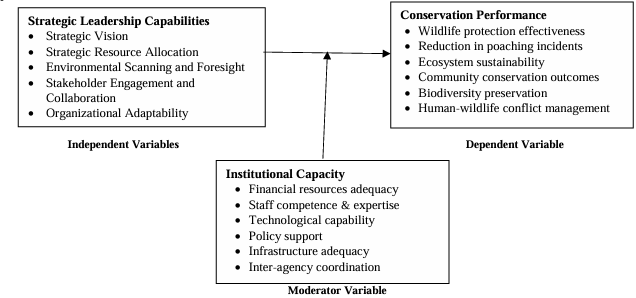
Strategic leadership capabilities are increasingly important for enhancing organizational effectiveness and sustainability in conservation institutions operating in dynamic and resource-constrained environments. Kenya Wildlife Service (KWS) continues to face challenges including poaching, habitat degradation, climate change, resource constraints, and human–wildlife conflicts, which undermine conservation performance. Despite growing research on leadership and organizational performance, limited empirical evidence exists on how strategic leadership capabilities influence conservation performance in wildlife conservation institutions, particularly when institutional capacity is considered as a moderating variable. This study examined the influence of strategic leadership capabilities on conservation performance at KWS and determined the moderating effect of institutional capacity. The study was anchored on Strategic Leadership Theory, Resource-Based View Theory, Dynamic Capabilities Theory, and Stakeholder Theory. It adopted a positivist research philosophy and a descriptive cross-sectional survey design. The target population comprised 1,500 management staff, conservation officers, departmental heads, and administrative personnel, from whom a sample of 316 respondents was selected through stratified random sampling. Primary data were collected using structured questionnaires whose validity and reliability were confirmed through pilot testing. Data were analyzed using SPSS Version 29 through descriptive statistics, Pearson correlation analysis, multiple regression analysis, and hierarchical moderated regression analysis. Findings revealed that strategic vision, environmental scanning and foresight, stakeholder engagement and collaboration, and organizational adaptability had positive and statistically significant influences on conservation performance. Strategic resource allocation dimension was found to be insignificant. Institutional capacity significantly moderated the relationships between strategic resource allocation and conservation performance and between organizational adaptability and conservation performance. However, its moderating effects on the relationships between strategic vision, environmental scanning and foresight, and stakeholder engagement and collaboration, respectively, and conservation performance were not statistically significant. The inclusion of the five interaction terms increased the model’s explanatory power, with R² rising from .667 to .688, representing an additional 2.1% of the variance in conservation performance (ΔR² = .021). The change in the model was statistically significant (F-change = 3.703, p = .003), indicating that the interaction terms collectively contributed significantly to explaining conservation performance. Thus, while institutional capacity demonstrated a significant overall moderating effect, this effect was not uniform across all dimensions of strategic leadership capabilities. Specifically, significant moderation was evident only for strategic resource allocation and organizational adaptability, whereas the interaction effects involving strategic vision, environmental scanning and foresight, and stakeholder engagement and collaboration were not statistically significant. The study therefore established that conservation performance depends on both effective strategic leadership capabilities and partly on adequate institutional capacity, including financial resources, competent personnel, technological capability, supportive policies, infrastructure, and inter-agency coordination. The study concludes that strengthening strategic leadership capabilities alongside institutional capacity is essential for improving wildlife protection, biodiversity conservation, ecosystem sustainability, and management of human–wildlife conflicts. The findings contribute to strategic management, conservation management, and environmental governance literature and provide practical guidance to policymakers, conservation managers, and development partners in designing strategies and policies that enhance conservation effectiveness and institutional resilience within Kenya’s wildlife conservation sector. They also underscore the importance of aligning leadership interventions with institutional resource capacity.
References
1) African Wildlife Foundation. (2023). Annual report 2023. African Wildlife Foundation.
2) Appleton, M. R., Barborak, J. R., Daltry, J. C., Long, B., O’Connell, M., Owen, N. R., Singh, R., Sparkes, E., Sterling, E. J., & Valencia, L. M. (2022). How should conservation be professionalized? Oryx, 56(5), 654–663. https://doi.org/10.1017/S0030605321000594
3) Appleton, M. R., Barborak, J. R., Daltry, J. C., Long, B., O’Connell, M., Owen, N. R., Singh, R., Sparkes, E., Sterling, E. J., & Valencia, L. M. (2022). How should conservation be professionalized? Oryx, 56(5), 654–663. https://doi.org/10.1017/S0030605321000594
4) Ashkevari, S. B., & Ghasemi, B. (2023). The impact of strategic leadership on organizational performance with regard to the role of organizational innovation. Journal of Organizational Behavior Research, 8(2), 40–53. https://doi.org/10.51847/vSDdNm6S8t
5) Barney, J. (1991). Firm resources and sustained competitive advantage. Journal of Management, 17(1), 99–120.
https://doi.org/10.1177/014920639101700108
6) Chang’alwa, M. V., & Kimaku, P. (2022). Corporate level strategy and performance of coffee industry in Nairobi Metropolitan, Kenya.
International Journal of Social Sciences Management and Entrepreneurship, 6(1), 288–299.
7) Creswell, J. W., & Creswell, J. D. (2018). Research design: Qualitative, quantitative, and mixed methods approaches (5th ed.). SAGE Publications.
8) Ezeh, M. O., Ogbu, A. D., Ikevuje, A. H., & George, E. P.-E. (2024). Stakeholder engagement and influence: Strategies for successful energy projects. International Journal of Management & Entrepreneurship Research, 6(7), 2375–2395.
https://doi.org/10.51594/ijmer.v6i7.1330
9) Freeman, R. E. (1984). Strategic management: A stakeholder approach. Pitman.
10) Hair, J. F., Black, W. C., Babin, B. J., & Anderson, R. E. (2019). Multivariate data analysis (8th ed.). Cengage.
11) Hayes, A. F. (2022). Introduction to mediation, moderation, and conditional process analysis: A regression-based approach (3rd ed.).
The Guilford Press.
12) Hitt, M. A., Ireland, R. D., & Hoskisson, R. E. (2007). Strategic management: Competitiveness and globalization: Concepts (7th ed.).
Thomson/South-Western.
13) Hitt, M. A., Ireland, R. D., & Hoskisson, R. E. (2020). Strategic management: Competitiveness and globalization: Concepts and cases (13th ed.). Cengage Learning.
14) Intergovernmental Science-Policy Platform on Biodiversity and Ecosystem Services. (2023). Thematic assessment report on invasive alien species and their control. IPBES.
15) Kenya Wildlife Service. (2023). Annual report and financial statements 2022/2023. Kenya Wildlife Service.
16) Kimaku, P. M., Omwenga, J., & Nzulwa, J. D. (2019). Determinants of successful implementation of strategic change in state corporations in Kenya. The Strategic Journal of Business & Change Management, 6(2), 82–95. https://doi.org/10.61426/sjbcm.v6i2.1101
17) Majani, L. V., Kimaku, P. M., & Omido, K. H. (2026). Managing resistance to change and its effect on performance of state corporations within Nairobi Metropolitan Area, Kenya. International Journal of Research and Innovation in Social Science, 10(3), 4640–4659. https://doi.org/10.47772/IJRISS.2026.100300344
18) Ministry of Tourism and Wildlife. (2024). Annual report 2023/2024. Government of Kenya.
19) Mwachia, J. K., Kimaku, P. M., & Makungu, T. (2023). Influence of organizational agility dimensions on performance of hotel industry in Kenyan Coast counties. International Journal of Social Sciences Management and Entrepreneurship, 7(1), 172–187.
20) Northouse, P. G. (2022). Leadership: Theory and practice (9th ed.). SAGE Publications.
21) Porzecanski, A. L., Sterling, E. J., Copsey, J. A., Appleton, M. R., Barborak, J. R., Bruyere, B. L., Bynum, N., Farmer, K. H., Finchum, R., Rakotobe, D., Stanoss, R. B., & Valdés-Velásquez, A. (2022). A systems framework for planning and evaluating capacity development in conservation: Recommendations for practitioners. Oryx, 56(5), 671–680. https://doi.org/10.1017/S003060532100154X
22) Saunders, M., Lewis, P., & Thornhill, A. (2019). Research methods for business students (8th ed.). Pearson.
23) Seneyia, J. K., Kimaku, P. M., & Omido, K. H. (2026). Strategic change management and organizational performance of the National Government Administration Officers (NGAOs) in Kenya. Journal of Social Science and Human Research Studies, 2(6), 673–686. https://doi.org/10.65150/EP-jsshrs/V2E6/2026-03
24) Taferner, S. G. (2023). Strategic foresight capability and its impact on firm performance: A systematic, AI-based literature review. Junior Management Science, 8(3), 658–681. https://doi.org/10.5282/jums/v8i3pp658-681
25) Teece, D. J. (2018). Business models and dynamic capabilities. Long Range Planning, 51(1), 40–49.
https://doi.org/10.1016/j.lrp.2017.06.007
26) Teece, D. J., Pisano, G., & Shuen, A. (1997). Dynamic capabilities and strategic management. Strategic Management Journal, 18(7), 509–533. https://doi.org/10.1002/(SICI)1097-0266(199708)18:7%3C509::AID-SMJ882%3E3.0.CO;2-Z
27) United Nations Development Programme. (2022). UNDP annual report 2022. United Nations Development Programme.
28) United Nations Environment Programme. (2023). UNEP annual report 2023. United Nations Environment Programme.
29) World Bank. (2024). The World Bank annual report 2024. World Bank.
30) Yahia-Marzouk, Y., & Jin, J. (2022). Linking environmental scanning and organizational innovation with competitive advantage: Evidence from Egyptian SMEs. Management & Sustainability: An Arab Review, 1(2), 170–195.https://doi.org/10.1108/MSAR-02-2022-0010
31) Yahia-Marzouk, Y., & Jin, J. (2022). The relationship between environmental scanning and organizational resilience: Roles of process innovation and environmental uncertainty. Frontiers in Environmental Science, 10, 966474. https://doi.org/10.3389/fenvs.2022.966474
Downloads
Published
Issue
Section
License
Copyright (c) 2026 Kenneth Ouma Ochieng, Patrick Mutua Kimaku, Fredrick Lala (Author)

This work is licensed under a Creative Commons Attribution 4.0 International License.












