How Transformational Leadership Fosters Employee Work Performance: Examining the Role of Knowledge Sharing Behaviors of Employees in Vietnamese SMEs
DOI:
https://doi.org/10.65150/EP-jmrr/V2E5/2026-11Keywords:
Transformational leadership, Work performance, Knowledge sharing.Abstract
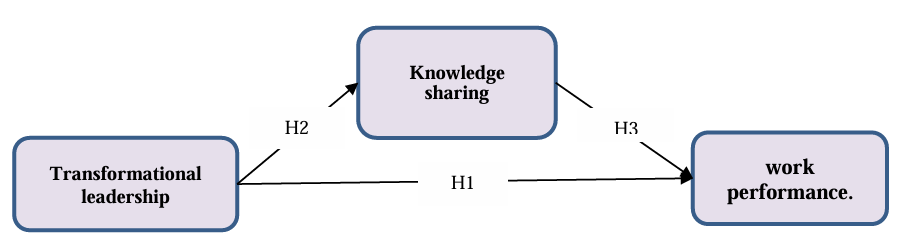
Work performance is considered a critical factor for firms to sustain growth and maintain competitive advantage, especially in the context of SMEs. The purpose of this paper is to examine the impacts of transformational leadership on employees’ work performance through the mediating role of knowledge sharing. The study employed Structural Equation Modeling (SEM) to test the relationships among these constructs using survey data collected from 215 participants working in 136 Vietnamese small and medium-sized enterprises. The findings indicate that transformational leadership have a significant positive effect on both knowledge sharing and employees’ work performance. In addition, knowledge sharing is found to significantly enhance employees’ work performance and plays a crucial mediating role in the relationship between transformational leadership and work performance. Importantly, this study contributes to extending the existing literature by highlighting the mechanism through which transformational leadership practices influence employee outcomes, and provides practical implications for managers to foster knowledge sharing in order to improve work performance in Vietnamese SMEs.
References
1) Abdelwahed, N. A. A., Al Doghan, M. A., Saraih, U. N., & Soomro, B. A. (2025). Unleashing potential: Islamic leadership’s influence on employee performance via Islamic organizational values, organizational culture and work motivation. International Journal of Law and Management, 67(2), 165-190.
2) Alyouzbaky, B. A., Al-Sabaawi, M. Y. M., & Tawfeeq, A. Z. (2024). Factors affecting online knowledge sharing and its effect on academic performance. VINE Journal of Information and Knowledge Management Systems, 54(5), 990-1010.
3) Bass, B. M. (1999). Two decades of research and development in transformational leadership. European journal of work and organizational psychology, 8(1), 9-32.
4) Berberoglu, A., & Secim, H. (2015). Organizational commitment and perceived organizational performance among health care professionals: Empirical evidence from a private Hospital in Northern Cyprus. Journal of Economics & Behavioral Studies, 7(1), 64.
5) Birasnav, M., Rangnekar, S., & Dalpati, A. (2011). Transformational leadership and human capital benefits: The role of knowledge management. Leadership & Organization Development Journal, 32(2), 106–126.
6) Blau, P. M. (1964). Justice in Social Exchange. Sociological Inquiry, 34(2), 193-206.
7) Cao, T. T., & Le, P. B. (2022). Impacts of transformational leadership on organizational change capability: a two-path mediating role of trust in leadership. European Journal of Management, https://doi.org/10.1108/EJMBE-06-2021-0180.
8) Cao, X., Guo, X., Vogel, D., & Zhang, X. (2016). Exploring the influence of social media on employee work performance. Internet Research, 26(2), 529-545.
9) Çetin, F., & Aşkun, D. (2018). The effect of occupational self-efficacy on work performance through intrinsic work motivation. Management Research Review, 41(2), 186-201.
10) Chen, Y., Jermias, J., & Lee, G. (2013). The Performance Implication of Goal Achievability in Incentive Contracts and Feedback. Paper presented at the CAAA Annual Conference.
11) Dai, Y.-D., Dai, Y.-Y., Chen, K.-Y., & Wu, H.-C. (2013). Transformational vs transactional leadership: which is better? A study on employees of international tourist hotels in Taipei City. International Journal of Contemporary Hospitality Management, 25(5), 760-778.
12) Deng, H., Duan, S. X., & Wibowo, S. (2023). Digital technology driven knowledge sharing for job performance. Journal of Knowledge Management, 27(2), 404-425.
13) Fornell, C., & Larcker, D. F. (1981). Evaluating structural equation models with unobservable variables and measurement error. Journal of marketing research, 18(1), 39-50.
14) Ha, N. T. T., Loan, B. T. T., & Phong, L. B. (2025). Fostering Work Performance: The Role of Servant Leadership, Work Engagement, and Knowledge Sharing. International Journal of Education and Knowledge Management, 8(1), 1-17.
15) Ha, T. T., & Le, B. P. (2023). Influence of High-Involvement and High-Commitment HRM Practices on Innovation: The Mediating Role of Knowledge Sharing. American Journal of Economics and Business Innovation, 2(2), 35-44.
16) Hoang, T. N., & Le, P. B. (2025). The influence of transformational leadership on knowledge sharing of teachers: the roles of knowledge-centered culture and perceived organizational support. The Learning Organization, 32(2), 328-349.
17) Henttonen, K., Kianto, A., & Ritala, P. (2016). Knowledge sharing and individual work performance: an empirical study of a public sector organisation. Journal of Knowledge Management, 20(4), 749-768.
18) Iskamto, D. (2020). The role of leadership and influence on employee performance in digital era. Jurnal Manajemen Bisnis, 17(4), 470-484.
19) Jabbour Al Maalouf, N., El Achi, S., & Balouza, M. (2025). Transformational leadership, innovation, and performance of SMEs in Europe. Cogent Business & Management, 12(1), 2473683.
20) Judge, T. A., & Piccolo, R. F. (2004). Transformational and transactional leadership: a meta-analytic test of their relative validity. Journal of applied psychology, 89(5), 755.
21) Kadarusman, K., & Bunyamin, B. (2021). The role of knowledge sharing, trust as mediation on servant leadership and job performance. Management Science Letters, 11(5), 1509-1520.
22) Kang, Y.-J., Kim, S.-E., & Chang, G.-W. (2008). The impact of knowledge sharing on work performance: An empirical analysis of the public employees' perceptions in South Korea. Journal of Public Administration, 31(14), 1548-1568.
23) Khan, H., Rehmat, M., Butt, T. H., Farooqi, S., & Asim, J. (2020). Impact of transformational leadership on work performance, burnout and social loafing: a mediation model. Future Business Journal, 6(1), 40.
24) Khanh, L. L. T., & Le, P. B. (2021). Improving the Innovation Performance for Vietnamese Firm Based on Practices of Idealized Influence and Individualized Consideration: The Mediating Role of Knowledge Sharing. International Journal of Business Administration, 12(3), 75-85.
25) Kuvaas, B. (2011). The interactive role of performance appraisal reactions and regular feedback. Journal of Managerial Psychology, 26(2), 123-137.
26) Le Ba, Phong. (2018). Research on the relationship between transformational leadership and knowledge sharing: the mediating roles of justice and trust (Doctoral dissertation, PhD Thesis, Hunan University.
27) Le Ba, P., Le Trung, T., Ngoc, T. H., Van, S. H., Thu, H. N. T., Phong, T. N., & Thanh, L. D. T. (2025). Impact of servant leadership on knowledge sharing and work performance: The moderating roles of innovative culture. Strategic Business Research, 1(1), 100008
28) Le, B. P., Lei, H., Phouvong, S., Than, T. S., Nguyen, T. M. A., & Gong, J. (2018). Self-efficacy and optimism mediate the relationship between transformational leadership and knowledge sharing. Social Behavior and Personality: an international journal, 46(11), 1833-1846.
29) Le, B. P., & Tran, Q. T. (2020). Leadership Practice for Building Trust of Followers: Decisive Factors of Organizational Performance. SEISENSE Journal of Management, 3(2), 45-57.
30) Le, P. B. (2024). Applying knowledge-based human resource management to drive innovation: the roles of knowledge sharing and competitive intensity. Management Research Review, 47(4), 602-621.
31) Le, P. B., & Ha, S. V. (2023). Impacts of knowledge-based HRM, knowledge sharing and perceived organizational supports on innovation performance: a moderated-mediation analysis. Evidence-based HRM: a Global Forum for Empirical Scholarship, 1-19.
32) Le, P. B., & Le, H. M. (2026). Knowledge-based HRM practices to foster knowledge sharing and innovation performance: the moderating role of competitive intensity. VINE Journal of Information and Knowledge Management Systems, 56(1), 173-192.
33) Le, P. B., & Lei, H. (2017). How transformational leadership supports knowledge sharing: Evidence from Chinese manufacturing and service firms. Chinese Management Studies, 11(3), 479-497.
34) Le, P. B., & Lei, H. (2018). The mediating role of trust in stimulating the relationship between transformational leadership and knowledge sharing processes. Journal of Knowledge Management, 22(3), 521-537.
35) Le, P. B., & Lei, H. (2019). Determinants of innovation capability: the roles of transformational leadership, knowledge sharing and perceived organizational support. Journal of Knowledge Management, 23(3), 527-547.
36) Le, P. B., & Son, T. T. (2024). How knowledge-based HRM practices and market turbulence foster organizational innovation capability: a two-path mediating role of knowledge sharing. Journal of Advances in Management Research, Vol. ahead-of-print No. ahead-of-print. https://doi.org/10.1108/GKMC-11-2023-0428.
37) Le, P. B., Thai Phong, L., & Vu, K. D. (2025). Leadership practices for pursuing frugal innovation in hotels and restaurants: the roles of knowledge sharing and information technology utilization. ournal of Hospitality and Tourism Insights, 8(6), 2099–2116.
38) Le, P. B., & Tuyen, N. T. (2025). Fostering organizational learning capability through leadership practices and knowledge sharing: the moderating role of knowledge-centered culture. Journal of Knowledge Management, 29(6), 2066-2083.
39) Le, P. T., & Le, P. B. (2025). Influence of knowledge-oriented leadership and knowledge sharing on radical and incremental innovation: the moderating role of market turbulence. VINE Journal of Information and Knowledge Management Systems, 55(1), 56-73.
40) Lei, H., Saeheng, P., & Le, P. B. (2024). Stimulating knowledge sharing behaviors for frugal innovation: the roles of inclusive leadership and competitive intensity. Journal of Knowledge Management, 28(5), 1468-1489.
41) Lin, C.-P., Huang, H.-T., & Huang, T. Y. (2020). The effects of responsible leadership and knowledge sharing on job performance among knowledge workers. Personnel Review, 49(9), 1879-1896.
42) Mi, L., Gan, X., Xu, T., Long, R., Qiao, L., & Zhu, H. (2019). A new perspective to promote organizational citizenship behaviour for the environment: The role of transformational leadership. Journal of Cleaner Production, 239, 118002.
43) Nhu, H. Y., & Phong, L. B. (2025). The impact of knowledge-based human resource management on employee performance in Hanoi SMEs. Hanoi University of Industry Journal of Science and Technology,61(10), 20-29. https://doi.org/10.57001/huih5804.2025.360.
44) Nhung, D. T. H., Phong, L. T., Phong, L. B., & Lusk, B. (2024). High-performance work system based on the AMO model, knowledge sharing, and employee performance in Vietnam’s private firms. Journal of International Economics and Management, 24(2), 73-92.
45) Nguon, V. (2022). Effect of transformational leadership on job satisfaction, innovative behavior, and work performance: A conceptual review. International Journal of Business and Management, 17(12), 75-89.
46) Nguyen, D. K., Phong, L. B., & Hui, L. (2019). Creating Competitive Advantage for Vietnamese Manufacturing and Service Firms: The Role of Collaborative Culture and Innovation Capability. International Journal of Business Administration, 10(2), 32-42.
47) Nguyen, T. N., Shen, C. H., & Le, P. B. (2022). Influence of transformational leadership and knowledge management on radical and incremental innovation: the moderating role of collaborative culture. Kybernetes, 51(7), 2240-2258.
48) Nunnally, J. C., & Bernstein, I. (1994). Elements of statistical description and estimation. Psychometric Theory 3 Edition, McGraw-Hill , New York.
49) Obeidat, B. Y., Al-Suradi, M. M., Masa’deh, R. e., & Tarhini, A. (2016). The impact of knowledge management on innovation: An empirical study on Jordanian consultancy firms. Management Research Review, 39(10), 1214-1238.
50) Ohemeng, F. L., Amoako-Asiedu, E., & Obuobisa Darko, T. (2018). The relationship between leadership style and employee performance: An exploratory study of the Ghanaian public service. International Journal of Public Leadership, 14(4), 274-296.
51) Phong, L. B., & Do, T. H. (2023). The nexus among transformational leadership and firm performance: testing the mediating role of knowledge sharing. Am J Appl Stat Econ, 2(1), 28-40
52) Phong, L. B., Hui, L., & Son, T. T. (2018). The mediating role of knowledge sharing in linking transformational leadership and innovation. The 5th IBSM International Conference on Business, Management and Accounting, Hanoi University of Industry, Vietnam., http://caal-inteduorg.com/proceedings/ibsm5/HRM2-12.pdf, 791-799.
53) Phong, L. B., & Le, H. M. (2023). Stimulating exploitative and exploratory innovation through transformational leadership and knowledge management capability: the moderating role of competitive intensity. Leadership & Organization Development Journal, 44(8), 1037-1056.
54) Phong, L. B., & Son, T. T. (2020). The Link Between Transformational Leadership and Knowledge Sharing: Mediating Role of Distributive, Procedural and Interactional Justice. Journal of Information Knowledge Management, 19(3), 2050020.
55) Phong, L. B., & Thanh, L. T. (2023). Transformational Leadership and Innovation Capability: Roles of Knowledge-centered Culture and Knowledge Sharing. The Journal of Asian Finance, Economics and Business, 10(1), 111-121.
56) Phong, L. B., & Tuyen, N. T. (2025). Enhancing employees’ knowledge sharing behavior in SMEs: The roles of leadership and psychological safety. Journal of Trade Science, 200(4), 81-92.
57) Podsakoff, P. M., MacKenzie, S. B., & Bommer, W. H. (1996). Transformational leader behaviors and substitutes for leadership as determinants of employee satisfaction, commitment, trust, and organizational citizenship behaviors. Journal of management, 22(2), 259-298.
58) Rahal, F. E. Z. M., & Farmanesh, P. J. S. (2022). Does servant leadership stimulate work engagement in the workplace? The mediating role of trust in leader. Sustainability, 14(24), 16528.
59) Riggio, R. E., & Bass, B. (2006). Transformational leadership: L. Erlbaum Associates.
60) Riyanto, S., Endri, E., & Hamid, A. (2021). The influence of transformational leadership and the work environment on employee performance: Mediating role of. Academy of Entrepreneurship Journal, 27(6), 1-11.
61) Sarwar, H., Ishaq, M. I., Amin, A., & Ahmed, R. (2020). Ethical leadership, work engagement, employees’ well-being, and performance: a cross-cultural comparison. Journal of Sustainable Tourism, 28(12), 2008-2026.
62) Son, T. T., Phong, L. B., & Loan, B. T. T. (2020). Transformational Leadership and Knowledge Sharing: Determinants of Firm’s Operational and Financial Performance. Sage Open, 10(2), 2158244020927426.
63) Srimongkolkul, P., Boriraj, J., & Wongsansukcharoen, J. J. (2025). Effects of authentic leadership, employee resilience, job satisfaction, and innovative work behavior on employee work performance in transport and logistics of Thailand. Cogent Business & Management, 12(1), 2511282.
64) Tran, D. T., Vu, K. D., Le, P. B., & Tran, P. T. L. (2023). Determinants of Radical and Incremental Innovation: The Roles of Human Resource Management Practices, Knowledge Sharing, and Market Turbulence. Interdisciplinary Journal of Information, Knowledge, and Management, 18, 203-224.
65) Tuyen, N. T., Le, N., & Phong, L. (2025). Influences of transformational and inclusive leadership on knowledge sharing behaviors of employees in Vietnamese SMEs. Journal of International Business and Management, 8(3), 01-13
66) Tuyen, N. T., & Phong, L. B. (2025). The impact of transformational leadership on employees’ knowledge sharing behavior: An empirical study in small and medium enterprises in Hanoi. VNU Journal of Economics and Business, 5(1), 73-81.
67) Van, N. T., Phong, L. B., & Loan, L. T. (2018). Antecedents of Innovation Capability: The Role of Transformational Leadership and Organizational Learning. International Journal of Business Administration, 9(5), 1-10.
68) Wang, H., Tsui, A. S., & Xin, K. R. (2011). CEO leadership behaviors, organizational performance, and employees' attitudes. The leadership quarterly, 22(1), 92-105.
69) Wang, S., & Noe, R. A. (2010). Knowledge sharing: A review and directions for future research. Human Resource Management Review, 20(2), 115-131.
70) Xiao, Y., Zhang, X., & Ordonez de Pablos, P. (2017). How does individuals’ exchange orientation moderate the relationship between transformational leadership and knowledge sharing? Journal of Knowledge Management, 21(6), 1622-1639.
71) Yukl, G. (2006). & (2002)” Leadership in Organizations”. In: Prentice Hall, New Jersey. Skulle det underlätta.
72) Zeeshan, S., Ng, S. I., Ho, J. A., & Jantan, A. H. (2021). Assessing the impact of servant leadership on employee engagement through the mediating role of self-efficacy in the Pakistani banking sector. Cogent Business & Management, 8(1), 1963029.
73) Zhu, W., Chew, I. K., & Spangler, W. D. (2005). CEO transformational leadership and organizational outcomes: The mediating role of human–capital-enhancing human resource management. The Leadership Quarterly, 16(1), 39-52.
Downloads
Published
Issue
Section
License
Copyright (c) 2026 Than Thanh Son, Le Ba Phong, Nguyen Thi Thu Ha (Author)

This work is licensed under a Creative Commons Attribution 4.0 International License.