Building Information Modelling (BIM) Adoption and Project Delivery Efficiency Among Selected Counties in Kenya
DOI:
https://doi.org/10.65150/EP-jmrr/V2E5/2026-09Keywords:
Building Information Modelling, Project Delivery Efficiency, Digital Transformation, Construction Industry, Technology InfrastructureAbstract
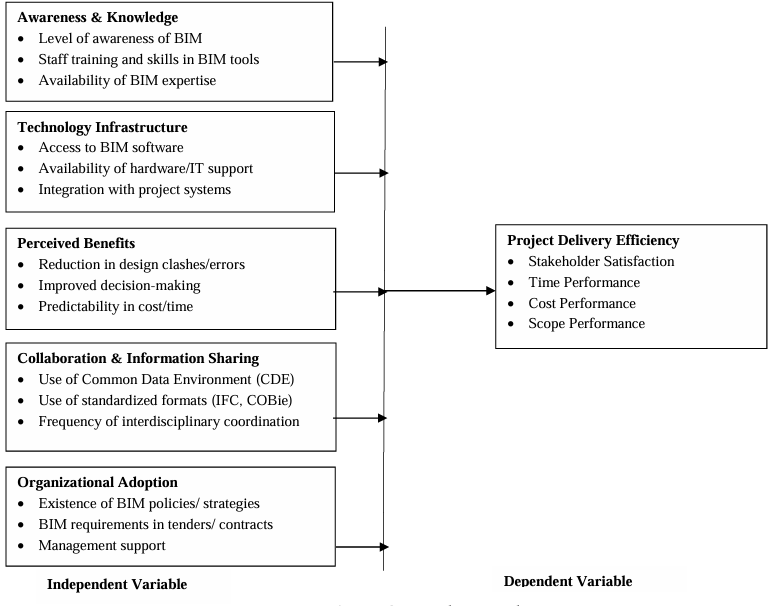
This study examined the effect of Building Information Modelling (BIM) adoption on project delivery efficiency in the construction industry within the Nairobi Metropolitan Region, Kenya. Although BIM has become a globally recognized approach for improving construction project performance, its adoption in Kenya has remained limited and fragmented. The study focused on five key dimensions of BIM adoption: awareness and knowledge, technology infrastructure, perceived benefits, collaboration and information sharing, and organizational adoption. A descriptive research design was adopted, and systematic probability sampling was used to select respondents from five counties within the Nairobi Metropolitan Region. From the target population, a sample size of 384 respondents was determined using statistical sampling formulas for large populations. Primary data were collected through structured questionnaires containing both open-ended and closed-ended questions. Quantitative data were analyzed using descriptive statistics, correlation analysis, and multiple regression techniques. A pilot study involving 38 respondents was conducted to assess the validity and reliability of the research instruments. The findings revealed that all the examined BIM dimensions had positive and statistically significant effects on project delivery efficiency. The study established that BIM improved cost control, time management, quality outcomes, stakeholder coordination, and decision-making efficiency through enhanced collaboration and reduced project rework. However, challenges such as high software acquisition costs and the absence of a national BIM policy framework hindered wider implementation. The study concluded that successful BIM adoption requires strong organizational support, technological readiness, and enabling policy frameworks. It recommended development of a national BIM regulatory framework, integration of BIM into public procurement systems, and increased investment in technical training programs.
References
1) Assefa, S., & Gebeyehu, S. (2021). Challenges affecting building information modelling adoption in the Ethiopian construction industry. International Journal of Construction Engineering and Management, 10(3), 75–84.
2) Azhar, S. (2011). Building information modeling (BIM): Trends, benefits, risks, and challenges for the AEC industry. Leadership and Management in Engineering, 11(3), 241–252.
3) Barney, J. B. (1991). Firm resources and sustained competitive advantage. Journal of Management, 17(1), 99–120.
4) Bell, E., Bryman, A., & Harley, B. (2018). Business research methods (5th ed.). Oxford University Press.
5) Bokor, O., Darko, A., & Chan, A. P. C. (2022). Building information modelling adoption barriers in developing countries: Evidence from Ghana. Journal of Construction in Developing Countries, 27(1), 45–63.
6) Brinkerhoff, D. W., & Brinkerhoff, J. M. (2021). Governance reforms and infrastructure development in Africa: Implications for digital transformation. Public Administration and Development, 41(2), 89–102.
7) Chong, H. Y., Lee, C. Y., & Wang, X. (2023). BIM-enabled collaboration and interdisciplinary coordination in construction projects. Automation in Construction, 145, 104620.
8) Creswell, J. W., & Creswell, J. D. (2023). Research design: Qualitative, quantitative, and mixed methods approaches (6th ed.). Sage Publications.
9) Davis, F. D. (1989). Perceived usefulness, perceived ease of use, and user acceptance of information technology. MIS Quarterly, 13(3), 319–340.
10) Davis, F. D. (1989). Perceived usefulness, perceived ease of use, and user acceptance of information technology. MIS Quarterly, 13(3), 319–340.
11) Eastman, C., Teicholz, P., Sacks, R., & Liston, K. (2020). BIM handbook: A guide to building information modeling for owners, designers, engineers, contractors, and facility managers (3rd ed.). Wiley.
12) Eischet, J. (2025). National BIM implementation and public infrastructure efficiency in the United Kingdom. Construction Innovation, 25(1), 55–71.
13) Gujarati, D. N., & Porter, D. C. (2019). Basic econometrics (6th ed.). McGraw-Hill Education.
14) Hair, J. F., Black, W. C., Babin, B. J., & Anderson, R. E. (2019). Multivariate data analysis (8th ed.). Cengage Learning.
15) Kaburo, L., Karanja, P., & Mwai, J. (2018). Barriers to building information modelling adoption in Kenya’s construction industry. International Journal of Construction Management, 18(5), 403–412.
16) Kenya National Bureau of Statistics. (2025). Economic survey 2025. Government Printer.
17) Kimaku, P. M. (2021). Determinants of Strategic Change Implementation in State Corporations in Kenya (Doctoral dissertation, JKUAT-COHRED).
18) Kimani, J., Ngugi, K., & Mbugua, D. (2020). Digital transformation and BIM adoption in Kenya’s construction sector. African Journal of Construction Economics and Building, 20(4), 66–79.
19) Liu, Z., van Nederveen, S., & Hertogh, M. (2023). Organizational capabilities and building information modelling implementation in construction projects. Engineering, Construction and Architectural Management, 30(5), 1640–1658.
20) Lu, Y., Wu, Z., Chang, R., & Li, Y. (2021). Building information modeling implementation in construction: A review and future directions. Automation in Construction, 91, 101–115.
21) Marzouk, M., Azab, S., & Metawie, M. (2022). Building information modelling and project delivery efficiency in construction management. Journal of Civil Engineering and Management, 28(3), 201–214.
22) Muriithi, P., & Gitau, P. (2023). Technological infrastructure and project performance in Kenya’s construction industry. International Journal of Project Management, 41(2), 144–156.
23) Nasila, M., & Cloete, C. (2018). Building information modelling adoption and project performance in developing economies. Journal of Construction Project Management and Innovation, 8(2), 1968–1985.
24) Oduor, J., Ochieng, R., & Mwangi, S. (2024). Awareness and adoption of building information modelling among construction professionals in Kenya. International Journal of Construction Engineering and Management, 13(1), 11–24.
25) Oladapo, A., & Oyewobi, L. (2020). Building information modelling adoption in the Nigerian construction industry: Challenges and prospects. Journal of Engineering, Design and Technology, 18(4), 1012–1028.
26) Olanrewaju, A., Abdul-Aziz, A. R., & Preece, C. (2023). Technology readiness and BIM adoption in developing countries. Built Environment Project and Asset Management, 13(3), 415–430.
27) Olatunji, O., Sher, W., & Gu, N. (2022). Interoperability and collaboration in BIM-enabled construction projects. Automation in Construction, 135, 104110.
28) Pallant, J. (2020). SPSS survival manual: A step-by-step guide to data analysis using IBM SPSS (7th ed.). Routledge.
29) Rogers, E. M. (2003). Diffusion of innovations (5th ed.). Free Press.
30) Rop, P., Bett, S., & Kiptoo, D. (2021). Policy and regulatory challenges affecting BIM adoption in Kenya. International Journal of Construction Management, 21(7), 690–701.
31) Sacks, R., Eastman, C., Lee, G., & Teicholz, P. (2018). BIM handbook: A guide to building information modeling for owners, designers, engineers, contractors, and facility managers (3rd ed.). Wiley.
32) Saunders, M. N. K., Lewis, P., & Thornhill, A. (2023). Research methods for business students (9th ed.). Pearson.
33) Sekaran, U., & Bougie, R. (2022). Research methods for business: A skill-building approach (9th ed.). Wiley.
34) Succar, B., & Sher, W. (2020). Building information modelling frameworks and adoption strategies. Automation in Construction, 19(3), 357–375.
35) Tornatzky, L. G., & Fleischer, M. (1990). The processes of technological innovation. Lexington Books.
36) Trist, E. L., & Bamforth, K. W. (1951). Some social and psychological consequences of the longwall method of coal-getting. Human Relations, 4(1), 3–38.
37) Windapo, A., & Cattell, K. (2021). Digital transformation and BIM implementation in South Africa’s construction industry. Journal of Construction in Developing Countries, 26(2), 87–104.
Downloads
Published
Issue
Section
License
Copyright (c) 2026 Erick Odhiambo Okello, Patrick Mutua Kimaku, Eunice Mutisya (Author)

This work is licensed under a Creative Commons Attribution 4.0 International License.