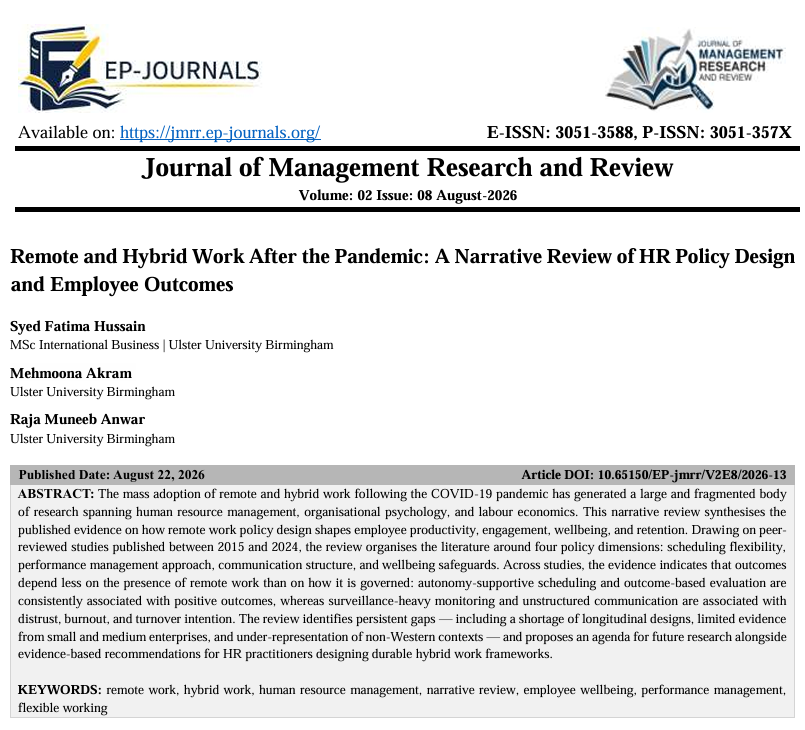
Remote and Hybrid Work After the Pandemic: A Narrative Review of HR Policy Design and Employee Outcomes
DOI:
https://doi.org/10.65150/EP-jmrr/V2E8/2026-13Keywords:
remote work, hybrid work, human resource management, narrative review, employee wellbeing, performance management, flexible workingAbstract
The mass adoption of remote and hybrid work following the COVID-19 pandemic has generated a large and fragmented body of research spanning human resource management, organisational psychology, and labour economics. This narrative review synthesises the published evidence on how remote work policy design shapes employee productivity, engagement, wellbeing, and retention. Drawing on peer-reviewed studies published between 2015 and 2024, the review organises the literature around four policy dimensions: scheduling flexibility, performance management approach, communication structure, and wellbeing safeguards. Across studies, the evidence indicates that outcomes depend less on the presence of remote work than on how it is governed: autonomy-supportive scheduling and outcome-based evaluation are consistently associated with positive outcomes, whereas surveillance-heavy monitoring and unstructured communication are associated with distrust, burnout, and turnover intention. The review identifies persistent gaps — including a shortage of longitudinal designs, limited evidence from small and medium enterprises, and under-representation of non-Western contexts — and proposes an agenda for future research alongside evidence-based recommendations for HR practitioners designing durable hybrid work frameworks.
References
1) Barrero, J.M., Bloom, N., & Davis, S.J. (2021). Why working from home will stick. National Bureau of Economic Research Working Paper No. 28731.
2) Bloom, N., Liang, J., Roberts, J., & Ying, Z.J. (2015). Does working from home work? Evidence from a Chinese experiment. Quarterly Journal of Economics, 130(1), 165–218.
3) Deci, E.L., & Ryan, R.M. (1985). Intrinsic motivation and self-determination in human behavior. Plenum Press.
4) Derks, D., van Mierlo, H., & Schmitz, E.B. (2014). A diary study on work-related smartphone use, psychological detachment and exhaustion: Examining the role of the perceived segmentation norm. Journal of Occupational Health Psychology, 19(1), 74–84.
5) Gajendran, R.S., & Harrison, D.A. (2007). The good, the bad, and the unknown about telecommuting: Meta-analysis of psychological mediators and individual consequences. Journal of Applied Psychology, 92(6), 1524–1541.
6) Gibbs, J.L., Rozaidi, N.A., & Eisenberg, J. (2013). Overcoming the ideology of openness: Probing the affordances of social media for organizational knowledge sharing. Journal of Computer-Mediated Communication, 19(1), 102–120.
7) Kelliher, C., & Anderson, D. (2010). Doing more with less? Flexible working practices and the intensification of work. Human Relations, 63(1), 83–106.
8) Mazmanian, M., Orlikowski, W.J., & Yates, J. (2013). The autonomy paradox: The implications of mobile email devices for knowledge professionals. Organization Science, 24(5), 1337–1357.
9) Moen, P., Kelly, E.L., Tranby, E., & Huang, Q. (2011). Changing work, changing health: Can real work-time flexibility promote health behaviors and well-being? Journal of Health and Social Behavior, 52(4), 404–429.
10) Ravid, D.M., Tomczak, D.L., White, J.C., & Behrend, T.S. (2020). EPM 20/20: A review, framework, and research agenda for electronic performance monitoring. Journal of Management, 46(1), 100–126.
11) Yang, L., Holtz, D., Jaffe, S., et al. (2022). The effects of remote work on collaboration among information workers. Nature Human Behaviour, 6(1), 43–54.
12) Allen, T.D., Golden, T.D., & Shockley, K.M. (2015). How effective is telecommuting? Assessing the status of our scientific findings. Psychological Science in the Public Interest, 16(2), 40–68.
13) Wang, B., Liu, Y., Qian, J., & Parker, S.K. (2021). Achieving effective remote working during the COVID-19 pandemic: A work design perspective. Applied Psychology, 70(1), 16–59.
14) Charalampous, M., Grant, C.A., Tramontano, C., & Michailidis, E. (2019). Systematically reviewing remote e-workers' well-being at work: A multidimensional approach. European Journal of Work and Organizational Psychology, 28(1), 51–73.
Downloads
Published
Issue
Section
License
Copyright (c) 2026 Syed Fatima Hussain, Mehmoona Akram , Raja Muneeb Anwar (Author)

This work is licensed under a Creative Commons Attribution 4.0 International License.












