Fleet Analytics and Operational Error Detection in U.S. Car Rental Operations
DOI:
https://doi.org/10.65150/EP-jmrr/V2E5/2026-10Keywords:
Algorithm oversight, Human Capital Theory, Mobility services management, Technology-Organization-Environment framework, Workforce oversight capabilityAbstract
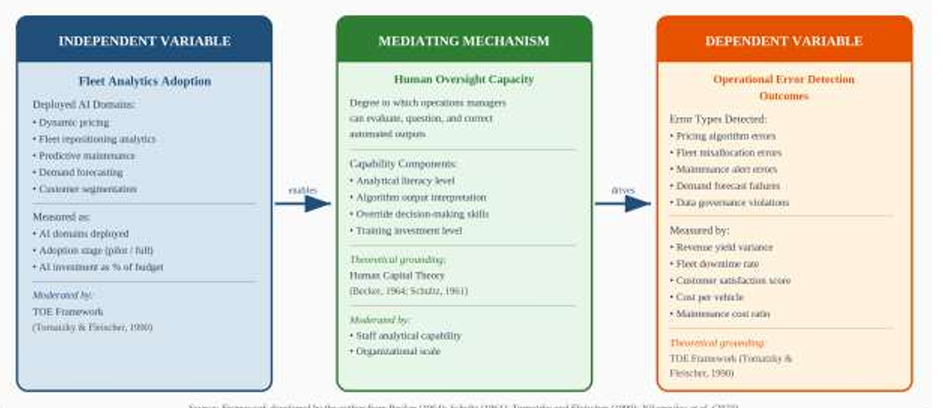
This paper examines the relationship between fleet analytics adoption as the independent variable and operational error detection outcomes as the dependent variable in United States car rental operations. Despite substantial investment by major car rental operators in artificial intelligence-driven analytics platforms, the managerial capability required to oversee, interpret, and govern automated outputs is not being developed systematically. Drawing on Human Capital Theory and the Technology-Organization-Environment framework, the paper conducts a systematic narrative literature review of peer-reviewed research in fleet management, operations management, machine learning, and car rental revenue management. Five fleet analytics domains generating operational error detection demands are mapped: dynamic pricing and revenue management, fleet repositioning analytics, predictive maintenance, demand forecasting, and customer segmentation. Barriers to effective analytical oversight are identified across the three framework dimensions and are found to be concentrated in the organizational and environmental dimensions rather than the technological one. Fleet analytics platforms are deployed at major operators; the managerial capability to govern them is not keeping pace with deployment. High staff turnover, data fragmentation, absent industry mandates, algorithm interpretability constraints, and margin pressure collectively prevent operators from realizing the full value of their analytics investments. The paper proposes a three-level reskilling framework covering operational analytics literacy, human-AI collaboration skills, and algorithmic governance capability, calibrated to operators at different organizational scales. Industry associations are identified as having the institutional capacity to address the coordination failure that prevents individual operators from investing adequately in analytics oversight capability.
References
1) Association to Advance Collegiate Schools of Business (AACSB). (2020). 2020 guiding principles and standards for business accreditation. AACSB International. https://www.aacsb.edu/-/media/documents/accreditation/2020-aacsb-business-accreditation-standards-june-2023.pdf
2) Becker, G. S. (1964). Human capital: A theoretical and empirical analysis, with special reference to education. University of Chicago Press.
3) Chaudhuri, A., & Ghosh, S. K. (2024). Predictive maintenance of vehicle fleets through hybrid deep learning-based ensemble methods for industrial IoT datasets. Logic Journal of the IGPL, 32(4), 671–687. https://doi.org/10.1093/jigpal/jzae017
4) Euromonitor International. (2024). The world market for car rental. Euromonitor International. https://www.euromonitor.com/the-world-market-for-car-rental/report
5) Grand View Research. (2024). Car rental market size, share and trends analysis report by vehicle, by booking mode, by application, by region, and segment forecasts, 2025–2030. Grand View Research. https://www.grandviewresearch.com/industry-analysis/car-rental-market
6) Guillen, J., Ruiz, P., Dellepiane, U., Maccarrone, L., Maccioni, R., Pinzuti, A., & Procacci, E. (2019). Europcar integrates forecasting, simulation, and optimization techniques in a capacity and revenue management system. INFORMS Journal on Applied Analytics, 49(1), 40–51. https://doi.org/10.1287/inte.2018.0970
7) Hector, I., & Panjanathan, R. (2024). Predictive maintenance in Industry 4.0: A survey of planning models and machine learning techniques. PeerJ Computer Science, 10, e2016. https://doi.org/10.7717/peerj-cs.2016
8) Li, D., & Pang, Z. (2017). Dynamic booking control for car rental revenue management: A decomposition approach. European Journal of Operational Research, 256(3), 850–867. https://doi.org/10.1016/j.ejor.2016.06.044
9) Li, D., Pang, Z., & Qian, L. (2023). Bid price controls for car rental network revenue management. Production and Operations Management, 32(1), 261–282. https://doi.org/10.1111/poms.13836
10) Nikopoulou, M., Kourouthanassis, P., Chasapi, G., Pateli, A., & Mylonas, N. (2023). Determinants of digital transformation in the hospitality industry: Technological, organizational, and environmental drivers. Sustainability, 15(3), 2736.
https://doi.org/10.3390/su15032736
11) Oliveira, B. B., Carravilla, M. A., & Oliveira, J. F. (2017). Fleet and revenue management in car rental companies: A literature review and an integrated conceptual framework. Omega: The International Journal of Management Science, 71, 11–26.
https://doi.org/10.1016/j.omega.2016.08.011
12) Oliveira, B. B., Carravilla, M. A., Oliveira, J. F., & Costa, A. M. (2019). A co-evolutionary matheuristic for the car rental capacity-pricing stochastic problem. European Journal of Operational Research, 276(2), 637–655. https://doi.org/10.1016/j.ejor.2019.01.015
13) Schultz, T. W. (1961). Investment in human capital. American Economic Review, 51(1), 1–17. https://www.jstor.org/stable/1818907
14) Soppert, M., Oliveira, B. B., Angeles, R., & Steinhardt, C. (2024). On the benefit of combining car rental and car sharing. Journal of Business Economics, 94(9), 1261–1298. https://doi.org/10.1007/s11573-024-01204-9
15) Tornatzky, L. G., & Fleischer, M. (1990). The processes of technological innovation. Lexington Books.
16) Zhang, C., Chen, J., & Raghunathan, S. (2023). When sharing economy meets traditional business: Coopetition between ride-sharing platforms and car-rental firms. Information Systems Research, 35(3), 1137–1153. https://doi.org/10.1287/isre.2022.0011
Downloads
Published
Issue
Section
License
Copyright (c) 2026 Salami Abdul Mohammed (Author)

This work is licensed under a Creative Commons Attribution 4.0 International License.