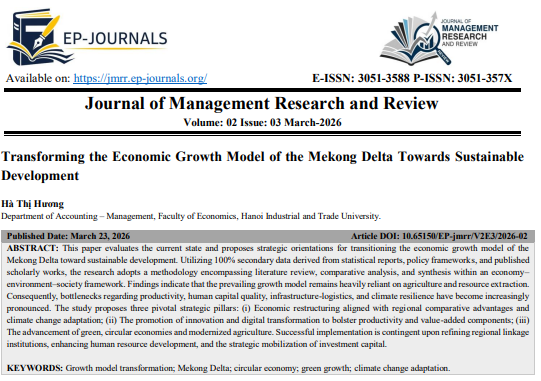
Transforming the Economic Growth Model of the Mekong Delta Towards Sustainable Development
DOI:
https://doi.org/10.65150/EP-jmrr/V2E3/2026-02Keywords:
Growth model transformation; Mekong Delta; circular economy; green growth; climate change adaptation.Abstract
This paper evaluates the current state and proposes strategic orientations for transitioning the economic growth model of the Mekong Delta toward sustainable development. Utilizing 100% secondary data derived from statistical reports, policy frameworks, and published scholarly works, the research adopts a methodology encompassing literature review, comparative analysis, and synthesis within an economy–environment–society framework. Findings indicate that the prevailing growth model remains heavily reliant on agriculture and resource extraction. Consequently, bottlenecks regarding productivity, human capital quality, infrastructure-logistics, and climate resilience have become increasingly pronounced. The study proposes three pivotal strategic pillars: (i) Economic restructuring aligned with regional comparative advantages and climate change adaptation; (ii) The promotion of innovation and digital transformation to bolster productivity and value-added components; (iii) The advancement of green, circular economies and modernized agriculture. Successful implementation is contingent upon refining regional linkage institutions, enhancing human resource development, and the strategic mobilization of investment capital.
References
1) Government of Vietnam. (2017, November 17). Resolution No. 120/NQ-CP on sustainable and climate-resilient development of the Mekong Delta. Government News Agency. https://chinhphu.vn/default.aspx?docid=192249&pageid=27160
2) General Statistics Office (GSO). (2025). Statistical Yearbook 2024. https://www.nso.gov.vn/du-lieu-va-so-lieu-thong-ke/2025/06/nien-giam-thong-ke-2024/
3) Huynh, T. N., Nguyen, T. T. A., Dinh, T. K. O., & Le, B. M. Q. (2025). The current status of circular economy development in the Mekong Delta. VNU Journal of Science: Policy and Management Studies, 41(1), 11–19.
https://doi.org/10.25073/2588-1116/vnupam.4548
4) Klijn, F., Asselman, N., & Wagenaar, D. (2018). Room for rivers: Risk reduction by enhancing the flood conveyance capacity of The Netherlands’ large rivers. Geosciences, 8(6), Article 224. https://doi.org/10.3390/geosciences8060224
5) Prime Minister. (2020, June 3). Decision No. 749/QD-TTg approving the "National Digital Transformation Program to 2025, with orientations toward 2030". Government News Agency. https://chinhphu.vn/default.aspx?docid=200163&pageid=27160
6) Prime Minister. (2021, October 1). Decision No. 1658/QD-TTg approving the National Green Growth Strategy for the 2021–2030 period, with a vision toward 2050. Government News Agency. https://vanban.chinhphu.vn/?docid=204226&pageid=27160
7) Prime Minister. (2022, February 28). Decision No. 287/QD-TTg approving the Mekong Delta Regional Master Plan for the 2021–2030 period, with a vision toward 2050. Government News Agency. https://chinhphu.vn/?docid=205414&pageid=27160&tagid=1&type=1
8) World Bank. (2017, July 31). Investment plan for the Bangladesh Delta Plan 2100: Volume 1—The plan (Report No. ACS23966). World Bank. https://documents1.worldbank.org/curated/en/890611546628658220/pdf/Investment-Plan-for-BDP-2100.pdf
9) World Bank. (2022). Digital technology for traceability in Vietnam’s fruit and vegetable value chains. World Bank.
Downloads
Published
Issue
Section
License
Copyright (c) 2026 Hà Thị Hương (Author)

This work is licensed under a Creative Commons Attribution 4.0 International License.