Conceptual Development of Artificial Intelligence Acceptance Among Employees of Open and Distance Learning Higher Education Institutions in Malaysia
DOI:
https://doi.org/10.65150/EP-jmrr/V2E8/2026-08Keywords:
acceptance of artificial intelligence, Technology Acceptance Model, open and distance learning, Malaysia, organisational supportAbstract
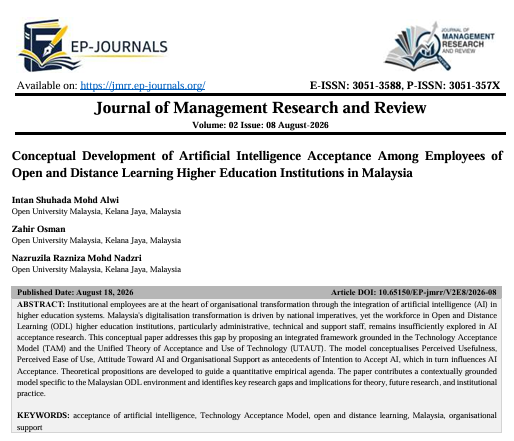
Institutional employees are at the heart of organisational transformation through the integration of artificial intelligence (AI) in higher education systems. Malaysia's digitalisation transformation is driven by national imperatives, yet the workforce in Open and Distance Learning (ODL) higher education institutions, particularly administrative, technical and support staff, remains insufficiently explored in AI acceptance research. This conceptual paper addresses this gap by proposing an integrated framework grounded in the Technology Acceptance Model (TAM) and the Unified Theory of Acceptance and Use of Technology (UTAUT). The model conceptualises Perceived Usefulness, Perceived Ease of Use, Attitude Toward AI and Organisational Support as antecedents of Intention to Accept AI, which in turn influences AI Acceptance. Theoretical propositions are developed to guide a quantitative empirical agenda. The paper contributes a contextually grounded model specific to the Malaysian ODL environment and identifies key research gaps and implications for theory, future research, and institutional practice.
References
1) Abouelenein, Y. A. M., Khalaf, M. H. R., Ghazala, A. F. A., & Mahdy, E. M. M. (2026). Faculty acceptance of blockchain technology in higher education: an extended technology acceptance model analysis. Education and Information Technologies, 1-27.
2) Al-Adwan, A. S., Meet, R. K., Anand, S., Shukla, G. P., Alsharif, R., & Dabbaghia, M. (2025). Understanding continuous use intention of technology among higher education teachers in emerging economy: Evidence from integrated TAM, TPACK, and UTAUT model. Studies in higher education, 50(3), 505-524.
3) AlAjmi, Q., AlRoshdi, Y., & Rostaq, A. (2024, December). Impact of Perceived Ease of Use and Usefulness, with Trust and Individual Impact as Mediators on AI Adoption Intentions among IT Students at UTAS-Muscat. In The International Conference of Advanced Computing and Informatics (pp. 173-184). Cham: Springer Nature Switzerland.
4) Al-Huwail, N., Al-Hunaiyyan, A., Alainati, S., & Alhabshi, A. (2025). Artificial Intelligence in Education: Perspectives and Challenges. International Journal of Interactive Mobile Technologies, 19(4), 26–47. https://doi.org/10.3991/ijim.v19i04.52117
5) Almogren, A. S., Al-Rahmi, W. M., & Dahri, N. A. (2024). Exploring factors influencing the acceptance of ChatGPT in higher education: A smart education perspective. Heliyon, 10(11).
6) Alotaibi, N. (2026). Faculty Acceptance of Generative AI in Higher Education: A Meta-Analysis of TAM and UTAUT Studies (2021-2025). International Journal of Higher Education, 15(1).
7) Chen, X., Jiang, L., Zhou, Z., & Li, D. (2025). Impact of perceived ease of use and perceived usefulness of humanoid robots on students' intention to use. Acta Psychologica, 258, 105217.
8) Cortellazzo, L., Bruni, E., & Zampieri, R. (2019). The role of leadership in a digitalized world: A review. Frontiers in Psychology, 10, 1938. https://doi.org/10.3389/fpsyg.2019.01938
9) Crompton, H., & Burke, D. (2023). Artificial intelligence in higher education: The state of the field. International Journal of Educational Technology in Higher Education, 20(1), 1–19. https://doi.org/10.1186/s41239-023-00386-6
10) Davis, F. D. (1989). Perceived usefulness, perceived ease of use, and user acceptance of information technology. MIS Quarterly, 13(3),319–340. https://doi.org/10.2307/249008
11) Economic Planning Unit. (2021). Malaysia digital economy blueprint. Prime Minister’s Department, Malaysia.
https://ekonomi.gov.my/sites/default/files/2021-02/malaysia-digital-economy-blueprint.pdf
12) Gathmyr, D., Suhud, U., Herlitah, H., Hamidah, H., Safariningsih, R. T. H., & Wilson, J. (2025). Technological advancements in perceived organizational support enhancing healthcare systems towards sustainable development goals. Aptisi Transactions on Technopreneurship (ATT), 7(2), 516-526.
13) Güneyli, A., Burgul, N. S., Dericioğlu, S., Cenkova, N., Becan, S., Şimşek, Ş. E., & Güneralp, H. (2024). Exploring Teacher Awareness of Artificial Intelligence in Education: A Case Study from Northern Cyprus. European Journal of Investigation in Health, Psychology & Education (EJIHPE), 14(8), 2358–2376. https://doi.org/10.3390/ejihpe14080156.
14) Fitria, & Abdul Hafid Hasim. (2026). Students’ Continuance Intention to Use LMS in Higher Education: A Technology Acceptance Model Study. Jurnal QOSIM : Jurnal Pendidikan Sosial & Humaniora, 4(3), 4540–4549. https://doi.org/10.61104/jq.v4i3.7901
15) Jöhnk, J., Weißert, M., & Wyrtki, K. (2021). Ready or not, AI comes: An interview study of organizational AI readiness factors. Business & Information Systems Engineering, 63(1), 5–20. https://doi.org/10.1007/s12599-020-00676-7
16) Karan, B., & Chakma, C. (2026). Influence of higher education students’ perceived behaviour on their artificial intelligence acceptance: an empirical investigation using technology acceptance model. Journal of Applied Research in Higher Education, 18(3), 745-760.
17) Lakulu, M. M., Izkair, A. S., Harfiez Abdul Muttalib, M. F., & Zainuddin, N. A. (2025). Understanding AI and Mobile Learning Adoption in Malaysian Universities: A UTAUT-Based Model. International Journal of Interactive Mobile Technologies, 19(11), 80–111. https://doi.org/10.3991/ijim.v19i11.52977
18) Linus, A. A., & Aladesusi, G. A. (2025). Attitude and Behavioural Intention towards Online Learning Tools: An Empirical Study of College of Education Students in North Central Nigeria. International Journal of Education and Development using Information and Communication Technology, 21(2), 107-120.
19) Mat Yusoff, S., Mohamad Marzaini, A. F., Hao, L., Zainuddin, Z., & Basal, M. H. (2025). Understanding the role of AI in Malaysian higher education curricula: An analysis of student perceptions. Discover Computing, 28(1), Article 62.
https://doi.org/10.1007/s10791-025-09567-5
20) Naseer, M., Shah, S. M. A., & Afzal, R. (2025). Organizational predictors of turnover intentions among healthcare professionals in Pakistan: A quantitative analysis. Journal of Political Stability Archive, 3(1), 664-684.
21) Nikolic, S., Wentworth, I., Sheridan, L., Moss, S., Duursma, E., Jones, R. A., Ros, M., & Middleton, R. (2024). A systematic literature review of attitudes, intentions and behaviours of teaching academics pertaining to AI and generative AI (GenAI) in higher education: An analysis of GenAI adoption using the UTAUT framework. Australasian Journal of Educational Technology, 40(2). https://doi.org/10.14742/ajet.9643
22) Slijepčević, M., Šević, N. P., Šević, A., & Krstić, J. (2026). Understanding What Drives AI Adoption in Higher Education: An Extended Technology Acceptance Model Approach. International Journal of Technology in Education, 9(3), 836-856.
23) Sungkawaningtyas, M., Susanto, E., Sumaryono, S., Wulandaru, D. R., & Rostiani, R. (2025). Enhancing work engagement public amidst change: the role of perceived organizational support, psychological capital and acceptance of change. International Journal of Organization Theory & Behavior, 1-19.
24) Tan, P. S. H., Seow, A. N., Choong, Y. O., Tan, C. H., Lam, S. Y., & Choong, C. K. (2024). University students’ perceived service quality and attitude towards hybrid learning: ease of use and usefulness as mediators. Journal of Applied Research in Higher Education, 16(5), 1500-1514.
25) Tasel-Jurkovic, K., & Altinbasak-Farina, İ. (2024). Higher education institution choice intention model: mediation effect of attitude. Journal of Marketing for Higher Education, 34(1), 136-155.
26) Uren, V., & Edwards, J. S. (2023). Technology readiness and the organizational journey towards AI adoption: An empirical study. International Journal of Information Management, 68, 102588. https://doi.org/10.1016/j.ijinfomgt.2022.102588
27) Venkatesh, V., Morris, M. G., Davis, G. B., & Davis, F. D. (2003). User Acceptance of Information Technology: Toward a Unified View. MIS Quarterly, 27(3), 425–478. https://doi.org/10.2307/30036540
28) Wut, T. M., Ka-man Sum, C., & Shun-mun Wong, H. (2025). Does perceived risk of AI matter? Teachers’ AI literacy and institutional support: perspective from self-determination theory. Education and Information Technologies, 1-23.
29) Xu, M. (2025). Drivers of Attitude and Behavioral Intention Toward Blended Learning in Higher Education. AU-GSB E-Journal, 18(4), 108.
30) Yussof, K. Y. S. K. M., Sudirman, N. S., Ahmad, M., Shah, J. M., Foo, J., & Daud, R. (2025). Organisation’s Support Influences the Acceptance and Use of E-Learning among Academic Staff of Higher Learning Institution in Sabah. Journal of Contemporary Issues and Thought, 15(1/2), 16-25.
Downloads
Published
Issue
Section
License
Copyright (c) 2026 Intan Shuhada Mohd Alwi, Zahir Osman, Nazruzila Razniza Mohd Nadzri (Author)

This work is licensed under a Creative Commons Attribution 4.0 International License.












