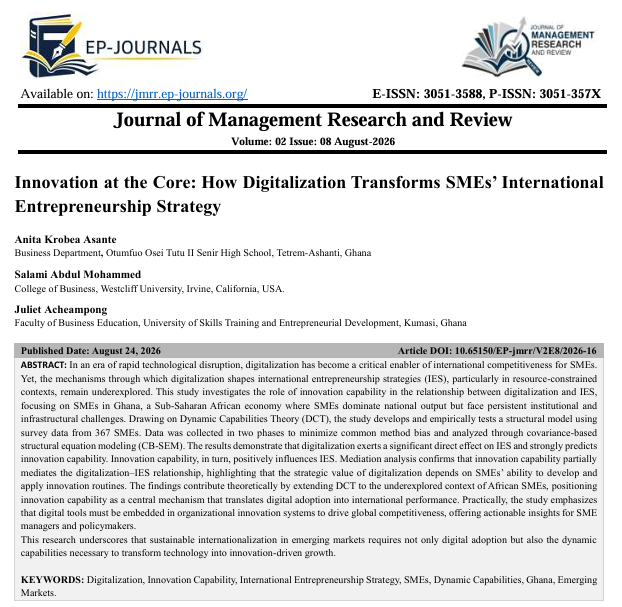
Innovation at the Core: How Digitalization Transforms SMEs’ International Entrepreneurship Strategy
DOI:
https://doi.org/10.65150/EP-jmrr/V2E8/2026-16Keywords:
Digitalization, Innovation Capability, International Entrepreneurship Strategy, SMEs, Dynamic Capabilities, Ghana, Emerging Markets.Abstract
In an era of rapid technological disruption, digitalization has become a critical enabler of international competitiveness for SMEs. Yet, the mechanisms through which digitalization shapes international entrepreneurship strategies (IES), particularly in resource-constrained contexts, remain underexplored. This study investigates the role of innovation capability in the relationship between digitalization and IES, focusing on SMEs in Ghana, a Sub-Saharan African economy where SMEs dominate national output but face persistent institutional and infrastructural challenges. Drawing on Dynamic Capabilities Theory (DCT), the study develops and empirically tests a structural model using survey data from 367 SMEs. Data was collected in two phases to minimize common method bias and analyzed through covariance-based structural equation modeling (CB-SEM). The results demonstrate that digitalization exerts a significant direct effect on IES and strongly predicts innovation capability. Innovation capability, in turn, positively influences IES. Mediation analysis confirms that innovation capability partially mediates the digitalization–IES relationship, highlighting that the strategic value of digitalization depends on SMEs’ ability to develop and apply innovation routines. The findings contribute theoretically by extending DCT to the underexplored context of African SMEs, positioning innovation capability as a central mechanism that translates digital adoption into international performance. Practically, the study emphasizes that digital tools must be embedded in organizational innovation systems to drive global competitiveness, offering actionable insights for SME managers and policymakers.
This research underscores that sustainable internationalization in emerging markets requires not only digital adoption but also the dynamic capabilities necessary to transform technology into innovation-driven growth.
References
1) Aboelmaged, M. G. (2014). Predicting e-readiness at firm-level: An analysis of technological, organisational and environmental (TOE) effects on e-maintenance readiness in manufacturing firms. International Journal of Information Management, 34(5), 639-651.
2) Adomako, S., Amankwah-Amoah, J., Dankwah, G. O., Danso, A., & Donbesuur, F. (2019). Institutional voids, international learning effort and internationalization of emerging market new ventures. Journal of International Management, 25(4), 100666.
3) Adomako, S., Danso, A., Boso, N., & Narteh, B. (2018). Entrepreneurial alertness and new venture performance: Facilitating roles of networking capability. International Small Business Journal, 36(5), 453-472.
4) Adomako, S., Opoku, R. A., & Frimpong, K. (2017). The moderating influence of competitive intensity on the relationship between CEOs' regulatory foci and SME internationalization. Journal of International Management, 23(3), 268-278.
5) Afum, E., Gao, Y., Agyabeng-Mensah, Y., & Sun, Z. (2021). Nexus between lean operations, eco-product innovativeness, social, green and business performances: an empirical evidence from Ghanaian manufacturing SMEs. Journal of Manufacturing Technology Management, 32(8), 1557-1577.
6) Al-Khatib, A. W., & Al-ghanem, E. M. (2022). Radical innovation, incremental innovation, and competitive advantage, the moderating role of technological intensity: evidence from the manufacturing sector in Jordan. European business review, 34(3), 344-369.
7) Amankwah-Amoah, J., Adomako, S., Danquah, J. K., Opoku, R. A., & Zahoor, N. (2022). Foreign market knowledge, entry mode choice and SME international performance in an emerging market. Journal of International Management, 28(4), 100955.
8) Amankwah-Amoah, J., Khan, Z., Wood, G., & Knight, G. (2021). COVID-19 and digitalization: The great acceleration. Journal of business research, 136, 602-611.
9) Ambrosini, V., & Bowman, C. (2009). What are dynamic capabilities and are they a useful construct in strategic
management?. International journal of management reviews, 11(1), 29-49.
10) Appiah-Kubi, E. (2024). Management knowledge and sustainability reporting in SMEs: The role of perceived benefit and stakeholder pressure. Journal of Cleaner Production, 434, 140067.
11) Appiah‐Kubi, E., Dura, C. C., Niță, D., Drigă, I., Preda, A., & Baltador, L. A. (2025). The effect of digitalization on sustainability reporting: The role of sustainability competence, green knowledge integration, and stakeholder pressure. Business Strategy and the Environment, 34(1), 1133-1153.
12) Armstrong, J. S., & Overton, T. S. (1977). Estimating nonresponse bias in mail surveys. Journal of marketing research, 14(3), 396-402.
13) Autio, E., Mudambi, R., & Yoo, Y. (2021). Digitalization and globalization in a turbulent world: Centrifugal and centripetal forces. Global Strategy Journal, 11(1), 3-16.
14) Bargoni, A., Ferraris, A., Vilamová, Š., & Wan Hussain, W. M. H. (2024). Digitalisation and internationalisation in SMEs: a systematic review and research agenda. Journal of Enterprise Information Management, 37(5), 1418-1457.
15) Barney, J. (1991). Firm resources and sustained competitive advantage. Journal of management, 17(1), 99-120.
16) Bharadwaj, A., El Sawy, O. A., Pavlou, P. A., & Venkatraman, N. V. (2013). Digital business strategy: toward a next generation of insights. MIS quarterly, 471-482.
17) Boso, N., Debrah, Y., & Amankwah-Amoah, J. (2018). (How) does Africa matter for international business scholarship?. AIB Insights, 18(4), 6-9.
18) Bresciani, S., Huarng, K. H., Malhotra, A., & Ferraris, A. (2021). Digital transformation as a springboard for product, process and business model innovation. Journal of Business Research, 128, 204-210.
19) Brouthers, K. D., Brouthers, L. E., & Werner, S. (2003). Transaction cost‐enhanced entry mode choices and firm performance. Strategic management journal, 24(12), 1239-1248.
20) Brown, T. A., & Moore, M. T. (2012). Confirmatory factor analysis. Handbook of structural equation modeling, 361, 379.
21) Buccieri, D., Javalgi, R. G., & Cavusgil, E. (2020). International new venture performance: Role of international entrepreneurial culture, ambidextrous innovation, and dynamic marketing capabilities. International Business Review, 29(2), 101639.
22) Capurro, R., Fiorentino, R., Garzella, S., & Giudici, A. (2022). Big data analytics in innovation processes: which forms of dynamic capabilities should be developed and how to embrace digitization?. European Journal of Innovation Management, 25(6), 273-294.
23) Caputo, A., Pizzi, S., Pellegrini, M. M., & Dabić, M. (2021). Digitalization and business models: Where are we going? A science map of the field. Journal of business research, 123, 489-501.
24) Cenamor, J., Parida, V., & Wincent, J. (2019). How entrepreneurial SMEs compete through digital platforms: The roles of digital platform capability, network capability and ambidexterity. Journal of business research, 100, 196-206.
25) Chatterjee, S., Chaudhuri, R., & Vrontis, D. (2022). Knowledge sharing in international markets for product and process innovation: moderating role of firm's absorptive capacity. International Marketing Review, 39(3), 706-733.
26) Cohen, W. M., & Levinthal, D. A. (1990). Absorptive capacity: A new perspective on learning and innovation. Administrative science quarterly, 35(1), 128-152.
27) Cuthbertson, R. W., & Furseth, P. I. (2022). Digital services and competitive advantage: Strengthening the links between RBV, KBV, and innovation. Journal of Business Research, 152, 168-176.
28) Del Giudice, M., Di Vaio, A., Hassan, R., & Palladino, R. (2022). Digitalization and new technologies for sustainable business models at the ship–port interface: A bibliometric analysis. Maritime Policy & Management, 49(3), 410-446.
29) DeSanctis, G., & Poole, M. S. (1994). Capturing the complexity in advanced technology use: Adaptive structuration theory. Organization science, 5(2), 121-147.
30) Eisenhardt, K., & Martin, J. A. (2000). Dynamic capabilities: What are they. Strategic management journal, 21(10/11), 1105-1121.
31) Ferreira, J. J., Fernandes, C. I., & Ferreira, F. A. (2019). To be or not to be digital, that is the question: Firm innovation and performance. Journal of Business research, 101, 583-590.
32) Fornell, C., & Larcker, D. F. (1981). Evaluating structural equation models with unobservable variables and measurement error. Journal of marketing research, 18(1), 39-50.
33) Gong, Y., Yao, Y., & Zan, A. (2023). The too-much-of-a-good-thing effect of digitalization capability on radical innovation: the role of knowledge accumulation and knowledge integration capability. Journal of Knowledge Management, 27(6), 1680-1701.
34) Greenwood, P. E., & Nikulin, M. S. (1996). A guide to chi-squared testing. John Wiley & Sons.
35) Han, H., & Trimi, S. (2022). Towards a data science platform for improving SME collaboration through Industry 4.0 technologies. Technological Forecasting and Social Change, 174, 121242.
36) Hao, X., Wen, S., Zhu, J., Wu, H., & Hao, Y. (2024). Can business managerial capacity improve green innovation in different industries? Evidence from Chinese listed companies. Business Strategy and the Environment, 33(3), 2600-2620.
37) Helfat, C. E., & Winter, S. G. (2011). Untangling dynamic and operational capabilities: Strategy for the (N) ever‐changing world. Strategic management journal, 32(11), 1243-1250.
38) Javaid, M., Haleem, A., Singh, R. P., & Suman, R. (2022). Artificial intelligence applications for industry 4.0: A literature-based study. Journal of Industrial Integration and Management, 7(01), 83-111.
39) Jean, R. J. B., Kim, D., Lien, Y. C., & Ro, S. (2020). The moderating effect of virtual integration on intergenerational governance and relationship performance in international customer–supplier relationships. International Marketing Review, 37(3), 579-592.
40) Johanson, J., & Vahlne, J. E. (2015). The Uppsala internationalization process model revisited: From liability of foreignness to liability of outsidership. In International business strategy (pp. 33-59). Routledge.
41) Kallmuenzer, A., Mikhaylov, A., Chelaru, M., & Czakon, W. (2025). Adoption and performance outcome of digitalization in small and medium-sized enterprises. Review of Managerial Science, 19(7), 2011-2038.
42) Knight, G. A., & Cavusgil, S. T. (2004). Innovation, organizational capabilities, and the born-global firm. Journal of international business studies, 35(2), 124-141.
43) Knight, G. A., & Liesch, P. W. (2016). Internationalization: From incremental to born global. Journal of world business, 51(1), 93-102.
44) Kraus, S., Schiavone, F., Pluzhnikova, A., & Invernizzi, A. C. (2021). Digital transformation in healthcare: Analyzing the current state-of-research. Journal of Business Research, 123, 557-567.
45) Lam, L., Nguyen, P., Le, N., & Tran, K. (2021). The relation among organizational culture, knowledge management, and innovation capability: Its implication for open innovation. Journal of Open Innovation: Technology, Market, and Complexity, 7(1), 66.
46) Lanivich, S. E., Adomako, S., Zahoor, N., Tarba, S. Y., & Stockdall, K. (2025). Bricolage and new-venture performance: conditions of digitalization, causation, and effectuation. Journal of Small Business Management, 1-39.
47) Leão, P., & da Silva, M. M. (2021). Impacts of digital transformation on firms' competitive advantages: A systematic literature review. Strategic Change, 30(5), 421-441.
48) Li, L., Su, F., Zhang, W., & Mao, J. Y. (2018). Digital transformation by SME entrepreneurs: A capability perspective. Information Systems Journal, 28(6), 1129-1157.
49) Li, L., Ye, F., Zhan, Y., Kumar, A., Schiavone, F., & Li, Y. (2022). Unraveling the performance puzzle of digitalization: Evidence from manufacturing firms. Journal of Business Research, 149, 54-64.
50) Loebbecke, C., & Picot, A. (2015). Reflections on societal and business model transformation arising from digitization and big data analytics: A research agenda. The journal of strategic information systems, 24(3), 149-157.
51) Matarazzo, M., Penco, L., Profumo, G., & Quaglia, R. (2021). Digital transformation and customer value creation in Made in Italy SMEs: A dynamic capabilities perspective. Journal of Business research, 123, 642-656.
52) Mendoza-Silva, Andrea. "Innovation capability: A sociometric approach." Social Networks 64 (2021): 72-82.
53) Migdadi, M. M. (2022). Social capital impact on mass customization capability and innovation capabilities: the mediating role of absorptive capacity. Journal of Business & Industrial Marketing, 37(12), 2488-2500.
54) Morgan, K. (1970). Sample size determination using Krejcie and Morgan table. Kenya Projects Organization (KENPRO), 38(1970), 607-610.
55) Najafi-Tavani, S., Najafi-Tavani, Z., Naudé, P., Oghazi, P., & Zeynaloo, E. (2018). How collaborative innovation networks affect new product performance: Product innovation capability, process innovation capability, and absorptive capacity. Industrial marketing management, 73, 193-205.
56) Nambisan, S., Siegel, D., & Kenney, M. (2018). On open innovation, platforms, and entrepreneurship. Strategic entrepreneurship journal, 12(3), 354-368.
57) Nambisan, S., Wright, M., & Feldman, M. (2019). The digital transformation of innovation and entrepreneurship: Progress, challenges
and key themes. Research policy, 48(8), 103773.
58) Orlikowski, W. J. (2000). Using technology and constituting structures: A practice lens for studying technology in organizations.
Organization science, 11(4), 404-428.
59) Oura, M. M., Zilber, S. N., & Lopes, E. L. (2016). Innovation capacity, international experience and export performance of SMEs in Brazil. International Business Review, 25(4), 921-932.
60) Pagani, M., & Pardo, C. (2017). The impact of digital technology on relationships in a business network. Industrial Marketing Management, 67, 185-192.
61) Podsakoff, P. M., MacKenzie, S. B., Lee, J. Y., & Podsakoff, N. P. (2003). Common method biases in behavioral research: a critical review of the literature and recommended remedies. Journal of applied psychology, 88(5), 879.
62) Pundziene, A., & Geryba, L. (2023). Managing technological innovation: Dynamic capabilities, collaborative innovation, and born-digital SMEs' performance. IEEE Transactions on Engineering Management, 71, 6968-6981.
63) Rogelberg, S. G., & Stanton, J. M. (2007). Introduction: Understanding and dealing with organizational survey nonresponse.
Organizational research methods, 10(2), 195-209.
64) Roy, S. K., Dey, B. L., Brown, D. M., Abid, A., Apostolidis, C., Christofi, M., & Tarba, S. (2025). Business model innovation through AI adaptation: the role of strategic human resources management. British Journal of Management, 36(2), 546-559.
65) Sassi, M., Qafoku, O., Bowden, M. E., Pearce, C. I., Latta, D., Miller, Q. R., ... & Rosso, K. M. (2024). Influence of time and ageing conditions on the properties of ferrihydrite. Environmental Science: Nano, 11(4), 1682-1692.
66) Scuotto, V., Lemaire, S. L. L., Magni, D., & Maalaoui, A. (2022). Extending knowledge-based view: Future trends of corporate social entrepreneurship to fight the gig economy challenges. Journal of Business Research, 139, 1111-1122.
67) Shen, S., Venaik, S., & Zhu, Y. (2023). A dynamic model of internationalization and innovation in emerging market enterprises: knowledge exploration, transformation, and exploitation. Management International Review, 63(4), 561-601.
68) Song, Y. (2023). How do Chinese SMEs enhance technological innovation capability? From the perspective of innovation ecosystem. European Journal of Innovation Management, 26(5), 1235-1254.
69) Teece, D. J. (2007). Explicating dynamic capabilities: the nature and microfoundations of (sustainable) enterprise performance. Strategic management journal, 28(13), 1319-1350.
70) Teece, D. J. (2014). The foundations of enterprise performance: Dynamic and ordinary capabilities in an (economic) theory of firms. Academy of management perspectives, 28(4), 328-352.
71) Teece, D. J., Pisano, G., & Shuen, A. (1997). Dynamic capabilities and strategic management. Strategic management journal, 18(7), 509-533.
72) Teece, D. J. (2023). Big tech and strategic management: How management scholars can inform competition policy. Academy of Management Perspectives, 37(1), 1-15.
73) Teece, D., Peteraf, M., & Leih, S. (2016). Dynamic capabilities and organizational agility: Risk, uncertainty, and strategy in the innovation economy. California management review, 58(4), 13-35.
74) Vial, G. (2019). Reflections on quality requirements for digital trace data in IS research. Decision Support Systems, 126, 113133.
75) Wang, C. L. (2008). Entrepreneurial orientation, learning orientation, and firm performance. Entrepreneurship theory and practice, 32(4), 635-657.
76) Wang, C. L., & Ahmed, P. K. (2007). Dynamic capabilities: A review and research agenda. International journal of management reviews, 9(1), 31-51.
77) Wernerfelt, B. (1984). A resource‐based view of the firm. Strategic management journal, 5(2), 171-180.
78) Zahra, S. A. (2021). International entrepreneurship in the post Covid world. Journal of World Business, 56(1), 101143.
79) Zahra, S. A., & George, G. (2002). Absorptive capacity: A review, reconceptualization, and extension. Academy of management review, 27(2), 185-203.
80) Zahra, S. A., Ireland, R. D., & Hitt, M. A. (2000). International expansion by new venture firms: International diversity, mode of market entry, technological learning, and performance. Academy of Management journal, 43(5), 925-950.
81) Zheng, Y., & Zhang, Q. (2023). Digital transformation, corporate social responsibility and green technology innovation-based on empirical evidence of listed companies in China. Journal of Cleaner Production, 424, 138805.
82) Zhou, L., Wu, W. P., & Luo, X. (2007). Internationalization and the performance of born-global SMEs: the mediating role of social networks. Journal of international business studies, 38(4), 673-690.
Downloads
Published
Issue
Section
License
Copyright (c) 2026 Anita Krobea Asante, Salami Abdul Mohammed, Juliet Acheampong (Author)

This work is licensed under a Creative Commons Attribution 4.0 International License.












