Sustainability Practices Intention in Food Manufacturing SMEs: A Dual-Mediation Model of Innovation Capability and Green Technology Capability
DOI:
https://doi.org/10.65150/EP-jmrr/V2E5/2026-06Keywords:
Sustainability Practices Intention, Innovation Capability, Green Technology Capability, Organizational Support, Human Resource Quality, Food Manufacturing SMEs.Abstract
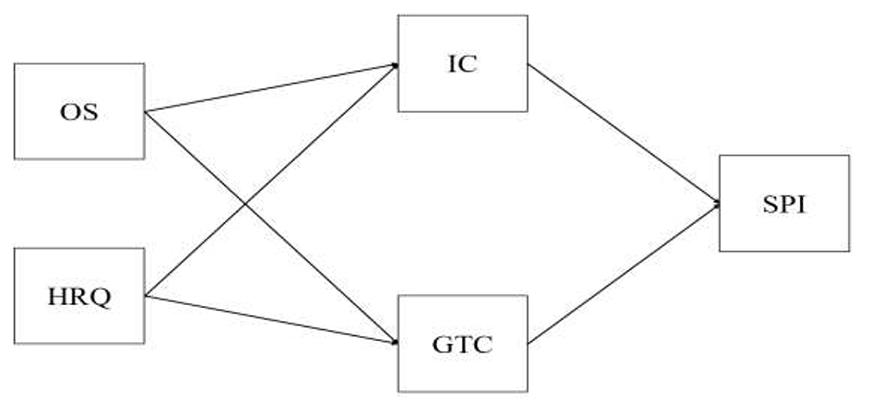
Sustainability has become a strategic imperative for food manufacturing small and medium-sized enterprises (SMEs). Particularly, in highly regulated environments such as Malaysia, where compliance with food safety, Halal certification, and environmental standards is increasingly stringent. Despite growing scholarly attention, existing research remains fragmented and provides limited theoretical explanation of how internal organizational resources are translated into Sustainability Practices Intention (SPI), especially in resource-constrained SME contexts. Addressing this gap, this paper develops a theory-integrated conceptual framework explaining the transformation of organizational resources into sustainability-oriented intentions. Grounded in the Natural Resource-Based View, Dynamic Capability Theory, and the Triple Bottom Line framework, the study proposes a dual-mediation model in which innovation capability and green technology capability function as parallel but distinct mechanisms linking organizational support and human resource quality to SPI. The framework advances current literature by distinguishing between general adaptive capability and sustainability-specific technological capability, thereby offering a more precise explanation of how SMEs operationalize sustainability beyond compliance-driven approaches. By integrating multiple theoretical perspectives into a unified model, the study extends understanding of sustainability practices intention and highlights capability development as a central driver of sustainability adoption in SMEs. Practically, the model provides guidance for managers and policymakers in designing targeted interventions that strengthen both innovation and green technology capabilities to enhance sustainability implementation in the food manufacturing sector.
References
1) Ajzen, I. (1991). The theory of planned behaviour. Organizational Behaviour and Human Decision Processes, 50(2), 179–211.
2) Arokiasamy, L., Fu, T., Piaralal, S. K., & Omar, S. S. (2023). A systematic review on human capital: A view from human resource development. KnE Social Sciences, 8(20), 57–76. https://doi.org/10.18502/kss.v8i20.14594
3) Barney, J. (1991). Firm resources and sustained competitive advantage. Journal of Management, 17(1), 99–120.
4) Calantone, R. J., Cavusgil, S. T., & Zhao, Y. (2002). Learning orientation, firm innovation capability, and firm performance. Industrial Marketing Management, 31(6), 515–524.
5) Chen, C. M., Chen, Y. C., & Chen, C. J. (2020). The relationships between green technology capabilities, green innovation, and firm performance: A contingent view. Journal of Business Research, 116, 502–513.
6) Chong, S. (2018). Factors influencing the adoption of green practices among Malaysian SMEs. Journal of Cleaner Production, 172, 287–297.
7) Delmas, M. A., & Pekovic, S. (2018). Organizational configurations for sustainability and employee productivity. Business & Society, 57(1), 216–251.
8) Elkington, J. (1997). Cannibals with forks: The triple bottom line of 21st-century business. Capstone Publishing.
9) Ghaleb, M. M. S., & Piaralal, S. K. (2024). Organic food and customers’ perception: A qualitative study. Future of Food: Journal on Food, Agriculture and Society, 12(1). https://doi.org/10.17170/kobra-202407218424
10) Ghimire, P., Piaralal, S. K., Zulkefli, N. A., Raghavan, S., & Daud, Y. R. (2026). Can cloud computing adoption drive SME sustainability? Evidence from Nepal. Strategic Business Research, 2(1), 100096. https://doi.org/10.1016/j.sbr.2026.100096
11) Hart, S. L. (1995). A natural-resource-based view of the firm. Academy of Management Review, 20(4), 986-1014.
12) Helfat, C. E., & Peteraf, M. A. (2015). Managerial cognitive capabilities and the micro foundations of dynamic capabilities. Strategic Management Journal, 36(6), 831–850. https://doi.org/10.1002/smj.2247
13) Hilmi, M. F., Ramayah, T., Mustapha, Y., & Pawanchik, S. (2020). Sustainable practices and performance of SMEs in Malaysia. Journal of Cleaner Production, 256, 120308.
14) Hubbard, G. (2009). Measuring organizational performance: Beyond the triple bottom line. Business Strategy and the Environment, 18(3), 177–191.
15) Jalil, M. F., Ali, A., & Kamarulzaman, R. (2021). Does innovation capability improve SME performance in Malaysia? International Journal of Entrepreneurship and Innovation, 23(4), 253–267. https://doi.org/10.1177/14657503211048967
16) Latip, M., Sharkawi, I., & Mohamed, Z. (2025). Enhancing sustainability practices in Malaysian food manufacturing SMEs: The mediating effect of innovation capability. Corporate Social Responsibility and Environmental Management, 32(3), 4035–4052.
https://doi.org/10.1002/csr.3170
17) Lim, W. Q., Nadarajah, D., & Wahab, S. A. (2022). Mediating effect of sustainable manufacturing practices between green innovation capability and sustainability performance among Malaysian manufacturing SMEs. Business Management and Strategy, 13(1), 102-133.
18) Longoni, A., & Cagliano, R. (2018). Sustainable innovativeness and the triple bottom line: The role of organizational time perspective. Journal of Business Ethics, 151(4), 1097–1120.
19) Mabkhot, H., & Piaralal, S. K. (2025). Exploring consumer cross-platform buying: Perception of organic food and psychological influences on behavioral adaptation. Future of Food: Journal on Food, Agriculture and Society, 13(1), 1–18.
https://doi.org/10.17170/kobra-202513101
20) Milne, M. J., & Gray, R. (2013). W(h)ither ecology? The triple bottom line, the global reporting initiative, and corporate sustainability reporting. Journal of Business Ethics, 118(1), 13–29. https://doi.org/10.1007/s10551-012-1543-8
21) Piaralal, S. K., Ramalingam, T., Zulkefli, N. A., Qazi, S., Haque, R., & Senathirajah, A. R. b. (2026). Transforming Telecoms: How Transformational Leadership, Creativity and Innovation Drive Organizational Performance. Administrative Sciences, 16(3), 150. https://doi.org/10.3390/admsci16030150
22) Rahman, A. A., & Raman, M. (2019). Green practices adoption among SMEs: Evidence from Malaysia. Asian Journal of Business and Accounting, 12(2), 45–68.
23) Singh, A. S. C., Piaralal, S. K., Zulkefli, N. A., & Raghavan, S. (2025). Driving sustainability performance in Malaysia’s palm oil industry: How employee engagement makes the difference. International Journal of Academic Research in Business and Social Sciences, 15(3), 195–212. http://dx.doi.org/10.6007/IJARBSS/v15-i3/24834
24) Teece, D. J., Pisano, G., & Shuen, A. (1997). Dynamic capabilities and strategic management. Strategic Management Journal, 18(7), 509–533. https://doi.org/10.1002/(SICI)1097-0266
25) Teece, D. J. (2007). Explicating dynamic capabilities. Strategic Management Journal, 28(13), 1319–1350.
https://doi.org/10.1002/smj.640
26) Teece, D. J. (2014). The foundations of enterprise performance: Dynamic and ordinary capabilities in an (economic) theory of firms. Academy of Management Perspectives, 28(4), 328–352. https://doi.org/10.5465/amp.2013.0116
27) Yong, J. Y., Yusliza, M. Y., Ramayah, T., & Fawehinmi, O. (2020). Nexus between green intellectual capital and green HRM. Journal of Cleaner Production, 267, 122035.
28) Yu, D., Tao, S., Hanan, A., Ong, T. S., Latif, B., & Ali, M. (2022). Fostering green innovation adoption through green dynamic capability: The moderating role of environmental dynamism and big data analytic capability. International Journal of Environmental Research and Public Health, 19(16), 10336. https://doi.org/10.3390/ijerph191610336
Downloads
Published
Issue
Section
License
Copyright (c) 2026 Tan Hee Keat, Shishi Kumar Piaralal, Nur Amalina Zulkefli, Nainatul Farzuha Nor, Santhi Raghavan (Author)

This work is licensed under a Creative Commons Attribution 4.0 International License.