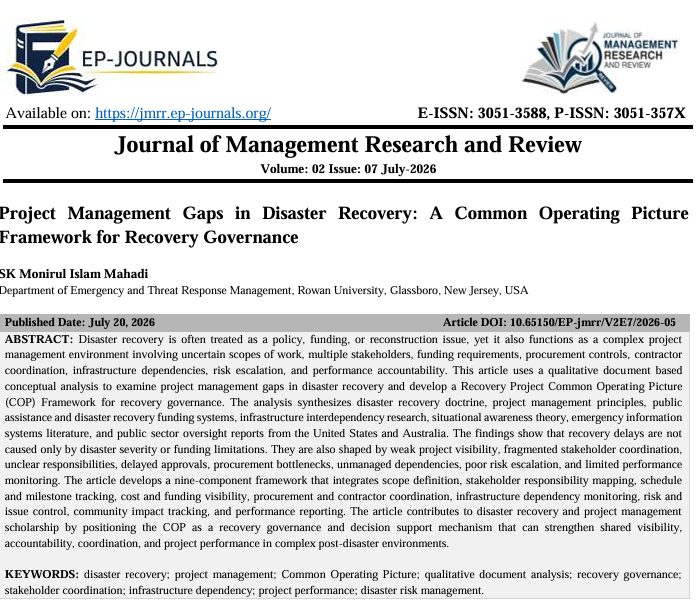
Project Management Gaps in Disaster Recovery: A Common Operating Picture Framework for Recovery Governance
DOI:
https://doi.org/10.65150/EP-jmrr/V2E7/2026-05Keywords:
disaster recovery, project management, Common Operating Picture, qualitative document analysis, recovery governance, stakeholder coordination, infrastructure dependency, project performance, disaster risk management.Abstract
Disaster recovery is often treated as a policy, funding, or reconstruction issue, yet it also functions as a complex project management environment involving uncertain scopes of work, multiple stakeholders, funding requirements, procurement controls, contractor coordination, infrastructure dependencies, risk escalation, and performance accountability. This article uses a qualitative document based conceptual analysis to examine project management gaps in disaster recovery and develop a Recovery Project Common Operating Picture (COP) Framework for recovery governance. The analysis synthesizes disaster recovery doctrine, project management principles, public assistance and disaster recovery funding systems, infrastructure interdependency research, situational awareness theory, emergency information systems literature, and public sector oversight reports from the United States and Australia. The findings show that recovery delays are not caused only by disaster severity or funding limitations. They are also shaped by weak project visibility, fragmented stakeholder coordination, unclear responsibilities, delayed approvals, procurement bottlenecks, unmanaged dependencies, poor risk escalation, and limited performance monitoring. The article develops a nine-component framework that integrates scope definition, stakeholder responsibility mapping, schedule and milestone tracking, cost and funding visibility, procurement and contractor coordination, infrastructure dependency monitoring, risk and issue control, community impact tracking, and performance reporting. The article contributes to disaster recovery and project management scholarship by positioning the COP as a recovery governance and decision support mechanism that can strengthen shared visibility, accountability, coordination, and project performance in complex post-disaster environments.
References
1) Kumah, Victoria Maame Afriyie, et al. "Decoding multilevel psychosocial hazards affecting construction professionals: a systematic review." Smart and Sustainable Built Environment (2026): 1-32.doi: https://doi.org/10.1108/SASBE-07-2025-0370
2) Alkindi, S. (2026). Decision-making strategies for project management and financial planning: UAE's public sector construction projects (Doctoral dissertation, Anglia Ruskin Research Online (ARRO)).doi: https://doi.org/10.25411/aru.31821199
3) Van Le, H., & Nguyen, Q. N. K. (2026). Integrating Shoreline Stabilisation, Incentive Alignment, and Co-Management for Mangrove Restoration in Ca Mau, Vietnam: A Practice and Policy Analysis. Case Studies in the Environment, 10(1), 2882467.doi: https://doi.org/10.1525/cse.2026.2882467
4) Afadzinu, S. K. (2026). Appointing the auditor-general: political control and audit transparency in Ghana. Journal of Public Budgeting, Accounting & Financial Management, 38(2), 299-317.doi: https://doi.org/10.1108/JPBAFM-03-2025-0075
5) Lagos, N. (2026). How have the transformations of Supreme Audit Institutions shaped contemporary public auditing? A professional, process, and stakeholder perspective. Financial Accountability & Management.doi: https://doi.org/10.1111/faam.70030
6) Yigitcanlar, Tan, et al. "Governing Urban AI from the Frontline: A Stage-Gate Framework for Municipal Algorithmic Decision-Making." Smart Cities 9.5 (2026): 81.doi: https://doi.org/10.3390/smartcities9050081
7) Wong, B. (2026). Operationalising AI Legal Governance: A Regulatory Compliance Framework for AI Systems. Journal of International Commercial Law and Technology, 7, 1374-1382.doi: 10.61336/Jiclt/26-01-127
8) Rashidfarokhi, Anahita, et al. "Enhancing social resilience: the role of social infrastructure in crisis management within the built environment." Climate Risk Management (2026): 100796.doi: https://doi.org/10.1016/j.crm.2026.100796
9) Wessels, W. (2026). An assessment of the current physiological needs satisfaction potentially influencing tourism growth in the nine provinces of South Africa. Community Development, 1-21.doi: https://doi.org/10.1080/15575330.2026.2622009
10) Mensah-Larkai, Joshua Samuel, et al. "The Most Vulnerable to Housing Rebuilding after Hurricane Maria: Evaluating FEMA’s Individuals and Households Program in Puerto Rico." Natural Hazards Review 26.2 (2025): 04025014.doi: https://doi.org/10.1061/NHREFO.NHENG-1939
11) Banogon, Meljun R., et al. "Bridging policy and practice: A qualitative study on PhilHealth claims and financial processes in public hospitals." Philippine Journal of Health Research and Development 29.3 (2025): 79-90.doi: 10.4103/PJHRD.PJHRD_6_25
12) Motalebi, Maedeh, et al. "Sustainability and stakeholder engagement in building information modelling-enabled construction: a review of critical success factors in design and planning phases." Sustainability 17.3 (2025): 1086.doi: https://doi.org/10.3390/su17031086
13) Brady, R., & Varkonyi-Sepp, J. (2026). A framework for consultancy in health psychology. In The Palgrave handbook of consultancy in health psychology (pp. 37-55). Cham: Springer Nature Switzerland.doi: https://doi.org/10.1007/978-3-031-94529-8_3
14) Esmaeili, Reza, et al. "Unveiling the dynamics of team cognition in emergency response teams." Frontiers in Psychology 16 (2025): 1534224.
doi: https://doi.org/10.3389/fpsyg.2025.1534224
15) Malhouni, Y., & Mabrouki, C. (2025). Whole-of-government approach in disaster management: collaborative case study on the 2023 Morocco earthquake response. Journal of Humanitarian Logistics and Supply Chain Management, 15(4), 414-444.doi: https://doi.org/10.1108/JHLSCM-10-2024-0152
16) Lubis, Muharman, et al. "Guarding our vital systems: A metric for critical infrastructure cyber resilience." Sensors 25.15 (2025): 4545.doi: https://doi.org/10.3390/s25154545
Downloads
Published
Issue
Section
License
Copyright (c) 2026 SK Monirul Islam Mahadi (Author)

This work is licensed under a Creative Commons Attribution 4.0 International License.