Workforce Scheduling Optimization Using Machine Learning in High-Turnover U.S. Service Operations: Evidence from the Hotel Industry
DOI:
https://doi.org/10.65150/EP-jmrr/V2E8/2026-14Keywords:
Algorithm oversight, Data-driven shift planning, Human Capital Theory, Labor cost efficiency, Staff retention analyticsAbstract
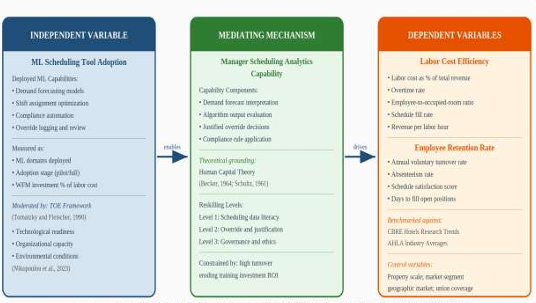
This paper examines the relationship between machine learning scheduling tool adoption as the independent variable and labor cost efficiency and employee retention rate as the dependent variables in high-turnover United States service operations, with an evidence base drawn from the hotel industry. The United States hotel industry presents the most acute and well-documented context for this inquiry: hotel employment stands at approximately 2.15 million workers, labor costs represent 32.4 percent of total hotel revenue, 65 percent of hotels report persistent staffing shortages, and the industry records one of the highest attrition rates in the United States service sector at 4.28 percent. Drawing on Human Capital Theory and the Technology-Organization-Environment framework, this paper conducts a systematic narrative literature review of peer-reviewed research on machine learning scheduling, workforce management, and high-turnover service operations. Four machine learning technique categories applied to scheduling optimization are reviewed and compared: supervised learning approaches, reinforcement learning, neural network demand forecasting, and constraint satisfaction hybrid methods. Barriers to effective adoption are mapped across the three framework dimensions and found to be concentrated in the organizational and environmental dimensions. The paper proposes a three-level reskilling framework for hotel operations managers and a four-stage implementation model with cost parameters and success metrics. A proposed mixed-methods empirical validation design specifies the research approach for primary data confirmation. The paper contributes the first integrated framework for machine learning scheduling adoption in high-turnover hotel operations that simultaneously addresses technology adoption barriers, workforce capability development, and labor cost efficiency measurement.
References
1) American Hotel and Lodging Association (AHLA). (2025a). 2025 state of the hotel industry report. AHLA.
https://www.ahla.com/sites/default/files/25_SOTI.pdf
2) American Hotel and Lodging Association (AHLA). (2025b). 65% of surveyed hotels report staffing shortages. AHLA.
https://www.ahla.com/news/65-surveyed-hotels-report-staffing-shortages
3) Association to Advance Collegiate Schools of Business (AACSB). (2020). 2020 guiding principles and standards for business accreditation. AACSB International.https://www.aacsb.edu/-/media/documents/accreditation/2020-aacsb-business-accreditation-standards-june-2023.pdf
4) Becker, G. S. (1964). Human capital: A theoretical and empirical analysis, with special reference to education. University of Chicago Press.
5) Brynjolfsson, E., Mitchell, T., and Rock, D. (2018). What can machines learn, and what does it mean for occupations and the economy? AEA Papers and Proceedings, 108, 43–47. https://doi.org/10.1257/pandp.20181019
6) Bureau of Labor Statistics, U.S. Department of Labor. (2024). Accommodation: NAICS 721 industry productivity and related data. https://www.bls.gov/iag/tgs/iag721.htm
7) CBRE Hotels Research. (2024a). New labor challenges arise in 2023. Trends in the Hotel Industry.
https://www.hotel-online.com/press_releases/release/new-labor-challenges-arise-in-2023/
8) CBRE Hotels Research. (2024b). All eyes on hotel operating costs in 2025: Lessons learned in 2024. CBRE.
https://www.cbre.com/insights/articles/all-eyes-on-operating-costs-in-2025-lessons-learned-in-2024
9) Liu, A., Lin, S., Chen, J., Wu, P., and Shen, Z. M. (2025). Machine learning for scheduling: A paradigm shift from solver-centric to data-centric approaches. arXiv. https://arxiv.org/abs/2512.22642
10) Ma, K., Yang, C., Xu, H., Lv, H., and Hong, F. (2024). A fast-flexible strategy based approach to solving employee scheduling problem considering soft work time. Scientific Reports, 14, 6170. https://doi.org/10.1038/s41598-024-56745-4
11) Mandelbaum, R., and Grigg, A. (2025). Hotel food and beverage: A bright spot in 2025. CBRE Hotels Research / Hospitalitynet. https://www.hospitalitynet.org/opinion/4129671.html
12) Nikopoulou, M., Kourouthanassis, P., Chasapi, G., Pateli, A., and Mylonas, N. (2023). Determinants of digital transformation in the hospitality industry: Technological, organizational, and environmental drivers. Sustainability,15(3),2736. https://doi.org/10.3390/su15032736
13) Schultz, T. W. (1961). Investment in human capital. American Economic Review, 51(1), 1–17. https://www.jstor.org/stable/1818907
14) Tornatzky, L. G., and Fleischer, M. (1990). The processes of technological innovation. Lexington Books.
15) Huang, M. H., and Rust, R. T. (2018). Artificial intelligence in service. Journal of Service Research, 21(2), 155–172.
https://doi.org/10.1177/1094670517752459
16) Nam, K., Dutt, C. S., Chathoth, P., Daghfous, A., and Khan, M. S. (2021). The adoption of artificial intelligence and robotics in the hotel industry: Prospects and challenges. Electronic Markets, 31(3), 553–574. https://doi.org/10.1007/s12525-020-00442-3
17) Wang, T., Aw, E. C. X., Tan, G. W. H., Sthapit, E., and Li, X. (2025). Can AI improve hotel service performance? A systematic review using ADO-TCM. Tourism and Hospitality Research. https://doi.org/10.1177/14673584251356817
18) Wirtz, J., Patterson, P. G., Kunz, W. H., Gruber, T., Lu, V. N., Paluch, S., and Martins, A. (2018). Brave new world: Service robots in the frontline. Journal of Service Management, 29(5), 907–931. https://doi.org/10.1108/JOSM-04-2018-0119
19) Cazzaniga, M., Jaumotte, F., Li, L., Melina, G., Panton, A. J., Pizzinelli, C., Rockall, E., and Mendes Tavares, M. (2024). Gen-AI: Artificial intelligence and the future of work (Staff Discussion Note SDN/2024/001). International Monetary Fund.
20) McKinsey Global Institute. (2022). The future of work after COVID-19. McKinsey and Company. https://www.mckinsey.com/featured-insights/future-of-work/the-future-of-work-after-covid-19
21) Shin, H., Ryu, J., and Jo, Y. (2025). Navigating artificial intelligence adoption in hospitality and tourism: Managerial insights, workforce transformation, and a future research agenda. International Journal of Hospitality Management, 128, 104187.
Downloads
Published
Issue
Section
License
Copyright (c) 2026 Salami Abdul Mohammed (Author)

This work is licensed under a Creative Commons Attribution 4.0 International License.












