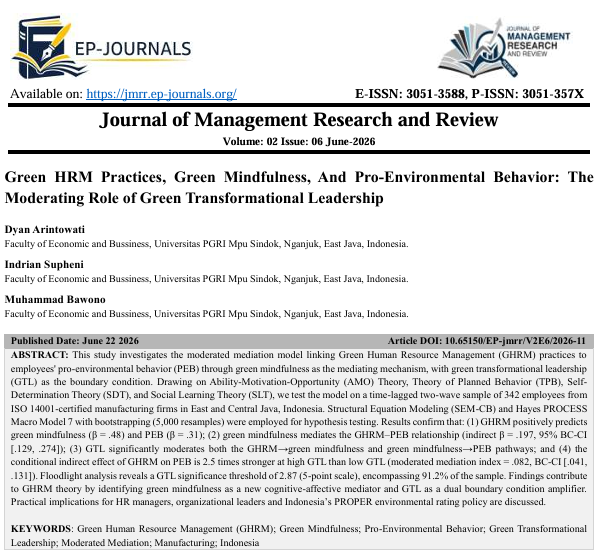
Green HRM Practices, Green Mindfulness, And Pro-Environmental Behavior: The Moderating Role of Green Transformational Leadership
DOI:
https://doi.org/10.65150/EP-jmrr/V2E6/2026-11Keywords:
Green Human Resource Management (GHRM), Green Mindfulness, Pro-Environmental Behavior, Green Transformational Leadership, Moderated Mediation, Manufacturing, IndonesiaAbstract
This study investigates the moderated mediation model linking Green Human Resource Management (GHRM) practices to employees' pro-environmental behavior (PEB) through green mindfulness as the mediating mechanism, with green transformational leadership (GTL) as the boundary condition. Drawing on Ability-Motivation-Opportunity (AMO) Theory, Theory of Planned Behavior (TPB), Self-Determination Theory (SDT), and Social Learning Theory (SLT), we test the model on a time-lagged two-wave sample of 342 employees from ISO 14001-certified manufacturing firms in East and Central Java, Indonesia. Structural Equation Modeling (SEM-CB) and Hayes PROCESS Macro Model 7 with bootstrapping (5,000 resamples) were employed for hypothesis testing. Results confirm that: (1) GHRM positively predicts green mindfulness (β = .48) and PEB (β = .31); (2) green mindfulness mediates the GHRM–PEB relationship (indirect β = .197, 95% BC-CI [.129, .274]); (3) GTL significantly moderates both the GHRM→green mindfulness and green mindfulness→PEB pathways; and (4) the conditional indirect effect of GHRM on PEB is 2.5 times stronger at high GTL than low GTL (moderated mediation index = .082, BC-CI [.041, .131]). Floodlight analysis reveals a GTL significance threshold of 2.87 (5-point scale), encompassing 91.2% of the sample. Findings contribute to GHRM theory by identifying green mindfulness as a new cognitive-affective mediator and GTL as a dual boundary condition amplifier. Practical implications for HR managers, organizational leaders and Indonesia’s PROPER environmental rating policy are discussed.
References
1) Aghaei, M., Aghaee, S., & Shahriari, M. (2024). The effect of green vision and green training on voluntary employee green behavior: The mediating role of green mindfulness. Environment, Development and Sustainability. https://doi.org/10.1007/s10668-024-05665-4
2) Ajzen, I. (1991). The theory of planned behavior. Organizational Behavior and Human Decision Processes, 50(2), 179–211. https://doi.org/https://doi.org/10.1016/0749-5978(91)90020-T
3) Appelbaum, E., Bailey, T., Berg, P., & Kalleberg, A. L. (2000). Manufacturing advantage: Why high-performance work systems pay off. ILR Press.
4) Bandura, A. (1977). Social learning theory. Prentice Hall.
5) Bawono, S., Harnani, S., & Wulandari, M. W. (2026). Green HRM, transformational leadership, and psychological safety as drivers of perceived labour productivity in Indonesian manufacturing. Discover Sustainability, 7(1), 438. https://doi.org/10.1007/s43621-026-02792-y
6) Bos-Nehles, A., Townsend, K., Cafferkey, K., & Trullen, J. (2023). Examining the ability, motivation and opportunity (AMO) framework in HRM research. International Journal of Management Reviews, 25(4), 725–739.
7) Brislin, R. W. (1970). Back-translation for cross-cultural research. Journal of Cross-Cultural Psychology, 1(3), 185–216.
8) Brown, K. W., & Ryan, R. M. (2003). The benefits of being present: Mindfulness and its role in psychological well-being. Journal of Personality and Social Psychology, 84(4), 822–848.
9) Cao, J., Sun, H., Cao, X., & Ma, H. (2026). Green transformational leadership and employees’ green behavior: A cross-level moderated mediation study. Frontiers in Psychology, 17, 1720404.
10) Chen, T., & Wu, Z. (2022). How to facilitate employees’ green behavior? The joint role of green HRM practice and green transformational leadership. Frontiers in Psychology, 13, 906869.
11) Chin, W. W., Thatcher, J. B., Wright, R. T., & Steel, D. (2013). Controlling for common method variance in PLS analysis: The measured latent marker variable approach. New Perspectives in Partial Least Squares, 169, 231–239.
12) Hair, J. F., Risher, J. J., Sarstedt, M., & Ringle, C. M. (2019). When to use and how to report the results of PLS-SEM. European Business Review, 31(1), 2–24.
13) Hayes, A. F. (2022). Introduction to mediation, moderation, and conditional process analysis (3rd ed.). Guilford Press.
14) Hu, L., & Bentler, P. M. (1999). Cutoff criteria for fit indexes in covariance structure analysis. Structural Equation Modeling, 6(1), 1–55.
15) Katz, I. M., Rauvola, R. S., Rudolph, C. W., & Zacher, H. (2022). Employee green behavior: A meta-analysis. Corporate Social Responsibility and Environmental Management, 29(6), 1703–1714.
16) Kim, Y. J., Kim, W. G., Choi, H. M., & Phetvaroon, K. (2019). The effect of green human resource management on hotel employees’ eco-friendly behavior and environmental performance. International Journal of Hospitality Management, 76, 83–93.
17) Kock, N. (2015). Common method bias in PLS-SEM: A full collinearity assessment approach. International Journal of E-Collaboration, 11(4), 1–10.
18) Li, W., & Xu, H. (2025). The impact of green human resource management on green mindfulness and employee well-being: A self-determination perspective. Current Psychology. https://doi.org/10.1007/s12144-025-08080-8
19) Ones, D. S., & Dilchert, S. (2012). Environmental sustainability at work: A call to action. Industrial and Organizational Psychology, 5(4), 444–466.
20) Podsakoff, P. M., MacKenzie, S. B., Lee, J. Y., & Podsakoff, N. P. (2003). Common method biases in behavioral research. Journal of Applied Psychology, 88(5), 879–903.
21) Renwick, D. W. S., Redman, T., & Maguire, S. (2013). Green human resource management: A review and research agenda. International Journal of Management Reviews, 15(1), 1–14.
22) Robertson, J. L., & Barling, J. (2013). Greening organizations through leaders’ influence on employees’ pro-environmental behaviors. Journal of Organizational Behavior, 34(2), 176–194.
23) Ryan, R. M., & Deci, E. L. (2020). Self-determination theory and the facilitation of intrinsic motivation, social development, and well-being. American Psychologist, 55(1), 68–78.
24) Spiller, S. A., Fitzsimons, G. J., Lynch, J. G., & McClelland, G. H. (2013). Spotlights, floodlights, and the magic number zero. Journal of Marketing Research, 50(2), 277–288.
25) Supheni, I., Ivada, E., Novianti, G. E., & Wiwin, W. (2023). Sustainable tourism from the perspective of tourists in Nganjuk, Indonesia. Journal of Sustainable Tourism and Entrepreneurship, 5(1), 1–18.
26) Tang, G., Chen, Y., Jiang, Y., Paillé, P., & Jia, J. (2018). Green human resource management practices: Scale development and validity. Asia Pacific Journal of Human Resources, 56(1), 31–55.
27) Xu, G., Xue, M., & Zhao, J. (2023). The relationship of AI opportunity perception and employee workplace well-being: A moderated mediation model. IJERPH, 20(3).
28) Yong, J. Y., Yusliza, M. Y., Ramayah, T., Jabbour, C. J. C., Sehnem, S., & Mani, V. (2019). Pathways towards sustainability in manufacturing organizations. Business Strategy and the Environment, 29(1), 212–228.
29) Zacher, H., Rudolph, C. W., & Katz, I. M. (2023). Employee green behavior as the core of environmentally sustainable organizations. Annual Review of Organizational Psychology and Organizational Behavior, 10, 465–494.
Downloads
Published
Issue
Section
License
Copyright (c) 2026 Dyan Arintowati, Indrian Supheni, Muhammad Bawono (Author)

This work is licensed under a Creative Commons Attribution 4.0 International License.












