Does Corporate Expansion Create Better Jobs?
DOI:
https://doi.org/10.65150/EP-jmrr/V2E7/2026-02Keywords:
listed firms, firm employment, pay quality, wage distribution, fixed effects, labour reallocationAbstract
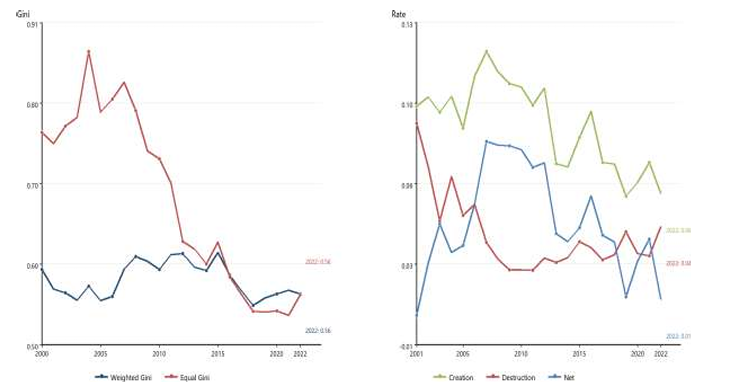
Whether employment growth is converted into better jobs is central to understanding how capital markets serve the real economy and how high-quality employment policies should be evaluated. Using a panel dataset of employees and wages among Chinese listed firms compiled from CSMAR, this study constructs a firm-level sample covering 5,329 listed firms and 56,589 firm-year observations from 2000 to 2022. It examines the dynamic tension between employment absorption and pay quality from five perspectives: aggregate expansion, industry and regional differentiation, wage distribution, job flows, and within-firm adjustment. The results show that the number of sample firms increased from 1,010 to 5,106, total employment rose from 2.75 million to 29.49 million, and total employee compensation payable expanded by approximately 108.8 times. In the log growth of total compensation, employment expansion and the increase in employment-weighted average wages contributed 50.6% and 49.4%, respectively. After controlling for firm fixed effects and year fixed effects, the elasticity of average wages with respect to employment is -0.326 and remains statistically significant after winsorisation, in a balanced panel, after excluding the financial sector, among normally listed firms, and in a first-difference model. The importance of this study lies in moving the employment debate from the quantity-oriented question of stabilising jobs to the distributional question of whether employment expansion improves pay quality. It addresses the limitations of prior research, which has tended to focus on employment counts, single-year cross-sections, or employer data from advanced economies, while paying less attention to the long-run co-evolution of wages and employment among Chinese listed firms.
References
Abowd, J. M., Kramarz, F., and Margolis, D. N. (1999). High Wage Workers and High Wage Firms. Econometrica, 67(2), 251–333.
Acemoglu, D., and Autor, D. (2011). Skills, Tasks and Technologies: Implications for Employment and Earnings. Handbook of Labor Economics, 4B, 1043–1171.
Acemoglu, D., and Restrepo, P. (2020). Robots and Jobs: Evidence from US Labor Markets. Journal of Political Economy, 128(6), 2188–2244.
Amiti, M., and Davis, D. R. (2012). Trade, Firms, and Wages: Theory and Evidence. Review of Economic Studies, 79(1), 1–36.
Autor, D. H., Dorn, D., Katz, L. F., Patterson, C., and Van Reenen, J. (2020). The Fall of the Labor Share and the Rise of Superstar Firms. Quarterly Journal of Economics, 135(2), 645–709.
Autor, D. H., Levy, F., and Murnane, R. J. (2003). The Skill Content of Recent Technological Change: An Empirical Exploration. Quarterly Journal of Economics, 118(4), 1279–1333.
Barth, E., Bryson, A., Davis, J. C., and Freeman, R. (2016). It's Where You Work: Increases in Earnings Dispersion across Establishments and Individuals in the United States. Journal of Labor Economics, 34(S2), S67–S97.
Bernard, A. B., Jensen, J. B., Redding, S. J., and Schott, P. K. (2007). Firms in International Trade. Journal of Economic Perspectives, 21(3), 105–130.
Bernard, A. B., Jensen, J. B., Redding, S. J., and Schott, P. K. (2012). The Empirics of Firm Heterogeneity and International Trade. Annual Review of Economics, 4, 283–313.
Bertrand, M., and Mullainathan, S. (2003). Enjoying the Quiet Life? Corporate Governance and Managerial Preferences. Journal of Political Economy, 111(5), 1043–1075.
Brown, C., and Medoff, J. (1989). The Employer Size-Wage Effect. Journal of Political Economy, 97(5), 1027–1059.
Cameron, A. C., Gelbach, J. B., and Miller, D. L. (2011). Robust Inference with Multiway Clustering. Journal of Business and Economic Statistics, 29(2), 238–249.
Card, D., Cardoso, A. R., Heining, J., and Kline, P. (2018). Firms and Labor Market Inequality: Evidence and Some Theory. Journal of Labor Economics, 36(S1), S13–S70.
Card, D., Heining, J., and Kline, P. (2013). Workplace Heterogeneity and the Rise of West German Wage Inequality. Quarterly Journal of Economics, 128(3), 967–1015.
Davis, S. J., and Haltiwanger, J. (1992). Gross Job Creation, Gross Job Destruction, and Employment Reallocation. Quarterly Journal of Economics, 107(3), 819–863.
Dunne, T., Foster, L., Haltiwanger, J., and Troske, K. R. (2004). Wage and Productivity Dispersion in United States Manufacturing: The Role of Computer Investment. Journal of Labor Economics, 22(2), 397–429.
Edmans, A. (2011). Does the Stock Market Fully Value Intangibles? Employee Satisfaction and Equity Prices. Journal of Financial Economics, 101(3), 621–640.
Edmans, A. (2012). The Link between Job Satisfaction and Firm Value, with Implications for Corporate Social Responsibility. Academy of Management Perspectives, 26(4), 1–19.
Flammer, C. (2015). Does Corporate Social Responsibility Lead to Superior Financial Performance? A Regression Discontinuity Approach. Management Science, 61(11), 2549–2568.
Guiso, L., Sapienza, P., and Zingales, L. (2015). The Value of Corporate Culture. Journal of Financial Economics, 117(1), 60–76.
Haltiwanger, J., Jarmin, R. S., and Miranda, J. (2013). Who Creates Jobs? Small versus Large versus Young. Review of Economics and Statistics, 95(2), 347–361.
Helpman, E., Itskhoki, O., and Redding, S. (2010). Inequality and Unemployment in a Global Economy. Econometrica, 78(4), 1239–1283.
Helpman, E., Itskhoki, O., Muendler, M. A., and Redding, S. J. (2017). Trade and Inequality: From Theory to Estimation. Review of Economic Studies, 84(1), 357–405.
Hsieh, C.-T., and Klenow, P. J. (2009). Misallocation and Manufacturing TFP in China and India. Quarterly Journal of Economics, 124(4), 1403–1448.
Lazear, E. P. (2000). Performance Pay and Productivity. American Economic Review, 90(5), 1346–1361.
Lazear, E. P., and Shaw, K. L. (2007). Personnel Economics: The Economist's View of Human Resources. Journal of Economic Perspectives, 21(4), 91–114.
Melitz, M. J. (2003). The Impact of Trade on Intra-Industry Reallocations and Aggregate Industry Productivity. Econometrica, 71(6), 1695–1725.
Nickell, S. J. (1996). Competition and Corporate Performance. Journal of Political Economy, 104(4), 724–746.
Oi, W. Y., and Idson, T. L. (1999). Firm Size and Wages. Handbook of Labor Economics, 3B, 2165–2214.
Petersen, M. A. (2009). Estimating Standard Errors in Finance Panel Data Sets: Comparing Approaches. Review of Financial Studies, 22(1), 435–480.
Song, J., Price, D. J., Guvenen, F., Bloom, N., and von Wachter, T. (2019). Firming Up Inequality. Quarterly Journal of Economics, 134(1), 1–50.
Syverson, C. (2011). What Determines Productivity? Journal of Economic Literature, 49(2), 326–365.
Downloads
Published
Issue
Section
License
Copyright (c) 2026 Dr. Gan Weixiang, Liu Qiaoran*, Dr. Xiao Mengfei, Dr. Ding Yuejun, Dr. Zhao Lin (Author)

This work is licensed under a Creative Commons Attribution 4.0 International License.












