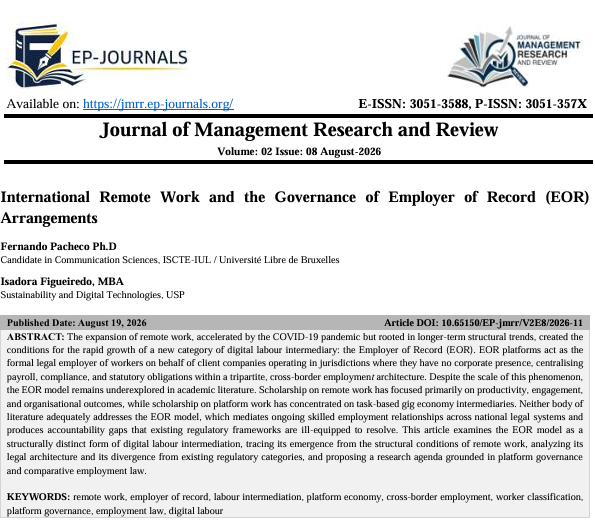
International Remote Work and the Governance of Employer of Record (EOR) Arrangements
DOI:
https://doi.org/10.65150/EP-jmrr/V2E8/2026-11Keywords:
remote work, employer of record, labour intermediation, platform economy, cross-border employment, worker classification, platform governance, employment law, digital labourAbstract
The expansion of remote work, accelerated by the COVID-19 pandemic but rooted in longer-term structural trends, created the conditions for the rapid growth of a new category of digital labour intermediary: the Employer of Record (EOR). EOR platforms act as the formal legal employer of workers on behalf of client companies operating in jurisdictions where they have no corporate presence, centralising payroll, compliance, and statutory obligations within a tripartite, cross-border employment architecture. Despite the scale of this phenomenon, the EOR model remains underexplored in academic literature. Scholarship on remote work has focused primarily on productivity, engagement, and organisational outcomes, while scholarship on platform work has concentrated on task-based gig economy intermediaries. Neither body of literature adequately addresses the EOR model, which mediates ongoing skilled employment relationships across national legal systems and produces accountability gaps that existing regulatory frameworks are ill-equipped to resolve. This article examines the EOR model as a structurally distinct form of digital labour intermediation, tracing its emergence from the structural conditions of remote work, analyzing its legal architecture and its divergence from existing regulatory categories, and proposing a research agenda grounded in platform governance and comparative employment law.
References
1) Adams-Prassl, J. (2022). Uber BV v Aslam: '[W]ork relations … cannot safely be left to contractual regulation'. Industrial Law Journal, 51(4), 955–966. https://doi.org/10.1093/indlaw/dwac027
2) Adams-Prassl, J., Aloisi, A., Countouris, N., De Stefano, V., & Rainone, S. (2025). Protecting platform workers in the European Union. European Labour Law Journal, 16(4). https://doi.org/10.1177/20319525251376935
3) Administrative Commission for the Coordination of Social Security Systems. (2023). Framework Agreement on the application of Article 16(1) of Regulation (EC) No. 883/2004 in cases of habitual cross-border telework. European Commission.
4) Aloisi, A. (2016). Commoditized workers: Case study research on labor law issues arising from a set of on-demand/gig economy platforms. Comparative Labor Law & Policy Journal, 37(3), 653–690.
5) Barge, J. K. (1994). Putting leadership back to work. Management Communication Quarterly, 8(1), 95–109.
https://doi.org/10.1177/0893318994008001005
6) Baruch, Y. (2001). The status of research on teleworking and an agenda for future research. International Journal of Management Reviews, 3(2), 113–129. https://doi.org/10.1111/1468-2370.00058
7) Belzunegui-Eraso, A., & Erro-Garcés, A. (2020). Teleworking in the context of the Covid-19 crisis. Sustainability, 12(9), 3662.
https://doi.org/10.3390/su12093662
8) Blackett, A. (2020). Everyday transgressions: Domestic workers' transnational challenge to international labor law. Cornell University Press.
9) Bloom, N., Liang, J., Roberts, J., & Ying, Z. J. (2015). Does working from home work? Evidence from a Chinese experiment. The Quarterly Journal of Economics, 130(1), 165–218. https://doi.org/10.1093/qje/qju032
10) Castells, M. (2009). Communication power. Oxford University Press.
11) Castells, M. (2013). Networks of outrage and hope: Social movements in the internet age. Polity Press.
12) Chamber of Commerce of the United States v. NLRB, 723 F. Supp. 3d 498 (E.D. Tex. 2024).
13) Clancy, M. (2020). The case for remote work. Iowa State University Department of Economics Working Paper.
https://doi.org/10.31235/osf.io/cg7n6
14) Court of Justice of the European Union. (2020). Case C-610/18, AFMB Ltd and Others v Raad van bestuur van de Sociale verzekeringsbank, Judgment of 16 September 2020. ECLI:EU:C:2020:713.
15) Court of Justice of the European Union. (2023). Case C-710/21, IEF Service GmbH v HB, Judgment of 16 February 2023.
ECLI:EU:C:2023:116.
16) Dash, S. (2006). Human capital as a basis of comparative advantage equations in services outsourcing: A cross country comparative study. 2006 International Conference on Information and Communication Technologies and Development.
https://doi.org/10.1109/ICTD.2006.301854
17) Davidov, G. (2004). Joint employer status in triangular employment relationships. British Journal of Industrial Relations, 42(4), 727–
746. https://doi.org/10.1111/j.1467-8543.2004.00338.x
18) De Stefano, V. (2016). The rise of the 'just-in-time workforce': On-demand work, crowdwork, and labor protection in the gig economy. Comparative Labor Law & Policy Journal, 37(3), 471–503.
19) Directive 2008/94/EC of the European Parliament and of the Council of 22 October 2008 on the protection of employees in the event of the insolvency of their employer. Official Journal of the European Union, L 283, 36–42.
20) Directive (EU) 2024/2831 of the European Parliament and of the Council of 23 October 2024 on improving working conditions in platform work. Official Journal of the European Union, L 2024/2831.
21) Dubé, L., & Robey, D. (2009). Surviving the paradoxes of virtual teamwork. Information Systems Journal, 19(1), 3–30.
https://doi.org/10.1111/j.1365-2575.2008.00313.x
22) European Trade Union Institute. (2023). The future of remote work (N. Countouris, V. De Stefano, A. Piasna, & S. Rainone, Eds.).
ETUI.
23) Eurostat. (2026). Employed persons working from home by professional status [Data set]. https://doi.org/10.2908/lfsa_ehomp (data extracted 17 August 2026)
24) Felstead, A., Jewson, N., & Walters, S. (2005). Changing places of work. Palgrave Macmillan.
25) Ferrazzi, K. (2014, December). Getting virtual teams right. Harvard Business Review, 92(12).
26) Freedland, M. (2007). Application of labour and employment law beyond the contract of employment. International Labour Review, 146(1–2), 3–20. https://doi.org/10.1111/j.1564-913X.2007.00001.x
27) Fudge, J. (2006). Fragmenting work and fragmenting organizations: The contract of employment and the scope of labour regulation. Osgoode Hall Law Journal, 44(4), 609–648.
28) Gereffi, G., & Sturgeon, T. (2004). Globalization, employment, and economic development: A briefing paper. MIT Industrial Performance Center.
29) Gigant, T., Cañibano, A., & Alfes, K. (2026). Insider to what? A dynamic analysis of freelancers' perceived insider/outsider status through the lens of the psychological contract. Journal of Occupational and Organizational Psychology, 99(1), e70105.
https://doi.org/10.1111/joop.70105
30) Grušić, U. (2023). Private international law aspects of the gig economy. Journal of Private International Law, 19(1), 1–35.
31) Haddud, A., & McAllen, D. (2018). Digital workplace management: Exploring aspects related to culture, innovation, and leadership. Portland International Conference on Management of Engineering and Technology (PICMET).
32) Hoch, J. E., & Dulebohn, J. H. (2017). Team personality composition, emergent leadership and shared leadership in virtual teams: A theoretical framework. Human Resource Management Review, 27(4), 678–693. https://doi.org/10.1016/j.hrmr.2016.12.012
33) Howell, J. M., & Hall-Merenda, K. E. (1999). The ties that bind: The impact of leader-member exchange, transformational and transactional leadership, and distance on predicting follower performance. Journal of Applied Psychology, 84, 680–694.
34) ILO. (2006). Employment Relationship Recommendation, 2006 (No. 198). International Labour Organization.
35) ILO. (2023). World employment and social outlook 2023: The value of essential work. International Labour Organization.
36) Illegems, V., Verbeke, A., & S'Jegers, R. (2001). The organizational context of teleworking implementation. Technological Forecasting and Social Change, 68(3), 275–291. https://doi.org/10.1016/S0040-1625(00)00105-0
37) International Workplace Group. (2018). The end of the traditional 9-5? [Global Workspace Survey]. IWG.
38) Ishmetova, S. (2024). Globalization and the international division of labor: Legal challenges and perspectives. International Journal of Law Justice and Jurisprudence, 4(1), 14–17. https://doi.org/10.22271/2790-0673.2024.v4.i1a.89
39) Jolkkonen, S. (2022). Oikeusvertaileva tutkielma kolmikantaisesta EOR-järjestelystä Suomessa ja Alankomaissa [Master's thesis, University of Helsinki]. http://hdl.handle.net/10138/350184
40) Judy, R. W., & d'Amico, C. (1997). Workforce 2020: Work and workers in the 21st century. Hudson Institute, Herman Kahn Center.
41) Kenney, M., & Zysman, J. (2016). The rise of the platform economy. Issues in Science and Technology, 32(3), 61–69.
42) Khan, H., & Islam, M. S. (2006). Outsourcing, migration, and brain drain in the global economy: Issues and evidence (SSRN Working Paper No. 004/2006). https://doi.org/10.2139/ssrn.1606106
43) Kizza, J. M. (2013). Ethical and social issues in the information age (5th ed.). Springer. https://doi.org/10.1007/978-1-4471-4990-3
44) Kratzer, J., Leenders, R. T. A. J., & Van Engelen, J. M. L. (2006). Team polarity and creative performance in innovation teams. Creativity and Innovation Management, 15(1), 96–104.
45) Maric, S., Schuessler, E. S., & Thäter, L. (2024). Neither employment nor self-employment: Avenues towards functional platform-mediated work systems. British Journal of Industrial Relations, 63(2), 287–304. https://doi.org/10.1111/bjir.12855
46) Marginson, P. (2016). Governing work and employment relations in an internationalized economy: The institutional challenge. ILR Review, 69(5), 1009–1034. https://doi.org/10.1177/0019793916654891
47) Marsden, D. (2004). The network economy and models of the employment contract. British Journal of Industrial Relations, 42(4), 659–684. https://doi.org/10.1111/j.1467-8543.2004.00335.x
48) National Labor Relations Board. (2023). Standard for determining joint-employer status: Final rule. 88 Fed. Reg. 73946 (October 27, 2023).
49) Neufeld, D. J., Wan, Z., & Fang, Y. (2010). Remote leadership, communication effectiveness and leader performance. Group Decision and Negotiation, 19(3), 227–246. https://doi.org/10.1007/s10726-008-9142-x
50) New Jersey Revised Statutes § 34:11-58.1. Contractor and Subcontractor Worker Protection Act.
51) Niezna, M., & Davidov, G. (2023). Consent in contracts of employment. The Modern Law Review, 86(5), 1134–1165. https://doi.org/10.1111/1468-2230.12802
52) Nilles, J. M. (1975). Telecommunications and organizational decentralization. IEEE Transactions on Communications, 23(10), 1142–1147. https://doi.org/10.1109/TCOM.1975.1092687
53) Nilles, J. M. (1988). Making telecommuting happen: A guide for telemanagers and telecommuters. Van Nostrand Reinhold.
54) Nogueira, A. M., & Patini, A. C. (2012). Trabalho remoto e desafios dos gestores. RAI - Revista de Administração e Inovação, 9(4), 121–152.
55) OECD. (2021). Teleworking in the COVID-19 pandemic: Trends and prospects. OECD Policy Responses to Coronavirus (COVID-19). OECD Publishing. https://doi.org/10.1787/72a416b6-en
56) Pass, S., & Ridgway, M. (2022). An informed discussion of the impact of COVID-19 and 'enforced' remote working on employee engagement. Human Resource Development International, 25(2), 236–249. https://doi.org/10.1080/13678868.2022.2048605
57) Paus, E., & Shapiro, H. (2007). Capturing the benefits from offshore outsourcing in developing countries: The case for active policies. In Global Capitalism Unbound (pp. 215–228). Palgrave Macmillan. https://doi.org/10.1057/9780230608849_13
58) Pettersson, I. (2024). Employer on paper: The EOR model under Swedish labour law [Master's thesis, Uppsala University].
59) Prassl, J. (2016). The concept of the employer. Oxford University Press.
60) Prassl, J. (2018). Humans as a service: The promise and perils of work in the gig economy. Oxford University Press.
61) Rajeev, M., & Vani, B. P. (2008). Problems and prospects of business process outsourcing industry: A case study of India (MPRA Paper No. 9834). Institute for Social and Economic Change. http://mpra.ub.uni-muenchen.de/9834/
62) Rak, P. (2025). Employer of record: Challenges for labour law. In M. Švec & J. Žuľová (Eds.), Algoritmy a inklúzia: Pracovné právo v ére technologickej a spoločenskej transformácie (pp. 116–126). ŠafárikPress. https://doi.org/10.33542/AAI-0456-9
63) Reljanović, M. (2024). "Uslužni poslodavac" (Employer of Record) i rešavanje radnopravnog statusa frilensera. Revija za radno i socijalno pravo, XXVIII(1), 101–123. https://doi.org/10.56461/rrsp2401_05
64) Salvatori, A. (2010). Labour contract regulations and workers' wellbeing: International longitudinal evidence. Labour Economics, 17(4), 667–678. https://doi.org/10.1016/j.labeco.2010.01.003
65) Schober, P., Boer, C., & Schwarte, L. A. (2018). Correlation coefficients: Appropriate use and interpretation. Anesthesia and Analgesia, 126(5), 1763–1768. https://doi.org/10.1213/ANE.0000000000002864
66) Silva, F. A. P., Velez, M. J. P., & Borrego, P. J. V. B. M. (2024). Perceived leadership effectiveness and turnover intention in remote work: The mediating role of communication. Caderno Pedagógico, 21(3), e3200. https://doi.org/10.54033/cadpedv21n3-093
67) Srnicek, N. (2017). Platform capitalism. Polity Press.
68) Uber BV v Aslam [2021] UKSC 5.
69) Van Schadewijk, M. (2021). The notion of 'employer': Towards a uniform European concept? European Labour Law Journal, 12(3), 363–386. https://doi.org/10.1177/20319525211020573
70) Verified Market Research. (2026). Global employer of record market size, by service, by end-user industry, by organization size, and by geography (Report ID 464450). https://www.verifiedmarketresearch.com/product/employer-of-record-market/
71) Wood, A. J., Graham, M., Lehdonvirta, V., & Hjorth, I. (2019). Good gig, bad gig: Autonomy and algorithmic control in the global gig economy. Work, Employment and Society, 33(1), 56–75. https://doi.org/10.1177/0950017018785616
72) Wright, C. F., Wailes, N., Bamber, G. J., & Lansbury, R. D. (2017). Beyond national systems, towards a 'gig economy'? A research agenda for international and comparative employment relations. Employee Responsibilities and Rights Journal, 29(4), 247–257. https://doi.org/10.1007/s10672-017-9308-2
Downloads
Published
Issue
Section
License
Copyright (c) 2026 Fernando Pacheco Ph.D , Isadora Figueiredo, MBA (Author)

This work is licensed under a Creative Commons Attribution 4.0 International License.












