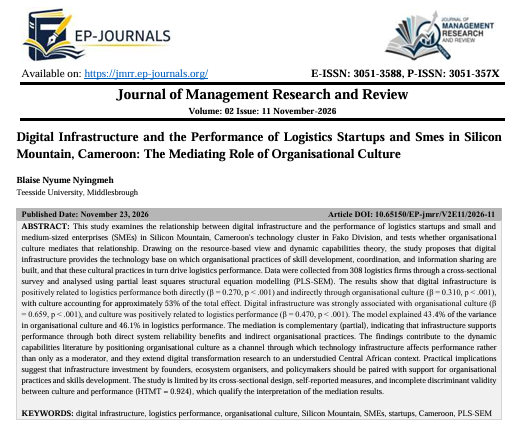
Digital Infrastructure and the Performance of Logistics Startups and Smes in Silicon Mountain, Cameroon: The Mediating Role of Organisational Culture
DOI:
https://doi.org/10.65150/EP-jmrr/V2E11/2026-11Keywords:
digital infrastructure, logistics performance, organisational culture, Silicon Mountain, SMEs, startups, Cameroon, PLS-SEMAbstract
This study examines the relationship between digital infrastructure and the performance of logistics startups and small and medium-sized enterprises (SMEs) in Silicon Mountain, Cameroon's technology cluster in Fako Division, and tests whether organisational culture mediates that relationship. Drawing on the resource-based view and dynamic capabilities theory, the study proposes that digital infrastructure provides the technology base on which organisational practices of skill development, coordination, and information sharing are built, and that these cultural practices in turn drive logistics performance. Data were collected from 308 logistics firms through a cross-sectional survey and analysed using partial least squares structural equation modelling (PLS-SEM). The results show that digital infrastructure is positively related to logistics performance both directly (β = 0.270, p < .001) and indirectly through organisational culture (β = 0.310, p < .001), with culture accounting for approximately 53% of the total effect. Digital infrastructure was strongly associated with organisational culture (β = 0.659, p < .001), and culture was positively related to logistics performance (β = 0.470, p < .001). The model explained 43.4% of the variance in organisational culture and 46.1% in logistics performance. The mediation is complementary (partial), indicating that infrastructure supports performance through both direct system reliability benefits and indirect organisational practices. The findings contribute to the dynamic capabilities literature by positioning organisational culture as a channel through which technology infrastructure affects performance rather than only as a moderator, and they extend digital transformation research to an understudied Central African context. Practical implications suggest that infrastructure investment by founders, ecosystem organisers, and policymakers should be paired with support for organisational practices and skills development. The study is limited by its cross-sectional design, self-reported measures, and incomplete discriminant validity between culture and performance (HTMT = 0.924), which qualify the interpretation of the mediation results.
References
1) Barney, J. (1986). Organizational culture: Can it be a source of sustained competitive advantage? Academy of Management Review, 11(3),
656–665. https://doi.org/10.5465/amr.1986.4306261
2) Barney, J. (1991). Firm resources and sustained competitive advantage. Journal of Management, 17(1), 99–120.
https://doi.org/10.1177/014920639101700108
3) Brynjolfsson, E. (1993). The productivity paradox of information technology. Communications of the ACM, 36(12), 66–77.
https://doi.org/10.1145/163298.163309
4) Chow, G., Heaver, T. D., & Henriksson, L. E. (1994). Logistics performance: Definition and measurement. International Journal of Physical Distribution & Logistics Management, 24(1), 17–28.
5) Cohen, J. (1988). Statistical power analysis for the behavioral sciences (2nd ed.). Lawrence Erlbaum Associates.
6) Eisenhardt, K. M., & Martin, J. A. (2000). Dynamic capabilities: What are they? Strategic Management Journal, 21(10–11), 1105–1121.
7) Hair, J. F., Hult, G. T. M., Ringle, C. M., & Sarstedt, M. (2021). A primer on partial least squares structural equation modeling (PLS-SEM) (3rd ed.). Sage.
8) Hair, J. F., Risher, J. J., Sarstedt, M., & Ringle, C. M. (2019). When to use and how to report the results of PLS-SEM. European Business Review, 31(1), 2–24. https://doi.org/10.1108/EBR-11-2018-0203
9) Hautala-Kankaanpää, T. (2022). The impact of digitalization on firm performance: Examining the role of digital culture and the effect of supply chain capability. Business Process Management Journal, 28(8). https://doi.org/10.1108/BPMJ-03-2022-0122
10) Henseler, J., Ringle, C. M., & Sarstedt, M. (2015). A new criterion for assessing discriminant validity in variance-based structural equation modeling. Journal of the Academy of Marketing Science, 43(1), 115–135. https://doi.org/10.1007/s11747-014-0403-8
11) Holm, S. (1979). A simple sequentially rejective multiple test procedure. Scandinavian Journal of Statistics, 6(2), 65–70.
12) Kock, N. (2015). Common method bias in PLS-SEM: A full collinearity assessment approach. International Journal of e-Collaboration, 11(4), 1–10. https://doi.org/10.4018/ijec.2015100101
13) Kuaban, G. S., Nkemeni, V., Nwobodo, O. J., Czekalski, P., & Mieyeville, F. (2024). Internet of Things adoption in technology ecosystems within the Central African region: The case of Silicon Mountain. Future Internet, 16(10), Article 376.
https://doi.org/10.3390/fi16100376
14) Kuteyi, D., & Winkler, H. (2022). Logistics challenges in Sub-Saharan Africa and opportunities for digitalization. Sustainability, 14(4), Article 2399. https://doi.org/10.3390/su14042399
15) Leonard-Barton, D. (1992). Core capabilities and core rigidities: A paradox in managing new product development. Strategic Management Journal, 13(S1), 111–125. https://doi.org/10.1002/smj.4250131009
16) Martínez-Caro, E., Cegarra-Navarro, J. G., & Alfonso-Ruiz, F. J. (2020). Digital technologies and firm performance: The role of digital organisational culture. Technological Forecasting and Social Change, 154, Article 119962.
https://doi.org/10.1016/j.techfore.2020.119962
17) Meade, A. W., & Craig, S. B. (2012). Identifying careless responses in survey data. Psychological Methods, 17(3), 437–455.
https://doi.org/10.1037/a0028085
18) Mentzer, J. T., & Konrad, B. P. (1991). An efficiency/effectiveness approach to logistics performance analysis. Journal of Business Logistics, 12(1), 33–62.
19) Nitzl, C., Roldán, J. L., & Cepeda, G. (2016). Mediation analysis in partial least squares path modeling: Helping researchers discuss more sophisticated models. Industrial Management & Data Systems, 116(9), 1849–1864. https://doi.org/10.1108/IMDS-07-2015-0302
20) Ntule, N. D., Ongo Nkoa, B. E., & Fuein, V. (2024). Effect of digitalization on logistics performance among logistics related companies in Cameroon. American Journal of Supply Chain Management, 9(3), 1–16. https://doi.org/10.47672/ajscm.2099
21) Pradana, M., Silvianita, A., Syarifuddin, S., & Renaldi, R. (2022). The implication of digital organisational culture on firm performance. Frontiers in Psychology, 13, Article 840699. https://doi.org/10.3389/fpsyg.2022.840699
22) Ringle, C. M., Wende, S., & Becker, J.-M. (2024). SmartPLS 4 [Computer software]. SmartPLS. https://www.smartpls.com
23) Schein, E. H. (2010). Organizational culture and leadership (4th ed.). Jossey-Bass.
24) Shmueli, G., Sarstedt, M., Hair, J. F., Cheah, J.-H., Ting, H., Vaithilingam, S., & Ringle, C. M. (2019). Predictive model assessment in PLS-SEM: Guidelines for using PLSpredict. European Journal of Marketing, 53(11), 2322–2347. https://doi.org/10.1108/EJM-02-2019-0189
25) Teece, D. J., Pisano, G., & Shuen, A. (1997). Dynamic capabilities and strategic management. Strategic Management Journal, 18(7), 509–533.
26) Verhoef, P. C., Broekhuizen, T., Bart, Y., Bhattacharya, A., Dong, J. Q., Fabian, N., & Haenlein, M. (2021). Digital transformation: A multidisciplinary reflection and research agenda. Journal of Business Research, 122, 889–901.
https://doi.org/10.1016/j.jbusres.2019.09.022
27) Vial, G. (2019). Understanding digital transformation: A review and a research agenda. The Journal of Strategic Information Systems, 28(2), 118–144. https://doi.org/10.1016/j.jsis.2019.01.003
28) World Bank. (2023). Logistics Performance Index 2023 [Data set]. https://lpi.worldbank.org/international/global
29) Zhao, X., Lynch, J. G., Jr., & Chen, Q. (2010). Reconsidering Baron and Kenny: Myths and truths about mediation analysis. Journal of Consumer Research, 37(2), 197–206. https://doi.org/10.1086/651257
Downloads
Published
Issue
Section
License
Copyright (c) 2026 Blaise Nyume Nyingmeh (Author)

This work is licensed under a Creative Commons Attribution 4.0 International License.