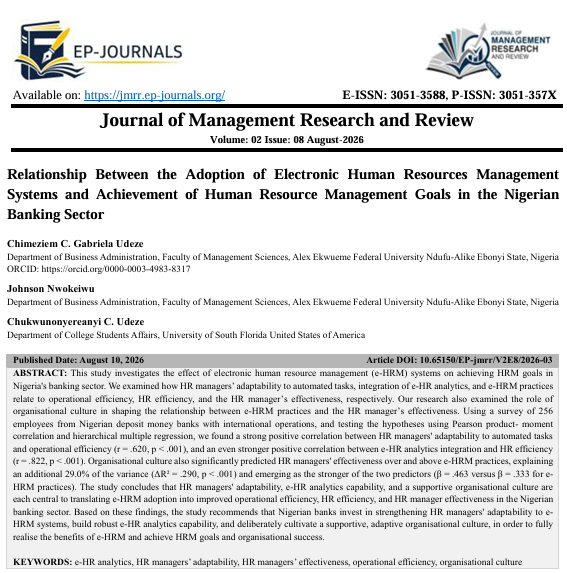
Relationship Between the Adoption of Electronic Human Resources Management Systems and Achievement of Human Resource Management Goals in the Nigerian Banking Sector
DOI:
https://doi.org/10.65150/EP-jmrr/V2E8/2026-03Keywords:
e-HR analytics, HR managers’ adaptability, HR managers’ effectiveness, operational efficiency, organisational cultureAbstract
This study investigates the effect of electronic human resource management (e-HRM) systems on achieving HRM goals in Nigeria's banking sector. We examined how HR managers’ adaptability to automated tasks, integration of e-HR analytics, and e-HRM practices relate to operational efficiency, HR efficiency, and the HR manager’s effectiveness, respectively. Our research also examined the role of organisational culture in shaping the relationship between e-HRM practices and the HR manager’s effectiveness. Using a survey of 256 employees from Nigerian deposit money banks with international operations, and testing the hypotheses using Pearson product- moment correlation and hierarchical multiple regression, we found a strong positive correlation between HR managers' adaptability to automated tasks and operational efficiency (r = .620, p < .001), and an even stronger positive correlation between e-HR analytics integration and HR efficiency (r = .822, p < .001). Organisational culture also significantly predicted HR managers' effectiveness over and above e-HRM practices, explaining an additional 29.0% of the variance (ΔR² = .290, p < .001) and emerging as the stronger of the two predictors (β = .463 versus β = .333 for e-HRM practices). The study concludes that HR managers' adaptability, e-HR analytics capability, and a supportive organisational culture are each central to translating e-HRM adoption into improved operational efficiency, HR efficiency, and HR manager effectiveness in the Nigerian banking sector. Based on these findings, the study recommends that Nigerian banks invest in strengthening HR managers' adaptability to e-HRM systems, build robust e-HR analytics capability, and deliberately cultivate a supportive, adaptive organisational culture, in order to fully realise the benefits of e-HRM and achieve HRM goals and organisational success.
References
1) Abubakar, B., & Akpan, U. I. (2020). An examination of appraisal techniques: Human resource management use for upgrading the employees in banking sector in Nigeria. The International Journal of Innovative Research & Development, 9(6), 130–139.https://doi.org/10.24940/ijird/2020/v9/i6/JUN20015
2) Abuhantash, A. (2023). The future of HR management: Exploring the potential of e-HRM for improving employee experience and organizational outcomes. World Journal of Advanced Research and Reviews, 18(2), 647–651.https://doi.org/10.30574/wjarr.2023.18.2.0883
3) Aduku, D. J., Hassan, O. M., & Nafiu, A. T. (2021). Descriptive analysis of perceived change acceptance and change rejection in banks in North Central Nigeria. Business Excellence and Management, 11(2), 52–68. https://doi.org/10.24818/beman/2021.11.2-04
4) Alebiosu, J. O., Salau, O. P., Atolagbe, T. M., & Dada, A. E. (2023). Bolstering the role of human resource information system on employees’ behavioural outcomes of selected manufacturing firms in Nigeria. Heliyon, 9(1), Article e12785.https://doi.org/10.1016/j.heliyon.2022.e12785
5) Ayari, A., Alzayer, A., Albarboori, A., Salem, M., & Sanosi, S. (2022). The effectiveness of E-HRM adoption in the banking industry of Bahrain during the pandemic. International Journal of Research in Human Resource Management, 4(1), 30–38.https://doi.org/10.33545/26633213.2022.v4.i1a.86
6) Barbulescu, F.-M., Vasiluță-Ştefănescu, M., Stoicov, I., Coman, C., & Coman, E. (2024). Strategic management of internal employer branding: Guerilla strategies to engage and retain top employees in a challenging workforce environment. Frontiers in Communication, 9, Article 1402125. https://doi.org/10.3389/fcomm.2024.1402125
7) Barney, J. B. (1991). Firm resources and sustained competitive advantage. Journal of Management, 17(1), 99–120.https://doi.org/10.1177/014920639101700108
8) Central Bank of Nigeria. (2019, October 16). Implementation of the cashless policy. https://www.cbn.gov.ng/Cashless/
9) Central Bank of Nigeria. (2024, May). Monthly economic report.
10) D’Angelo, C., Gazzaroli, D., Corvino, C., & Gozzoli, C. (2022). Changes and challenges in human resources management: An analysis of human resources roles in a bank context after COVID-19. Sustainability, 14(8), Article 4847. https://doi.org/10.3390/su14084847
11) De Alwis, A. C., Andrlić, B., & Sostar, M. (2022). The influence of E-HRM on modernizing the role of HRM context. Economies, 10(8), Article 181. https://doi.org/10.3390/economies10080181
12) dela Cruz, M. M., & Cabaluna, A. Y. (2022). Investigating human resource practices and its impact on employee performance in selected banks in the Philippines. Journal of Business and Management Studies, 4(1), 233–256. https://doi.org/10.32996/jbms.2022.4.1.26
13) Destriani, R., Adhitama, R. Y., Sensuse, D. I., Hidayat, D. S., & Purwaningsih, E. H. (2024). Challenges and technology trends in implementing a human resource management system: A systematic literature review. Journal of Information Systems Engineering and Business Intelligence, 10(3), 355–367. https://doi.org/10.20473/jisebi.10.3.355-367
14) Duffey, C. (2019). Superhuman innovation: Transforming business with artificial intelligence. Kogan Page.
15) Faqihi, A., & Miah, S. J. (2023). Artificial intelligence-driven talent management system: Exploring the risks and options for constructing a theoretical foundation. Journal of Risk and Financial Management, 16(1), Article 31. https://doi.org/10.3390/jrfm16010031
16) Fernandes, P., Pereira, R., & Wiedenhöft, G. (2023). Organizational culture and the individuals’ discretionary behaviors at work: A cross-cultural analysis. Frontiers in Sociology, 8, Article 1190488. https://doi.org/10.3389/fsoc.2023.1190488
17) Kareska, K. (2023). Human resource management strategies for achieving competitive advantage of organizations (SSRN Working Paper). https://doi.org/10.2139/ssrn.4514970
18) Kero, C. A., & Bogale, A. T. (2023). A systematic review of resource-based view and dynamic capabilities of firms and future research avenues. International Journal of Sustainable Development and Planning, 18(10), 3137–3154. https://doi.org/10.18280/ijsdp.181016
19) Kess-Momoh, A. J., Tula, S. T., Bello, B. G., Omotoye, G. B., & Daraojimba, A. I. (2024). Strategic human resource management in the 21st century: A review of trends and innovations. World Journal of Advanced Research and Reviews, 21(1), 746–757.https://doi.org/10.30574/wjarr.2024.21.1.0105
20) Kola-Oyeneyin, E., Kuyoro, M., & Olanrewaju, T. (2020, September). Harnessing Nigeria’s fintech potential. McKinsey & Company. https://www.mckinsey.com/featured-insights/middle-east-and-africa/harnessing-nigerias-fintech-potential
21) Krejcie, R. V., & Morgan, D. W. (1970). Determining sample size for research activities. Educational and Psychological Measurement, 30(3), 607–610. https://doi.org/10.1177/001316447003000308
22) Kyari, A. K., & Akinwale, Y. O. (2020). An assessment of the level of adoption of financial technology by Nigerian banks. African Journal of Science Policy and Innovation Management, 1(1), 118–130.
23) Lottu, O. A., Abdul, A. A., Daraojimba, D. O., Alabi, A. M., John-Ladega, A. A., & Daraojimba, C. (2023). Digital transformation in banking: A review of Nigeria’s journey to economic prosperity. International Journal of Advanced Economics, 5(8), 215–238.https://doi.org/10.51594/ijae.v5i8.572
24) Madanchian, M., & Taherdoost, H. (2025). Barriers and enablers of AI adoption in human resource management: A critical analysis of organizational and technological factors. Information, 16(1), Article 51. https://doi.org/10.3390/info16010051
25) Marr, B. (2020). The intelligence revolution: Transforming your business with AI. Kogan Page.
26) Milon, M., Alam, M. A., & Pias, M. H. (2022). Exploring the key practices of E-HRM in place of traditional HRM: A study on private industry of Bangladesh. Journal of Human Resource and Sustainability Studies, 10(3), 403–417.https://doi.org/10.4236/jhrss.2022.103024
27) Muktamar, A., & Nurnaningsih, N. A. (2024). Breaking barriers: Unravelling the complexities of HR tech integration. Management Studies and Business Journal (Productivity), 1(2), 224–237. https://doi.org/10.62207/8c2wpp17
28) Mushumba, A., & Nyirenda, M. (2025). Effects of human resource information system functions on performance of public institutions: A case of Zambia Air Force. Open Journal of Business and Management, 13(1), 24–40. https://doi.org/10.4236/ojbm.2025.131002
29) Njoku, E., Ruël, H., Rowlands, H., Evans, L., & Murdoch, M. (2019). An analysis of the contribution of E-HRM to sustaining business performance. In R. Bissola & B. Imperatori (Eds.), HRM 4.0 for human-centered organizations (Advanced Series in Management, Vol. 23, pp. 21–39). Emerald Publishing Limited. https://doi.org/10.1108/S1877-636120190000023003
30) Ogunode, O. A., Akintoye, I. R., Ajayi, M., & Joshua, A. A. (2022). Cyber security and financial innovation of selected deposit money banks in Nigeria. Universal Journal of Accounting and Finance, 10(3), 643–652. https://doi.org/10.13189/ujaf.2022.100302
31) Ogunode, O. A., & Akintoye, R. I. (2023). Financial technologies and financial inclusion in emerging economies: Perspectives from Nigeria. Asian Journal of Economics, Business and Accounting, 23(1), 38–54. https://doi.org/10.9734/ajeba/2023/v23i1915
32) Osuma, G. O., Babajide, A. A., Ikpefan, O. A., Nwuba, E. B., & Jegede, P. W. (2019). Effects of global decline in oil price on the financial performance of selected deposit money banks in Nigeria. International Journal of Energy Economics and Policy, 9(3), 187–195.https://doi.org/10.32479/ijeep.7514
33) Pahuja, S., Mahlawat, S., Kumar, V., Sah, R. K., Paliwal, M., Singh, S., & Kumar, M. (2024). Gaining competitive advantage status through human resource practices: A study of Indian banks. Social Sciences & Humanities Open, 9, Article 100804.https://doi.org/10.1016/j.ssaho.2024.100804
34) Papadionysiou, E., & Myloni, B. (2023). Socio-cultural dimensions, employee-related assumptions and HRM practices—A multivariate model in a cross-national setting. Cogent Business & Management, 10(1), Article 2197157.https://doi.org/10.1080/23311975.2023.2197157
35) Peretz, H. (2024). Sustainable human resource management and employees’ performance: The impact of national culture. Sustainability, 16(17), Article 7281. https://doi.org/10.3390/su16177281
36) Pillutla, B. T. (2025). Advancing human resource efficiency through SAP Success Factors and AI-enabled cloud workflow. International Journal of Innovative Research in Computer and Communication Engineering, 13(4), 3011–3018.https://doi.org/10.15680/IJIRCCE.2025.1304002
37) Prapraite, V. (2022). An assessment of lean and agile customer satisfaction in human resources management. Social Economics, 63, 73–82. https://doi.org/10.26565/2524-2547-2022-63-07
38) Prasad, B. V., Hamraaia, M. H. Y., Sharma, A., Sahana, B. C., & Pereira, C. S. (2024). The impact of technology on human resource management: Trends and challenges. Educational Administration: Theory and Practice, 30(5), 9746–9752.https://doi.org/10.53555/kuey.v30i5.4635
39) Rao, C. L., Ramachandran, K. K., Lakshmi, K. K., Vemuri, V. P., Krishnan, C. B., & Jindal, T. (2024). The impact of remote work on the culture and performance of multinational corporations. Journal of Informatics Education and Research, 3(2), 2873–2881.https://doi.org/10.52783/jier.v3i2.489
40) Revythi, A., & Tselios, N. (2019). Extension of technology acceptance model by using System Usability Scale to assess behavioral intention to use e-learning. Education and Information Technologies, 24, 2341–2355. https://doi.org/10.1007/s10639-019-09869-4
41) Schein, E. H. (1990). Organizational culture. American Psychologist, 45(2), 109–119. https://doi.org/10.1037/0003-066X.45.2.109
42) Siam, M. R. A., & Alhaderi, S. M. (2019). The scope of e-HRM and its effectiveness. Polish Journal of Management Studies, 19(2),353–362. https://doi.org/10.17512/pjms.2019.19.2.30
43) Tadesse Bogale, A., & Debela, K. L. (2024). Organizational culture: A systematic review. Cogent Business & Management, 11(1), Article 2340129. https://doi.org/10.1080/23311975.2024.2340129
44) Tanasescu, L. G., Vines, A., Bologa, A. R., & Vîrgolici, O. (2024). Data analytics for optimizing and predicting employee performance. Applied Sciences, 14(8), Article 3254. https://doi.org/10.3390/app14083254
45) Umar, T. R., Yammama, B. A., & Shaibu, R. O. (2020). The implications of adopting and implementing electronic human resource management practices on job performance. Journal of Human Resource Management, 8(2), 96–108.https://doi.org/10.11648/j.jhrm.201200802.17
46) Vares, H., Kargar Shouraki, M., & Yazdi, N. (2024). Sustainable entrepreneurship in the age of digital transformation. Journal of Management and Sustainability, 14(2), 155–166. https://doi.org/10.5539/jms.v14n2p155
47) Vlastaridou, A., Nikou, E., Kouroupaki, I., & Glykas, M. (2022). Human resources management in Quality 4.0 maturity assessment. In V. Bevanda (Ed.), International Scientific Conference ITEMA 2022: Vol. 6. Conference proceedings (pp. 277–291). Association of Economists and Managers of the Balkans. https://doi.org/10.31410/ITEMA.2022.277
48) Waheed, A., Xiaoming, M., Waheed, S., Ahmad, N., & Tian-tian, S. (2020). E-HRM implementation, adoption and its predictors: A case of small and medium enterprises of Pakistan. International Journal of Information Technology and Management, 19(2–3), 162–180.https://doi.org/10.1504/IJITM.2020.106217
49) Zhang, Y., Iqbal, S., Tian, H., & Akhtar, S. (2024). Digitizing success: Leveraging digital human resource practices for transformative productivity in Chinese SMEs. Heliyon, 10(17), Article e36853. https://doi.org/10.1016/j.heliyon.2024.e36853
Downloads
Published
Issue
Section
License
Copyright (c) 2026 Chimeziem C. Gabriela Udeze, Johnson Nwokeiwu, Chukwunonyereanyi C. Udeze (Author)

This work is licensed under a Creative Commons Attribution 4.0 International License.