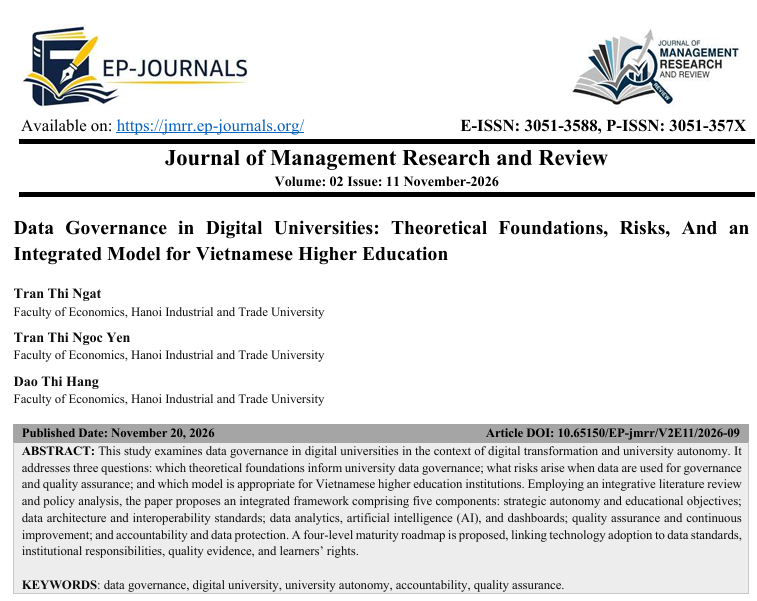
Data Governance in Digital Universities: Theoretical Foundations, Risks, And an Integrated Model for Vietnamese Higher Education
DOI:
https://doi.org/10.65150/EP-jmrr/V2E11/2026-09Keywords:
data governance, digital university, university autonomy, accountability, quality assurance.Abstract
This study examines data governance in digital universities in the context of digital transformation and university autonomy. It addresses three questions: which theoretical foundations inform university data governance; what risks arise when data are used for governance and quality assurance; and which model is appropriate for Vietnamese higher education institutions. Employing an integrative literature review and policy analysis, the paper proposes an integrated framework comprising five components: strategic autonomy and educational objectives; data architecture and interoperability standards; data analytics, artificial intelligence (AI), and dashboards; quality assurance and continuous improvement; and accountability and data protection. A four-level maturity roadmap is proposed, linking technology adoption to data standards, institutional responsibilities, quality evidence, and learners’ rights.
References
1) ABET. (2024). Criteria for accrediting engineering programs, 2025–2026. https://www.abet.org/accreditation/accreditation-criteria/criteria-for-accrediting-engineering-programs-2025-2026/
2) Abraham, R., Schneider, J., & vom Brocke, J. (2019). Data governance: A conceptual framework, structured review, and research agenda. International Journal of Information Management, 49, 424–438. https://doi.org/10.1016/j.ijinfomgt.2019.07.008
3) ASEAN University Network. (2020). Guide to AUN-QA assessment at programme level, version 4.0. https://www.aunsec.org/application/files/9117/7942/9691/Guide_to_AUN-QA_Assessment_at_Programme_Level_Version_4.0.pdf
4) European Commission, High-Level Expert Group on Artificial Intelligence. (2019). Ethics guidelines for trustworthy AI.
https://digital-strategy.ec.europa.eu/en/library/ethics-guidelines-trustworthy-ai
5) Gasser, U., & Almeida, V. A. F. (2017). A layered model for AI governance. IEEE Internet Computing, 21(6), 58–62.
https://doi.org/10.1109/MIC.2017.4180835
6) Government of Vietnam. (2023). Decree No. 13/2023/ND-CP of April 17, 2023, on personal data protection. https://vanban.chinhphu.vn/?docid=207759&pageid=27160
7) Khatri, V., & Brown, C. V. (2010). Designing data governance. Communications of the ACM, 53(1), 148–152.
https://doi.org/10.1145/1629175.1629210
8) OECD. (2023). OECD digital education outlook 2023: Towards an effective digital education ecosystem. OECD Publishing. https://doi.org/10.1787/c74f03de-en
9) Prime Minister of Vietnam. (2022). Decision No. 131/QD-TTg of January 25, 2022, approving the scheme for enhancing information technology applications and digital transformation in education and training for 2022–2025, with an orientation toward 2030.
https://vanban.chinhphu.vn/?classid=2&docid=205236&pageid=27160
10) Slade, S., & Prinsloo, P. (2013). Learning analytics: Ethical issues and dilemmas. American Behavioral Scientist, 57(10), 1510–1529.
https://doi.org/10.1177/0002764213479366
11) UNESCO. (2023). Global education monitoring report 2023: Technology in education: A tool on whose terms? UNESCO.
https://unesdoc.unesco.org/ark:/48223/pf0000385723
12) Williamson, B., & Eynon, R. (2020). Historical threads, missing links, and future directions in AI in education. Learning, Media and Technology, 45(3), 223–235. https://doi.org/10.1080/17439884.2020.1798995
Downloads
Published
Issue
Section
License
Copyright (c) 2026 Tran Thi Ngat, Tran Thi Ngoc Yen, Dao Thi Hang (Author)

This work is licensed under a Creative Commons Attribution 4.0 International License.