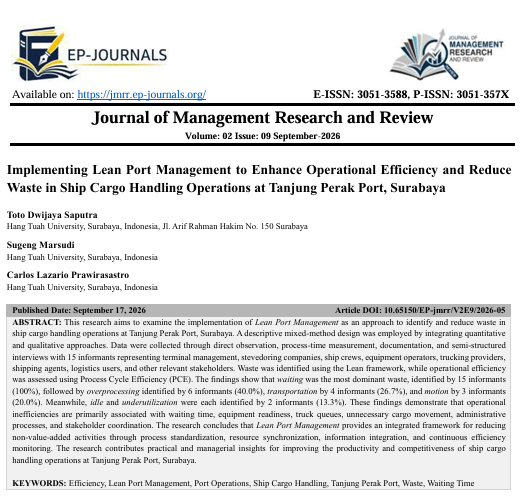
Implementing Lean Port Management to Enhance Operational Efficiency and Reduce Waste in Ship Cargo Handling Operations at Tanjung Perak Port, Surabaya
DOI:
https://doi.org/10.65150/EP-jmrr/V2E9/2026-05Keywords:
Efficiency, Lean Port Management, Port Operations, Ship Cargo Handling, Tanjung Perak Port, Waste, Waiting TimeAbstract
This research aims to examine the implementation of Lean Port Management as an approach to identify and reduce waste in ship cargo handling operations at Tanjung Perak Port, Surabaya. A descriptive mixed-method design was employed by integrating quantitative and qualitative approaches. Data were collected through direct observation, process-time measurement, documentation, and semi-structured interviews with 15 informants representing terminal management, stevedoring companies, ship crews, equipment operators, trucking providers, shipping agents, logistics users, and other relevant stakeholders. Waste was identified using the Lean framework, while operational efficiency was assessed using Process Cycle Efficiency (PCE). The findings show that waiting was the most dominant waste, identified by 15 informants (100%), followed by overprocessing identified by 6 informants (40.0%), transportation by 4 informants (26.7%), and motion by 3 informants (20.0%). Meanwhile, idle and underutilization were each identified by 2 informants (13.3%). These findings demonstrate that operational inefficiencies are primarily associated with waiting time, equipment readiness, truck queues, unnecessary cargo movement, administrative processes, and stakeholder coordination. The research concludes that Lean Port Management provides an integrated framework for reducing non-value-added activities through process standardization, resource synchronization, information integration, and continuous efficiency monitoring. The research contributes practical and managerial insights for improving the productivity and competitiveness of ship cargo handling operations at Tanjung Perak Port, Surabaya.
References
1) Adler, N., Hirte, G., Kumar, S., & Niemeier, W. (2022). The impact of specialization, ownership, competition and regulation on efficiency: A case study of Indian seaports. Maritime Economics & Logistics, 24, 507–536.
2) Alamsyah, & Marasabessy, A. (2025). Analisis penerapan metode Value Stream Mapping pada proses bongkar muat kapal container untuk meningkatkan efisiensi waktu pada Pelabuhan Sunda Kelapa PT Pelabuhan Indonesia (Pelindo). Applied Science Technology on Naval Engineering, 3(2), 12–18. https://doi.org/10.54378/astne.v3i2.11792
3) Ardiansyah, M. (2023). Peningkatan kinerja bongkar muat pada terminal kendaraan Pelabuhan Patimban dengan konsep lean strategy [Master's thesis, Institut Teknologi Sepuluh Nopember].
4) Basulo-Ribeiro, J., & Teixeira, A. P. (2024). Industry 4.0 supporting logistics towards smart ports: Benefits, challenges and trends based on a systematic literature review. Journal of Industrial Engineering and Management, 17(2). https://doi.org/10.3926/jiem.6180
5) Belmoukari, B., Audy, J.-F., & Forget, P. (2023). Smart port: A systematic literature review. European Transport Research Review, 15, Article 4. https://doi.org/10.1186/s12544-023-00581-6
6) Bouzekri, H., et al. (2022). An integrated decision support system for planning production, storage and bulk port operations in a fertilizer supply chain. International Journal of Production Economics, 252, 108561. https://doi.org/10.1016/j.ijpe.2022.108561
7) Daulay, M. A., Amri, & Syukriah. (2021). Analisis waste pada proses pembongkaran peti kemas dengan pendekatan Lean Service di PT Pelindo I Cabang Lhokseumawe. Industrial Engineering Journal, 10(2). https://doi.org/10.53912/iej.v10i2.681
8) Ding, Y., & Voss, S. (2023). Real-time monitoring and optimal resource allocation for automated container terminals: A digital twin application at the Yangshan Port. Journal of Advanced Transportation, 2023, Article 6909801. https://doi.org/10.1155/2023/6909801
9) Ering, M. R., & Suparno. (2021). Penerapan metode Lean Six Sigma untuk meningkatkan kinerja operasi dalam penanganan bongkar muat petikemas domestik di Terminal Berlian Pelabuhan Tanjung Perak Surabaya. Ekonis: Jurnal Ekonomi dan Bisnis, 23(2).
10) Fahreza, M. (2024). Efisiensi proses bongkar muatan batu bara untuk mengatasi idle time oleh PT Delta Artha Bahari Nusantara di Pelabuhan Probolinggo. Jurnal 7 Samudra, 9(1), 45–52. https://doi.org/10.54992/7samudra.v9i1.181
11) Gao, S., Chang, Q., & Chen, S. (2023). A digital twin-based approach for optimizing operation energy consumption at automated container terminals. Journal of Cleaner Production, 385, 135782. https://doi.org/10.1016/j.jclepro.2022.135782
12) Ghiara, H., & Tei, A. (2021). Port activity and technical efficiency: Determinants and external factors. Maritime Policy & Management, 48(5), 711–724.
13) Gonzalez, J. (2025). A benchmarking approach to lean quality practices: Developing a strategic roadmap for port efficiency. Benchmarking: An International Journal. https://doi.org/10.1108/BIJ-12-2024-1092
14) Knatz, G., Notteboom, T., & Pallis, A. (2022). Container terminal automation: Revealing distinctive terminal characteristics and operating parameters. Maritime Economics & Logistics, 24(3), 537–565.
15) Krmac, E., & Mansouri Kaleibar, M. (2023). A comprehensive review of data envelopment analysis methodology in port efficiency evaluation. Maritime Economics & Logistics, 25(3). https://doi.org/10.1057/s41278-022-00239-5
16) Kurnianingsih, & Rusdianto. (2025). Pengelolaan bongkar muat dalam meningkatkan efisiensi kinerja operasi: Studi kasus PT Pelindo Branch Gresik. Jurnal Ekonomi, Manajemen, Bisnis dan Akuntansi Review, 5(2), 1–9. https://doi.org/10.53697/emba.v5i2.3563
17) Li, K., Li, Y., Zhu, W., Yuen, K. F., Tong, L., & Zhou, Y. (2023). Smart port: A bibliometric review and future research directions. Transportation Research Part E: Logistics and Transportation Review, 174, 103098. https://doi.org/10.1016/j.tre.2023.103098
18) Maskuri, Purwanto, & Ihkamuddin. (2024). Analisis efisiensi quay container crane terhadap waktu bongkar muat petikemas pada PT Pelindo Terminal Petikemas Semarang. Jurnal Sains Bangunan, 1(1), 49–56. https://doi.org/10.58906/alsaba.v1i1.143
19) Maturbongs, et al. (2025). Analisis penanganan dokumen dan hambatan proses bongkar muat di kapal KM Ciremai pada Pelabuhan Sorong. JPB: Jurnal Patria Bahari, 5(1), 15–22. https://doi.org/10.54017/jpb.v5i1.182
20) Nawawi, Bintari, & Adiguna. (2024). Analysis of delays in the container loading and unloading process at the stevedoring stage at PT Pelabuhan Indonesia (Persero) Regional 2 Pangkal Balam. Marine Inside, 6(1).
21) Paraskevas, A., Madas, M., Zeimpekis, V., & Fouskas, K. (2024). Smart ports in Industry 4.0: A systematic literature review. Logistics, 8(1), 28. https://doi.org/10.3390/logistics8010028
22) Pham, T. Q. (2023). A smart port development: Systematic literature and bibliometric analysis. Asian Journal of Shipping and Logistics, 39(3), 57–62. https://doi.org/10.1016/j.ajsl.2023.06.005
23) Setyarini, R., Praharsi, Y., & Sari, D. P. (2022). Optimization of shipping services with waste analysis using Lean Service. In Proceedings of the Asia Pacific Industrial Engineering and Operations Management Conference. Surabaya, Indonesia.
24) Suradi, Lantara, D., & Padhil, A. (2023). Waste analysis of tapioca unloading process with lean supply chain approach in Makassar Port. Acta Logistica, 10(1), 71–77. https://doi.org/10.22306/al.v10i1.353
25) Triska, Y., Frazzon, E. M., Silva, L. C. P., & Heilig, L. (2022). Smart port terminals: Conceptual framework, maturity modeling and research agenda. Maritime Policy & Management, 51, 1–24.
26) Van Battum, R., et al. (2022). Performance improvements in container terminals through the bottleneck mitigation cycle. Maritime Economics & Logistics. https://doi.org/10.1057/s41278-022-00245-7
27) Veenstra, A., & Harmelink, M. (2022). Process mining ship arrivals in port: The case of the Port of Antwerp. Maritime Economics & Logistics, 24(3), 584–601.
28) Wardana, & Wibisono. (2025). Evaluasi kinerja fasilitas dan peralatan operasional Terminal Petikemas Surabaya (TPS). Jurnal Media Publikasi Terapan Transportasi, 3(2), 212–223. https://doi.org/10.26740/mitrans.v3n2.p212-223
29) Welem. (2022). Optimalisasi penataan lapangan penumpukan untuk memperlancar kegiatan bongkar muat. Syntax Literate, 7(11).
30) Wonggiawan. (2023). Analisis Lean Service untuk mengurangi non productive time pada pelayanan kapal dengan metode Value Stream Mapping [Undergraduate thesis, Universitas Mercu Buana].
31) Yaya, et al. (2024). Digital transformation in smart ports: A systematic literature review. Revista Brasileira de Gestão Ambiental e Sustentabilidade, 11(27), 533–550.
32) Yigit, et al. (2023). TwinPort: 5G drone-assisted data collection with digital twin for smart seaports. Scientific Reports, 13, 12310.
Downloads
Published
Issue
Section
License
Copyright (c) 2026 Toto Dwijaya Saputra, Sugeng Marsudi , Carlos Lazario Prawirasastro (Author)

This work is licensed under a Creative Commons Attribution 4.0 International License.