Digital Japa, Labour-Market Competition, And the Wage Paradox in the Global South: Evidence from Employee-Cost Disclosures of Nigerian Listed Firms
DOI:
https://doi.org/10.65150/EP-jmrr/V2E11/2026-01Keywords:
Digital Japa, digital labour migration, CPI-adjusted growth, remote work, Nigeria, employee cost.Abstract
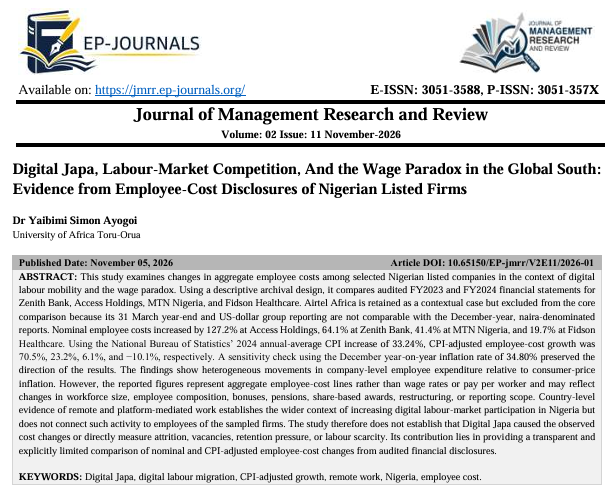
This study examines changes in aggregate employee costs among selected Nigerian listed companies in the context of digital labour mobility and the wage paradox. Using a descriptive archival design, it compares audited FY2023 and FY2024 financial statements for Zenith Bank, Access Holdings, MTN Nigeria, and Fidson Healthcare. Airtel Africa is retained as a contextual case but excluded from the core comparison because its 31 March year-end and US-dollar group reporting are not comparable with the December-year, naira-denominated reports. Nominal employee costs increased by 127.2% at Access Holdings, 64.1% at Zenith Bank, 41.4% at MTN Nigeria, and 19.7% at Fidson Healthcare. Using the National Bureau of Statistics’ 2024 annual-average CPI increase of 33.24%, CPI-adjusted employee-cost growth was 70.5%, 23.2%, 6.1%, and −10.1%, respectively. A sensitivity check using the December year-on-year inflation rate of 34.80% preserved the direction of the results. The findings show heterogeneous movements in company-level employee expenditure relative to consumer-price inflation. However, the reported figures represent aggregate employee-cost lines rather than wage rates or pay per worker and may reflect changes in workforce size, employee composition, bonuses, pensions, share-based awards, restructuring, or reporting scope. Country-level evidence of remote and platform-mediated work establishes the wider context of increasing digital labour-market participation in Nigeria but does not connect such activity to employees of the sampled firms. The study therefore does not establish that Digital Japa caused the observed cost changes or directly measure attrition, vacancies, retention pressure, or labour scarcity. Its contribution lies in providing a transparent and explicitly limited comparison of nominal and CPI-adjusted employee-cost changes from audited financial disclosures.
References
1) Access Holdings Plc. (2025). Audited consolidated financial statements for the year ended 31 December 2024. Nigerian Exchange Group. https://doclib.ngxgroup.com/Financial_NewsDocs/43800_ACCESS_HOLDINGS_PLC-_QUARTER_5_-_FINANCIAL_STATEMENT_FOR_2024_FINANCIAL_STATEMENTS_APRIL_2025.pdf
2) Adegoke, D. (2023). “Japa”: An exploratory study of the roles of social media in an out-migration trend in Nigeria. Social Media + Society, 9(4). https://doi.org/10.1177/20563051231203691
3) Airtel Africa Plc. (2024). Annual report and accounts 2024. https://cdn-webportal.airtelstream.net/website/investor/main/pdf/annual-report/Annual-Report-and-Accounts-2024_FINAL.pdf
4) Ajonbadi, H., Adekoya, O. D., Jayasuria, J. G., & Mordi, C. (2026). Labour market segmentation and the experiences of web-based platform workers in Nigeria. The Economic and Labour Relations Review. Advance online publication.
https://doi.org/10.1017/elr.2026.10083
5) Anwar, M. A., & Graham, M. (2020a). Between a rock and a hard place: Freedom, flexibility, precarity and vulnerability in the gig economy in Africa. Competition & Change, 25, 237–258. https://doi.org/10.1177/1024529420914473
6) Anwar, M. A., & Graham, M. (2020b). Digital labour at economic margins: African workers and the global information economy. Review of African Political Economy, 47(163), 95–105. https://doi.org/10.1080/03056244.2020.1728243
7) Barney, J. (1991). Firm resources and sustained competitive advantage. Journal of Management, 17(1), 99–120.
https://doi.org/10.1177/014920639101700108
8) Becker, G. S. (1993). Human capital: A theoretical and empirical analysis, with special reference to education (3rd ed.). University of Chicago Press. https://doi.org/10.7208/chicago/9780226041223
9) Braesemann, F., Stephany, F., Teutloff, O., Kässi, O., Graham, M., & Lehdonvirta, V. (2022). The global polarisation of remote work. PLOS ONE, 17(10), e0274630. https://doi.org/10.1371/journal.pone.0274630
10) Fidson Healthcare Plc. (2025). Annual report and financial statements for the year ended 31 December 2024. Nigerian Exchange Group. https://doclib.ngxgroup.com/Financial_NewsDocs/43608_FIDSON_HEALTHCARE_PLC-_QUARTER_5_-_FINANCIAL_STATEMENT_FOR_2024_FINANCIAL_STATEMENTS_MARCH_2025.pdf
11) Kar, S., & Marjit, S. (2024). Does skill emigration hurt unskilled workers? Theory and cross-country evidence. International Migration. https://doi.org/10.1111/imig.13259
12) Melia, E. (2020). African jobs in the digital era: Export options with a focus on online labour. German Development Institute. https://doi.org/10.23661/dp3.2020
13) MTN Nigeria Communications Plc. (2025). Audited consolidated and separate financial statements for the year ended 31 December 2024. Nigerian Exchange Group.
14) MyJobMag. (2026). Remote work statistics 2026: Trends, statistics and data. https://www.myjobmag.com/blog/remote-work-statistics
15) National Bureau of Statistics. (2025a). Consumer price index and inflation report: December 2024.
https://microdata.nigerianstat.gov.ng/index.php/catalog/154/download/1126/CPI_DEC_2024.pdf
16) National Bureau of Statistics. (2025b). Highlights of the 2024 CPI rebasing results.
17) Professions.ng. (2023). Remote work in Nigeria surges by 200% in two years. https://www.professions.ng
18) Punch. (n.d.). Nigeria’s digital labour market and online gig economy. https://www.punchng.com
19) Rani, U., & Furrer, M. (2021). Digital labour platforms and new forms of flexible work in developing countries: Algorithmic management of work and workers. Competition & Change, 25(2), 212–236. https://doi.org/10.1177/1024529420905187
20) Stegeman, H., & Hardy, K. (2025). Locating online labour: The salience of the national scale in remote digital work. Environment and Planning A: Economy and Space, 57, 369–384. https://doi.org/10.1177/0308518X251322361
21) StranSact. (n.d.). Remote employment trends study. https://www.stransact.com
22) TechTrends Africa. (2026). The state of online work in Nigeria: A workforce in transition. https://www.techtrends.africa
23) Teece, D. J., Pisano, G., & Shuen, A. (1997). Dynamic capabilities and strategic management. Strategic Management Journal, 18(7),
509–533.
24) Vanguard News. (2026). Remote work reshapes Nigeria’s tech workforce, widens global opportunities. https://www.vanguardngr.com
25) Wernerfelt, B. (1984). A resource-based view of the firm. Strategic Management Journal, 5(2), 171–180.
26) World Bank. (2023). Working without borders: The promise and peril of online gig work. https://documents1.worldbank.org
27) World Economic Forum. (2025). The future of jobs report 2025.
https://www3.weforum.org/docs/WEF_Future_of_Jobs_Report_2025.pdf
28) Zenith Bank Plc. (2025). Annual report 2024. https://www.zenithbank.com/media/4016/zenith-bank-annual-report-2024-web.pdf
Downloads
Published
Issue
Section
License
Copyright (c) 2026 Dr Yaibimi Simon Ayogoi (Author)

This work is licensed under a Creative Commons Attribution 4.0 International License.