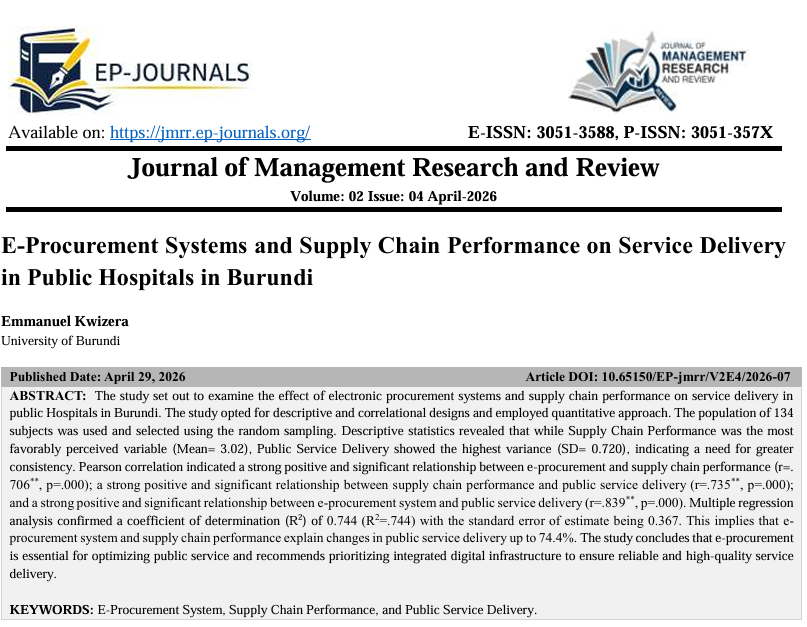
E-Procurement Systems and Supply Chain Performance on Service Delivery in Public Hospitals in Burundi
DOI:
https://doi.org/10.65150/EP-jmrr/V2E4/2026-07Keywords:
E-Procurement System, Supply Chain Performance, and Public Service Delivery.Abstract
The study set out to examine the effect of electronic procurement systems and supply chain performance on service delivery in public Hospitals in Burundi. The study opted for descriptive and correlational designs and employed quantitative approach. The population of 134 subjects was used and selected using the random sampling. Descriptive statistics revealed that while Supply Chain Performance was the most favorably perceived variable (Mean= 3.02), Public Service Delivery showed the highest variance (SD= 0.720), indicating a need for greater consistency. Pearson correlation indicated a strong positive and significant relationship between e-procurement and supply chain performance (r=. 706**, p=.000); a strong positive and significant relationship between supply chain performance and public service delivery (r=.735**, p=.000); and a strong positive and significant relationship between e-procurement system and public service delivery (r=.839**, p=.000). Multiple regression analysis confirmed a coefficient of determination (R2) of 0.744 (R2=.744) with the standard error of estimate being 0.367. This implies that e-procurement system and supply chain performance explain changes in public service delivery up to 74.4%. The study concludes that e-procurement is essential for optimizing public service and recommends prioritizing integrated digital infrastructure to ensure reliable and high-quality service delivery.
References
1) Atiga, O., Seidu, M. T., & Asaana, J. (2026). Effect of E-Procurement Practices on The Procurement Performance of Public Institutions in Ghana: The Mediating Role of Staff Competence. African Journal of Applied Research, 12(1).
2) Baily, P. J. H. (2008). Procurement principles and management. Harlow, England: Prentice Hall Financial Times.
3) Baltacioglu, T., Ada, E., Kaplan, M.D., Yurt, O., &Kaplan, Y.C. (2007). A new framework for service supply chains. Serv Ind J 27:105–124.
4) Banda, R. K. (2025). Public Procurement and Service Delivery: A Strategic Framework for Developing Economies. Academic Press.
5) Barngetuny, D. & Kimutai, G. (2015). Effects of e-procurement on supply chain management performance in Elgeyo-Marakwet County. International Academic Journal of Procurement and Supply Chain Management, 1(5), 99- 120.
6) CAMEBU. (2022). Rapport annuel sur l’approvisionnement en médicaments au Burundi. Centre d’Achats des Médicaments du Burundi.
7) Handfield, R.B., Monczka, R.M., Giunipero, L.C., & Patterson, J.L. (2019). Sourcing and supply chain management. Mason: Cengage Learning.
8) Katuu, S. (2015). Electronic records management in Africa: A review of literature. Journal of the South African Society of Archivists.
9) Kazeem, Y. K. (2025). E-Procurement Management Practices and Procurement Performance of Public Hospitals in Lagos State, Nigeria: The Mediating Role of Supply Chain Performance. International Journal of Scientific Research and Management, 13(8).
10) Kovács, G., & Falagara Sigala, I. (2024). Lessons learned from humanitarian logistics for public sector supply chain resilience. Journal of Public Procurement, 24(1), 45-62.
11) Laryea, E. (2026). The Link Between Supply Chain Integration and Quality of Service in Local Government. International Journal of Logistics Systems and Management, 48(3), 312-330.
12) Lusch, R.F., &Vargo, S.L. (2006). Service-dominant logic: reactions, reflections and refinements. Mark Theory 6:281–288.
13) Ministry of Health Burundi. (2021). Health sector strategic plan and procurement reforms report. Bujumbura: Government of Burundi.
14) Nambela, N. (2024). The effectiveness of e-procurement systems in Zambia: A case study of Ministry of Health Lusaka province. International Journal of Business and Social Science, 13(9), 243-255.
15) Neef, D. (2016). E-procurement: From strategy to implementation. New Jersey: FT Press.
16) Nyasetia, J. (2024). E-Supply Chain Management Practices and Operational Performance of Hospitals in Kiambu County, Kenya. University of Nairobi Repository.
17) OECD. (2019). Public procurement and governance: Enhancing transparency through digital transformation. Organisation for Economic Co-operation and Development.
18) Organisation for Economic Co-operation and Development (OECD). (2019). Reforming public procurement: Progress in implementing the 2015 OECD recommendation. OECD Publishing. https://www.oecd.org/en/publications/refor ming-public-procurement_1de41738- en.html
19) Osborne, S.P. (2021). Public service logic, creating value for public service users, citizens, and society through public service delivery. Routledge, New York.
20) Presutti, W. D. (2003). Supply Management and e-procurement: Creating Value Added in the Supply Chain. Industrial Marketing Management, 32(3), 219-226.
21) Rotich, G. K., & Okello, B. (2015). Analysis of use of e-procurement on performance of the procurement functions of County Governments in Kenya. International Journal of Economics, Commerce and Management, 3(6), 1381-1398.
22) Sangari, M. S. (2025). E-Procurement Readiness Assessment in Hospitals: A Novel Hybrid Fuzzy Decision Map and Grey Relational Analysis Approach. Decision Making: Applications in Management and Engineering.
23) Sienkiewicz Małyjurek, K., & Szymczak, M. (2024). Understanding public service supply chain management: a systematic literature review. Management Review Quarterly, 74:1879–1943
24) Srinivasan, M., Mukherjee, D., &Gaur, A.S. (2016). Buyer-supplier partnership quality and supply chain performance: Moderating role of risks, and environmental uncertainty. European Management Journal, 29(4), 260-271.
25) Tjilen, A. P. (2025). E-Procurement Implementation and Its Impact on Government Performance and Public Service Delivery in South Papua Province, Indonesia. International Journal of Research and Review, 12(7), 81–91.
26) Van Weele, A. J. (2015). Purchasing and supply chain management: analysis. London: Planning and Practice, Thomson International.
27) WHO. (2021). Digital health in the African region: Strengthening health systems through technology. World Health Organization.
28) World Bank. (2020). E-procurement systems and public sector efficiency in developing countries. Washington, DC: World Bank Group.
29) Yaraa, I. O. (2024). Tackling Supply Chain Challenges in the Healthcare Sector Through E-Procurement. Yaraa Business Insights.
Downloads
Published
Issue
Section
License
Copyright (c) 2026 Emmanuel Kwizera (Author)

This work is licensed under a Creative Commons Attribution 4.0 International License.