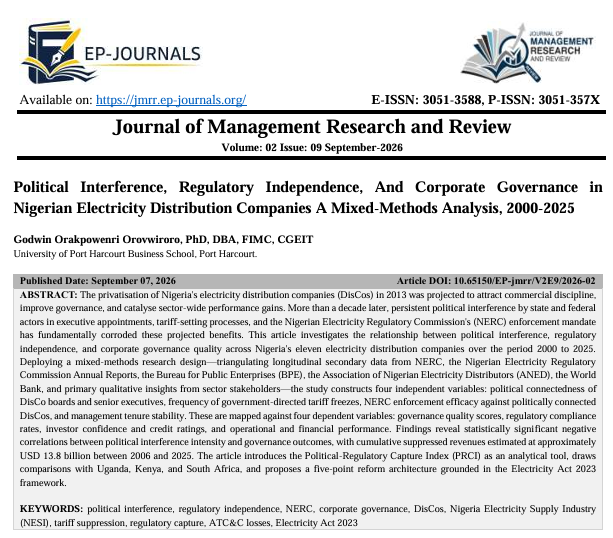
Political Interference, Regulatory Independence, And Corporate Governance in Nigerian Electricity Distribution Companies A Mixed-Methods Analysis, 2000-2025
DOI:
https://doi.org/10.65150/EP-jmrr/V2E9/2026-02Keywords:
political interference, regulatory independence, NERC, corporate governance, DisCos, Nigeria Electricity Supply Industry (NESI), tariff suppression, regulatory capture, ATC&C losses, Electricity Act 2023Abstract
The privatisation of Nigeria's electricity distribution companies (DisCos) in 2013 was projected to attract commercial discipline, improve governance, and catalyse sector-wide performance gains. More than a decade later, persistent political interference by state and federal actors in executive appointments, tariff-setting processes, and the Nigerian Electricity Regulatory Commission's (NERC) enforcement mandate has fundamentally corroded these projected benefits. This article investigates the relationship between political interference, regulatory independence, and corporate governance quality across Nigeria's eleven electricity distribution companies over the period 2000 to 2025. Deploying a mixed-methods research design—triangulating longitudinal secondary data from NERC, the Nigerian Electricity Regulatory Commission Annual Reports, the Bureau for Public Enterprises (BPE), the Association of Nigerian Electricity Distributors (ANED), the World Bank, and primary qualitative insights from sector stakeholders—the study constructs four independent variables: political connectedness of DisCo boards and senior executives, frequency of government-directed tariff freezes, NERC enforcement efficacy against politically connected DisCos, and management tenure stability. These are mapped against four dependent variables: governance quality scores, regulatory compliance rates, investor confidence and credit ratings, and operational and financial performance. Findings reveal statistically significant negative correlations between political interference intensity and governance outcomes, with cumulative suppressed revenues estimated at approximately USD 13.8 billion between 2006 and 2025. The article introduces the Political-Regulatory Capture Index (PRCI) as an analytical tool, draws comparisons with Uganda, Kenya, and South Africa, and proposes a five-point reform architecture grounded in the Electricity Act 2023 framework.
References
1) Adenikinju, A. (2005). Analysis of the cost of infrastructure failures in a developing economy: The case of the electricity sector in Nigeria. AERC Research Paper No. 148. African Economic Research Consortium.
2) Association of Nigerian Electricity Distributors (ANED). (2024). State of the distribution sector: Performance and compliance report 2023/2024. ANED Secretariat.
3) Bhorat, H., Buthelezi, M., Chipkin, I., Duma, S., Mondi, L., Peter, C., Qobo, M., Swilling, M., & Friedenstein, H. (2017). Betrayal of the promise: How South Africa is being stolen. Public Affairs Research Institute (PARI).
4) Boubakri, N., Cosset, J.-C., & Guedhami, O. (2005). Postprivatization corporate governance: The role of ownership structure and investor protection. Journal of Financial Economics, 76(2), 369-399. https://doi.org/10.1016/j.jfineco.2004.05.003
5) Bureau for Public Enterprises (BPE). (2023). NESI privatisation transaction report: Ten-year review, 2013-2023. BPE.
6) Claessens, S., & Djankov, S. (1999). Ownership concentration and corporate performance in the Czech Republic. Journal of Comparative Economics, 27(3), 498-513. https://doi.org/10.1006/jcec.1999.1598
7) Creswell, J. W., & Plano Clark, V. L. (2017). Designing and conducting mixed methods research (3rd ed.). SAGE Publications.
8) DiMaggio, P. J., & Powell, W. W. (1983). The iron cage revisited: Institutional isomorphism and collective rationality in organizational fields. American Sociological Review, 48(2), 147-160. https://doi.org/10.2307/2095101
9) Eberhard, A., & Godinho, C. (2017). Overcoming the governance gap in African electricity utilities. Public Utility Research Center, University of Florida.
10) Ekumankama, O. O. (2023). Decentralised electricity regulation in Nigeria: Opportunities and governance risks under the Electricity Act 2023. Nigerian Journal of Energy Law, 14(2), 88-117.
11) Electric Power Sector Reform (EPSR) Act. (2005). Laws of the Federation of Nigeria. Federal Government of Nigeria.
12) Electricity Act. (2023). Federal Republic of Nigeria Official Gazette. Federal Government of Nigeria.
13) Gratwick, K. N., & Eberhard, A. (2008). Demise of the standard model for power sector reform and the emergence of hybrid power markets. Energy Policy, 36(10), 3948-3960. https://doi.org/10.1016/j.enpol.2008.07.021
14) International Energy Agency (IEA). (2023). Africa energy outlook 2023. IEA Publications. https://www.iea.org/reports/africa-energy-outlook-2023
15) Iwayemi, A. (2008). Nigeria's dual energy problems: Policy issues and challenges. International Association for Energy Economics Newsletter, 4th Quarter, 17-21.
16) Jensen, M. C., & Meckling, W. H. (1976). Theory of the firm: Managerial behavior, agency costs and ownership structure. Journal of Financial Economics, 3(4), 305-360. https://doi.org/10.1016/0304-405X(76)90026-X
17) Laffont, J.-J., & Tirole, J. (1991). The politics of government decision-making: A theory of regulatory capture. Quarterly Journal of Economics, 106(4), 1089-1127. https://doi.org/10.2307/2937958
18) Megginson, W. L., & Netter, J. M. (2001). From state to market: A survey of empirical studies on privatization. Journal of Economic Literature, 39(2), 321-389. https://doi.org/10.1257/jel.39.2.321
19) National Prosecuting Authority. (2021). Investigative directive on state capture in the South African electricity sector. Republic of South Africa.
20) Nigerian Electricity Regulatory Commission (NERC). (2020). State of the electricity industry report, 2015-2020. NERC Publications.
21) Nigerian Electricity Regulatory Commission (NERC). (2022). DisCo corporate governance and regulatory compliance assessment. NERC Order No. NERC/2022/014.
22) Nigerian Electricity Regulatory Commission (NERC). (2024). Annual report on distribution system performance, 2023-2024. NERC Publications.
23) North, D. C. (1990). Institutions, institutional change and economic performance. Cambridge University Press.
24) Okafor, C., & Nwosu, A. (2021). Political connections and the performance of electricity distribution companies in Nigeria: Panel data evidence, 2014-2020. African Journal of Economics and Sustainable Development, 4(3), 45-71.
25) Oke, M. A. (2016). Regulatory governance and the Nigerian electricity sector: Challenges and prospects. Energy Research & Social Science, 18, 105-118. https://doi.org/10.1016/j.erss.2016.02.009
26) Orovwiroro, G. O. (2024). Utility revenue erosion cycle in Nigerian electricity distribution: A longitudinal analysis, 2013-2025. International Journal of Energy Economics and Policy, 14(4), 211-228.
27) Scott, W. R. (1995). Institutions and organizations. SAGE Publications.
28) Stigler, G. J. (1971). The theory of economic regulation. Bell Journal of Economics and Management Science, 2(1), 3-21. https://doi.org/10.2307/3003160
29) World Bank. (2020). Uganda energy sector performance and reform analysis. World Bank Group.
30) World Bank. (2024). Nigeria electricity sector development policy report. World Bank Group.https://doi.org/10.1596/978-1-4648-1920-3
31) Young, M. N., Peng, M. W., Ahlstrom, D., Bruton, G. D., & Jiang, Y. (2008). Corporate governance in emerging economies: A review of the principal–principal perspective. Journal of Management Studies, 45(1), 196-220. https://doi.org/10.1111/j.1467-6486.2007.00752.x
Downloads
Published
Issue
Section
License
Copyright (c) 2026 Godwin Orakpowenri Orovwiroro, PhD, DBA, FIMC, CGEIT (Author)

This work is licensed under a Creative Commons Attribution 4.0 International License.