Compliance Paradox in Complex Organizations: Evidence from Medication Errors Healthcare Management in Healthcare Systems
DOI:
https://doi.org/10.65150/EP-jmrr/V2E4/2026-08Keywords:
Medication error, compliance behavior, system complexity, compliance paradox, PLS-SEMAbstract
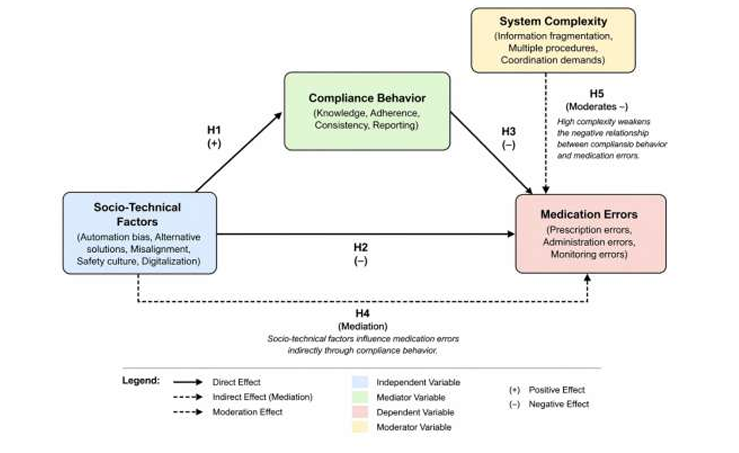
Medication errors remain a persistent challenge in healthcare systems despite various efforts to improve procedural compliance. This study aims to analyze the relationship between compliance behavior and medication errors by integrating socio-technical perspectives and the moderating role of system of complexity. Data were collected from 260 healthcare professionals in Manado, North Sulawesi, Indonesia and analyzed using the Partial Least Squares Structural Equation Modeling (PLS-SEM) approach to test direct, mediation, and moderation relationships among variables. The results show that socio-technical factors have a positive and significant effect on compliance behavior and a negative effect on medication errors. Furthermore, compliance behavior was found to have a negative effect on medication errors and acted as partial mediator in this relationship. However, system complexity significantly weakened the negative effect of compliance behavior on medication errors, indicating that increased compliance does not always lead to decrease in errors under complex system conditions. These findings reveal a phenomenon of compliance paradox, where procedural compliance become less effective in environments with high complexity. This study contributes to the development of socio-technical perspective and provides practical implications regarding the importance of system simplification and cognitive load reduction to enhance patient safety.
References
1) Alex, Sumana, Ayne B. Adenew, Cherinne Arundel, David D. Maron, and Jennifer C. Kerns. 2016. “Medication Errors Despite Using Electronic Health Records.” Quality Management in Health Care 25(1): 32–37. doi:10.1097/QMH.0000000000000080.
2) Ash, Joan S., Dean F. Sittig, Richard Dykstra, Emily Campbell, and Kenneth Guappone. 2009. “The Unintended Consequences of Computerized Provider Order Entry: Findings from a Mixed Methods Exploration.” International Journal of Medical Informatics 78: S69–76. doi:10.1016/j.ijmedinf.2008.07.015.
3) Bates DW, Cullen DJ, Cullen DJ, Petersen LA Laird N, Small SD, Servi D, Laffel G, et al. 1995. “Incidence of Adverse Drug Events and Potential Adverse Drug Events. Implications for Prevention. ADE Prevention Study Group.” JAMA 274(1): 29–34.
4) Black, Ashly D., Josip Car, Claudia Pagliari, Chantelle Anandan, Kathrin Cresswell, Tomislav Bokun, Brian McKinstry, et al. 2011. “The Impact of EHealth on the Quality and Safety of Health Care: A Systematic Overview.” PLoS Medicine 8(1): e1000387. doi:10.1371/journal.pmed.1000387.
5) Braithwaite, Jeffrey, Kate Churruca, Janet C. Long, Louise A. Ellis, and Jessica Herkes. 2018. “When Complexity Science Meets Implementation Science: A Theoretical and Empirical Analysis of Systems Change.” BMC Medicine 16(1): 63. doi:10.1186/s12916-018-1057-z.
6) Brennan-Bourdon, Lorena Michele, Alan O. Vázquez-Alvarez, Jahaira Gallegos-Llamas, Manuel Koninckx-Cañada, José Luis Marco-Garbayo, and Selene G. Huerta-Olvera. 2020. “A Study of Medication Errors during the Prescription Stage in the Pediatric Critical Care Services of a Secondary-Tertiary Level Public Hospital.” BMC Pediatrics 20(1): 549. doi:10.1186/s12887-020-02442-w.
7) Carayon, Pascale, Tosha B. Wetterneck, A. Joy Rivera-Rodriguez, Ann Schoofs Hundt, Peter Hoonakker, Richard Holden, and Ayse P. Gurses. 2014. “Human Factors Systems Approach to Healthcare Quality and Patient Safety.” Applied Ergonomics 45(1): 14–25. doi:10.1016/j.apergo.2013.04.023.
8) Cresswell, K. M., D. W. Bates, and A. Sheikh. 2013. “Ten Key Considerations for the Successful Implementation and Adoption of Large-Scale Health Information Technology.” Journal of the American Medical Informatics Association 20(e1): e9–13. doi:10.1136/amiajnl-2013-001684.
9) Dixon-Woods, Mary. 2019. “How to Improve Healthcare Improvement—an Essay by Mary Dixon-Woods.” BMJ: l5514. doi:10.1136/bmj.l5514.
10) Durand, Maxime, Christel Castelli, Clarisse Roux-Marson, Jean-Marie Kinowski, and Géraldine Leguelinel-Blache. 2024. “Evaluating the Costs of Adverse Drug Events in Hospitalized Patients: A Systematic Review.” Health Economics Review 14(1): 11. doi:10.1186/s13561-024-00481-y.
11) Elliott, Rachel Ann, Elizabeth Camacho, Dina Jankovic, Mark J Sculpher, and Rita Faria. 2021. “Economic Analysis of the Prevalence and Clinical and Economic Burden of Medication Error in England.” BMJ Quality & Safety 30(2): 96–105. doi:10.1136/bmjqs-2019-010206.
12) FitzHenry, F., J. F. Peterson, M. Arrieta, L. R. Waitman, J. S. Schildcrout, and R. A. Miller. 2007. “Medication Administration Discrepancies Persist Despite Electronic Ordering.” Journal of the American Medical Informatics Association 14(6): 756–64. doi:10.1197/jamia.M2359.
13) Greenhalgh, Trisha, Joseph Wherton, Chrysanthi Papoutsi, Jennifer Lynch, Gemma Hughes, Christine A’Court, Susan Hinder, et al. 2017. “Beyond Adoption: A New Framework for Theorizing and Evaluating Nonadoption, Abandonment, and Challenges to the Scale-Up, Spread, and Sustainability of Health and Care Technologies.” Journal of Medical Internet Research 19(11): e367. doi:10.2196/jmir.8775.
14) Hodkinson, Alexander, Natasha Tyler, Darren M. Ashcroft, Richard N. Keers, Kanza Khan, Denham Phipps, Aseel Abuzour, et al. 2020. “Preventable Medication Harm across Health Care Settings: A Systematic Review and Meta-Analysis.” BMC Medicine 18(1): 313. doi:10.1186/s12916-020-01774-9.
15) Hollnagel, Erik. 2018. Safety–I and Safety–II. CRC Press. doi:10.1201/9781315607511.
16) Isfahani, Parvaneh, Aliyeh Bazi, Samira Alirezaei, Somayeh Samani, Mohammad Sarani, Fatemeh Boulagh, Mahdieh Poodineh Moghadam, and Mahnaz Afshari. 2024. “Medication Error Rates in Iranian Hospitals: A Meta-Analysis.” BMC Health Services Research 24(1): 743. doi:10.1186/s12913-024-11187-6.
17) Ismail, Aniza, and Siti Norhani Mazrah Khalid. 2022. “Patient Safety Culture and Its Determinants among Healthcare Professionals at a Cluster Hospital in Malaysia: A Cross-Sectional Study.” BMJ Open 12(8): e060546. doi:10.1136/bmjopen-2021-060546.
18) Keers, Richard N., Steven D. Williams, Jonathan Cooke, and Darren M. Ashcroft. 2013. “Causes of Medication Administration Errors in Hospitals: A Systematic Review of Quantitative and Qualitative Evidence.” Drug Safety 36(11): 1045–67.doi:10.1007/s40264-013-0090-2.
19) Koppel, Ross. 2005. “Role of Computerized Physician Order Entry Systems in Facilitating Medication Errors.” JAMA 293(10): 1197.doi:10.1001/jama.293.10.1197.
20) Pastó-Cardona, Lourdes, C. Masuet-Aumatell, B. Bara-Oliván, I. Castro-Cels, A. Clopés-Estela, F. Pàez-Vives, J.A. Schönenberger-Arnaiz, M.Q. Gorgas-Torner, and C. Codina-Jané. 2009. “Incident Study of Medication Errors in Drug Use Processes: Prescription, Transcription, Validation, Preparation, Dispensing, and Administering in the Hospital Environment.” Farmacia Hospitalaria (English Edition) 33(5): 257–68. doi:10.1016/S2173-5085(09)70091-7.
21) Ratwani, Raj M., Jacob Reider, and Hardeep Singh. 2019. “A Decade of Health Information Technology Usability Challenges and the Path Forward.” JAMA 321(8): 743. doi:10.1001/jama.2019.0161.
22) Schmutz, J., and T. Manser. 2013. “Do Team Processes Really Have an Effect on Clinical Performance? A Systematic Literature Review.” British Journal of Anaesthesia 110(4): 529–44. doi:10.1093/bja/aes513.
23) Shojania, Kaveh G, and Eric J Thomas. 2013. “Trends in Adverse Events over Time: Why Are We Not Improving?” BMJ Quality & Safety 22(4): 273–77. doi:10.1136/bmjqs-2013-001935.
24) Sittig, D. F., and H. Singh. 2010. “A New Sociotechnical Model for Studying Health Information Technology in Complex Adaptive Healthcare Systems.” Quality and Safety in Health Care 19(Suppl 3): i68–74. doi:10.1136/qshc.2010.042085.
25) Stevens, Erin L., Adam Hulme, Natassia Goode, Lauren Coventon, Gemma Read, and Paul M. Salmon. 2023. “Understanding Complexity in a Safety Critical Setting: A Systems Approach to Medication Administration.” Applied Ergonomics 110: 104000. doi:10.1016/j.apergo.2023.104000.
26) Tobaiqy, Mansour, and Katie MacLure. 2024. “Medication Errors in Saudi Arabian Hospital Settings: A Systematic Review.” Medicina 60(9): 1411. doi:10.3390/medicina60091411.
27) Wensing, Michel, and Richard Grol. 2019. “Knowledge Translation in Health: How Implementation Science Could Contribute More.” BMC Medicine 17(1): 88. doi:10.1186/s12916-019-1322-9.
28) Westbrook, Johanna I, Marilyn I Rob, Amanda Woods, and Dave Parry. 2011. “Errors in the Administration of Intravenous Medications in Hospital and the Role of Correct Procedures and Nurse Experience.” BMJ Quality & Safety 20(12): 1027–34. doi:10.1136/bmjqs-2011-000089.
29) Yusuff, Kazeem Babatunde, Mariam Mustafa, and Najla Hezam Al-Qahtani. 2021. “Prevalence, Types and Severity of Medication Errors Associated with the Use of Automated Medication Use Systems in Ambulatory and Institutionalized Care Settings: A Systematic Review Protocol.” PLOS ONE 16(12): e0260992. doi:10.1371/journal.pone.0260992.
Downloads
Published
Issue
Section
License
Copyright (c) 2026 Anita Linda Yohana Pratasik, Agus Supandi Soegoto, Joubert Barens Maramis, Hendra Novie Tawas (Author)

This work is licensed under a Creative Commons Attribution 4.0 International License.