The Impact of Augmented Reality (AR) Technology on Online Purchase Intention: Differences Between Generation Z and Millennials in Hanoi When Shopping for Cosmetic Products
DOI:
https://doi.org/10.65150/EP-jmrr/V2E4/2026-01Keywords:
Augmented Reality (AR), Online Purchase Intention, Gen Z, MillennialsAbstract
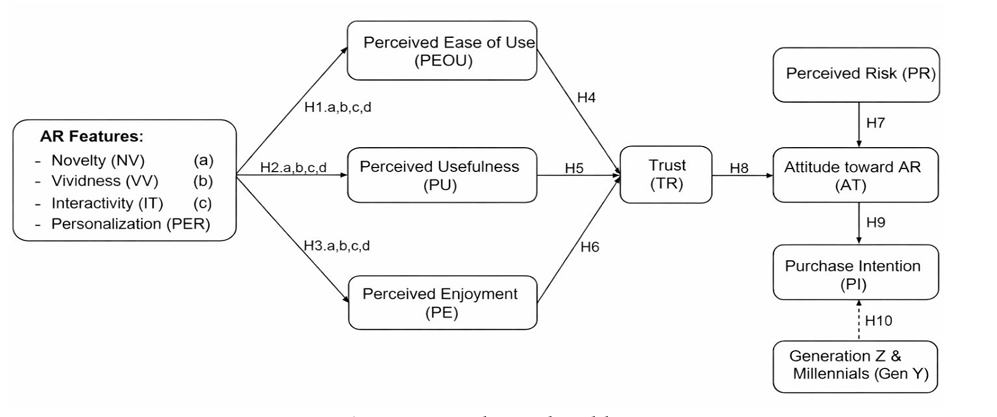
The present study evaluates the impact of augmented reality (AR) technology on online purchase intent in the cosmetics industry. At the same time, the study analyzes the differences in perceptions and attitudes between Gen Z and Millennials in Hanoi. The research integrates both qualitative and quantitative methodologies. The authors conducted direct surveys with two groups of participants, Gen Z and Millennials in Hanoi, who had prior experience using AR in cosmetic shopping. A total of 520 questionnaires were obtained from the survey, of which 475 valid responses were used for analysis. The SEM model was employed to analyze the collected data. The results of the study show that factors related to AR technology all positively influence intermediate variables and online purchase intent. Specifically, the perception of usefulness and ease of use has a positive effect on customer trust. Beliefs positively impact attitudes, and attitudes have a drive to purchase intentions. Factors such as interactivity, intuitiveness, and personalization of AR technology all contribute to improving consumers' awareness of product value and experience. The results also showed differences between the two groups of customers, with the impact of interactivity on sensory experience stronger among Millennials, while personalization had a greater impact on Gen Z. These findings offer important managerial implications for businesses in optimizing the use of AR technology in marketing, enhancing customer experience, fostering online purchase intention.
References
Ajzen, I. (1991). The theory of planned behavior. Organizational behavior and human decision processes, 50(2), 179-211.
Armstrong, G., Adam, S., Denize, S., & Kotler, P. (2018). Principles of marketing Edition. Pearson Education Limited.
Azuma, R. T. (1997). A survey of augmented reality. Presence: teleoperators & virtual environments, 6(4), 355-385.
Bauer, R. A. (1960). Consumer behavior as risk taking. In Proceedings of the 43rd National Conference of the American Marketing Assocation, June 15, 16, 17, Chicago, Illinois, 1960. American Marketing Association.
Bauer, R. A. (1967). Consumer behavior as risk taking. Marketing: Critical perspectives on business and management, 593, 13-21.
Chiu, C. M., Hsu, M. H., Lai, H., & Chang, C. M. (2012). Re-examining the influence of trust on online repeat purchase intention: The moderating role of habit and its antecedents. Decision support systems, 53(4), 835-845.
Cook, A. V., Ohri, L., Kusumoto, L., Reynolds, C., & Schwertzel, E. (2020, January 10). Augmented shopping: The quiet revolution. Deloitte Insights. https://www.deloitte.com/us/en/insights/topics/emerging-technologies/augmented-shopping-3d-technology-retail.html
Davis, F. D. (1989). Perceived usefulness, perceived ease of use, and user acceptance of information technology. MIS quarterly, 13(3), 319-340.
Davis, F. D., Bagozzi, R. P., & Warshaw, P. R. (1992). Extrinsic and intrinsic motivation to use computers in the workplace 1. Journal of applied social psychology, 22(14), 1111-1132.
Fauska, P., Kryvinska, N., & Strauss, C. (2013). The role of e-commerce in B2B markets of goods and services. International Journal of Services, Economics and Management, 5(1-2), 41-71.
Featherman, M. S., & Pavlou, P. A. (2003). Predicting e-services adoption: a perceived risk facets perspective. International journal of human-computer studies, 59(4), 451-474.
Fishbein, M., & Ajzen, I. (1977). Belief, attitude, intention, and behavior: An introduction to theory and research.
Google, Temasek, & Bain & Company. (2023). e-Conomy SEA 2023: Reaching new heights: Navigating the path to profitable growth. https://www.temasek.com.sg/content/dam/temasek-corporate/news-and-views/resources/reports/google-temasek-bain-e-conomy-sea-2023-report.pdf
Grubert, J., & Grasset, R. (2013). Augmented reality for Android application development. Packt Pub.
Hai Yen. (2026, March 20). Vietnam's retail beauty, personal care market expands 30% in 2025 amid intense competition. The Investor. https://theinvestor.vn/vietnams-retail-beauty-personal-care-market-expands-30-in-2025-amid-intense-competition-d18652.html
Hassenzahl, M., Diefenbach, S., & Göritz, A. (2010). Needs, affect, and interactive products-Facets of user experience. Interacting with computers, 22(5), 353-362.
Hsu, C. L., & Lin, J. C. C. (2008). Acceptance of blog usage: The roles of technology acceptance, social influence and knowledge sharing motivation. Information & management, 45(1), 65-74.
Joko Wijoseno, W., & Ariyanti, M. (2017). Perceived factors influencing consumer trust and its impact on online purchase intention in Indonesia. International Journal of Science and Research, 6(8), 961-968.
Jo, H., & Park, D. H. (2023). Affordance, usefulness, enjoyment, and aesthetics in sustaining virtual reality engagement. Scientific Reports, 13(1), 15097.
Lissitsa, S., & Kol, O. (2016). Generation X vs. Generation Y–A decade of online shopping. Journal of retailing and consumer services, 31, 304-312.
Luhmann, N. (2000). Familiarity, confidence, trust: Problems and alternatives. Trust: Making and breaking cooperative relations, 6(1), 94-107.
Mayer, R. C., Davis, J. H., & Schoorman, F. D. (1995). An integrative model of organizational trust. Academy of management review, 20(3), 709-734.
McLean, G., & Wilson, A. (2019). Shopping in the digital world: Examining customer engagement through augmented reality mobile applications. Computers in human behavior, 101, 210-224.
Ntoa, S. (2025). Usability and user experience evaluation in intelligent environments: A review and reappraisal. International Journal of Human-Computer Interaction, 41(5), 2829-2858.
Pavlou, P. A. (2003). Consumer acceptance of electronic commerce: Integrating trust and risk with the technology acceptance model. International journal of electronic commerce, 7(3), 101-134.
Pine, B. J., & Gilmore, J. H. (1998). Welcome to the experience economy.
Quaresma, M., Soares, M. M., & Correia, M. (2022). UX Concepts and Perspectives–From Usability to User-Experience Design. In Handbook of Usability and User-Experience (pp. 3-16). CRC Press.
Rousseau, D. M., Sitkin, S. B., Burt, R. S., & Camerer, C. (1998). Not so different after all: A cross-discipline view of trust. Academy of management review, 23(3), 393-404.
Smink, A. R., Frowijn, S., van Reijmersdal, E. A., van Noort, G., & Neijens, P. C. (2019). Try online before you buy: How does shopping with augmented reality affect brand responses and personal data disclosure. Electronic Commerce Research and Applications, 35, 100854.
Suryadi, N., Zulfikar, R., & Prasarry, Y. V. (2025). AI product knowledge as moderator of trust and attitude in usage intention: a study of Indonesian postgraduates. Cogent Social Sciences, 11(1), 2526799.
Thuy Dung. (2025, January 7). Viet Nam's e-commerce hits US$25 billion in 2024. Viet Nam Government Portal. https://en.baochinhphu.vn/viet-nams-e-commerce-market-up-20-in-2024-111250107155234946.htm
Turban, E., Outland, J., King, D., Lee, J. K., Liang, T. P., & Turban, D. C. (2018). Electronic commerce 2018: a managerial and social networks perspective (Vol. 2017). Cham: springer.
Van der Heijden, H., Verhagen, T., & Creemers, M. (2003). Understanding online purchase intentions: contributions from technology and trust perspectives. European journal of information systems, 12(1), 41-48.
Venkatesh, V., & Davis, F. D. (2000). A theoretical extension of the technology acceptance model: Four longitudinal field studies. Management science, 46(2), 186-204.
Yim, M. Y. C., Chu, S. C., & Sauer, P. L. (2017). Is augmented reality technology an effective tool for e-commerce? An interactivity and vividness perspective. Journal of interactive marketing, 39(1), 89-103.
Downloads
Published
Issue
Section
License
Copyright (c) 2026 Ha NGUYEN- VAN, Thuy Luong Thanh, Hai-Anh Nguyen, Yen LE-THI- HAI, Huong HOANG- LAN, Linh NGUYEN- NGOC (Author)

This work is licensed under a Creative Commons Attribution 4.0 International License.