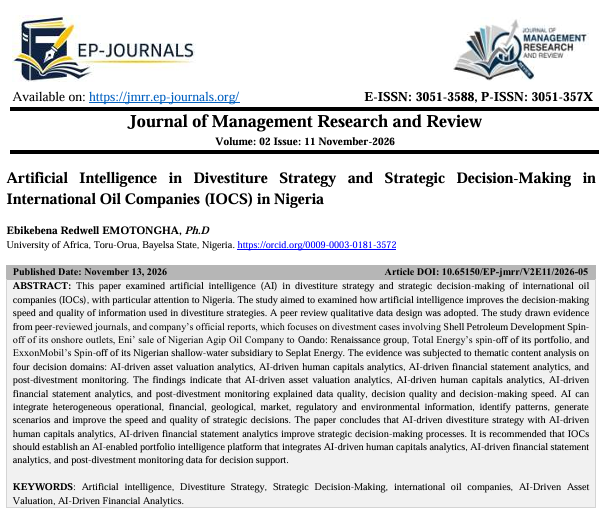
Artificial Intelligence in Divestiture Strategy and Strategic Decision-Making in International Oil Companies (IOCS) in Nigeria
DOI:
https://doi.org/10.65150/EP-jmrr/V2E11/2026-06Keywords:
Artificial intelligence, Divestiture Strategy, Strategic Decision-Making, international oil companies, AI-Driven Asset Valuation, AI-Driven Financial Analytics.Abstract
This paper examined artificial intelligence (AI) in divestiture strategy and strategic decision-making of international oil companies (IOCs), with particular attention to Nigeria. The study aimed to examined how artificial intelligence improves the decision-making speed and quality of information used in divestiture strategies. A peer review qualitative data design was adopted. The study drawn evidence from peer-reviewed journals, and company’s official reports, which focuses on divestment cases involving Shell Petroleum Development Spin-off of its onshore outlets, Eni’ sale of Nigerian Agip Oil Company to Oando: Renaissance group, Total Energy’s spin-off of its portfolio, and ExxonMobil’s Spin-off of its Nigerian shallow-water subsidiary to Seplat Energy. The evidence was subjected to thematic content analysis on four decision domains: AI-driven asset valuation analytics, AI-driven human capitals analytics, AI-driven financial statement analytics, and post-divestment monitoring. The findings indicate that AI-driven asset valuation analytics, AI-driven human capitals analytics, AI-driven financial statement analytics, and post-divestment monitoring explained data quality, decision quality and decision-making speed. AI can integrate heterogeneous operational, financial, geological, market, regulatory and environmental information, identify patterns, generate scenarios and improve the speed and quality of strategic decisions. The paper concludes that AI-driven divestiture strategy with AI-driven human capitals analytics, AI-driven financial statement analytics improve strategic decision-making processes. It is recommended that IOCs should establish an AI-enabled portfolio intelligence platform that integrates AI-driven human capitals analytics, AI-driven financial statement analytics, and post-divestment monitoring data for decision support.
References
1) Abolarin, S. K., Fevrier, K., & Abdulsamad, A. (2025). Navigating the energy transition: International oil company divestments and the stranded asset dilemma in Africa. The Extractive Industries and Society, 24, 101737. https://doi.org/10.1016/j.exis.2025.101737
2) Csaszar, F. A., Ketkar, H., & Kim, H. (2024). Artificial intelligence and strategic decision making: Evidence from entrepreneurs and investors. Strategy Science, 9(4), 322–345.https://doi.org/10.1287/stsc.2024.0190
3) Dai, L., Sheng, B., Chen, T., Wu, Q., Liu, R., Cai, C., ... & Jia, W. (2024). A deep learning system for predicting time to progression of diabetic retinopathy. Nature medicine, 30(2), 584-594.
4) Danach, K., Rammal, A., Moukadem, I., Harb, H., & Nasser, A. (2025). Advanced optimization in e-commerce logistics: Combining matheuristics with random forests for hub location efficiency. IEEE Access, 13, 55915-55926.
5) Eni. (2024). Eni: Sale of NAOC to Oando completed. Eni press release. ExxonMobil. (2022, February 25). ExxonMobil to sell Mobil Producing Nigeria shallow water affiliate. ExxonMobil news release.
6) Emotongha, E. R., & Bayo, P. L. (2024). Lean production strategies and environmental sustainability of Industrial Goods Companies in Nigeria. Responsible Consumption, Production and Accounting in Emerging Economies, 731.
7) Kolev, K. D. (2016). To divest or not to divest: A meta‐analysis of the antecedents of corporate divestitures. British Journal of Management, 27(1), 179-196.
8) Nawaz, N., Arunachalam, H., Pathi, B. K., & Gajenderan, V. (2024). The adoption of artificial intelligence in human resources management practices. International journal of information management data insights, 4(1), 100208.
9) NIST. (2023). Artificial Intelligence Risk Management Framework (AI RMF 1.0) (NIST AI 1001). National Institute of Standards and Technology. https://doi.org/10.6028/NIST.AI.100 1
10) NIST. (2024). Artificial Intelligence Risk Management Framework: Generative Artificial Intelligence Profile (NIST AI 600-1).
11) National Institute of Standards and Technology. Shell. (2024). Shell agrees to sell Nigerian onshore subsidiary, SPDC.
12) Sedky, A. (2026). Decision-Making Quality as a Strategic Enabler of Organizational Success.Architecting Strategic Business Transformation Through Data-Driven Systems, 1-36.
13) Shell Global (2025, March 13). Shell completes sale of SPDC to focus its portfolio in Nigeria on Deepwater and Integrated Gas positions. Shell Global. TotalEnergies. Total completes sale of its interest in onshore OML 17.
14) Tabassi, E. (2023). Artificial intelligence risk management framework (AI RMF 1.0).
15) Total Energies (2025). Nigeria: Total Energies completes the divestment of its non-operated interest in the Bonga field. Total Energies.
16) Tonye, A. F., Mazzacano, P. M., & Matthew, I. O. (2025). Multinational oil companies’ onshore asset divestment and oil production in Nigeria. International Journal of Research, 12(3), 23-31.
17) Oni, E. O., Fajobi, M. A., Obafemi, P. S., & Okunade, S. K. (2026). Global divestment of international oil companies: Beyond the Nigerian experience. Frontiers in Political Science, 8. https://doi.org/10.3389/fpos.2026.1769928.
Downloads
Published
Issue
Section
License
Copyright (c) 2026 Ebikebena Redwell EMOTONGHA, Ph.D (Author)

This work is licensed under a Creative Commons Attribution 4.0 International License.