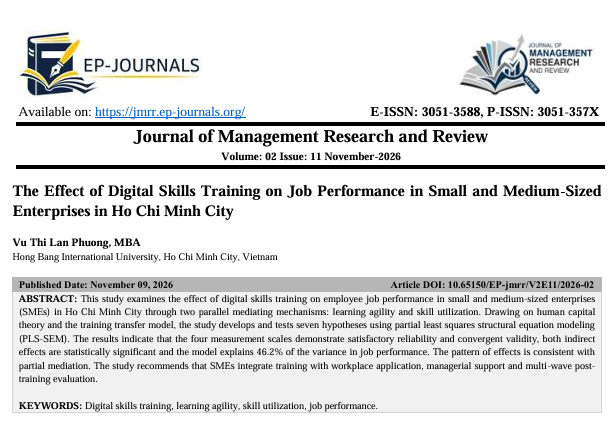
The Effect of Digital Skills Training on Job Performance in Small and Medium-Sized Enterprises in Ho Chi Minh City
DOI:
https://doi.org/10.65150/EP-jmrr/V2E11/2026-02Keywords:
Digital skills training, learning agility, skill utilization, job performance.Abstract
This study examines the effect of digital skills training on employee job performance in small and medium-sized enterprises (SMEs) in Ho Chi Minh City through two parallel mediating mechanisms: learning agility and skill utilization. Drawing on human capital theory and the training transfer model, the study develops and tests seven hypotheses using partial least squares structural equation modeling (PLS-SEM). The results indicate that the four measurement scales demonstrate satisfactory reliability and convergent validity, both indirect effects are statistically significant and the model explains 46.2% of the variance in job performance. The pattern of effects is consistent with partial mediation. The study recommends that SMEs integrate training with workplace application, managerial support and multi-wave post-training evaluation.
References
1) Audrin, B., Audrin, C., & Salamin, X. (2024). Digital skills at work: Conceptual development and empirical validation of a measurement scale. Technological Forecasting and Social Change, 202, 123279. https://doi.org/10.1016/j.techfore.2024.123279
2) Baldwin, T. T., & Ford, J. K. (1988). Transfer of training: A review and directions for future research. Personnel Psychology, 41(1), 63–105. https://doi.org/10.1111/j.1744-6570.1988.tb00632.x
3) Blume, B. D., Ford, J. K., Baldwin, T. T., & Huang, J. L. (2010). Transfer of training: A meta-analytic review. Journal of Management, 36(4), 1065–1105. https://doi.org/10.1177/0149206309352880
4) Bouwmans, M., Lub, X., Orlowski, M., & Nguyen, T.-V. (2024). Developing the digital transformation skills framework: A systematic literature review approach. PLOS ONE, 19(7), e0304127. https://doi.org/10.1371/journal.pone.0304127
5) Dao, T. H. A., Sisavath, C., Bui, H. T. T., Bui, T. Q., & Le, T. H. (2025). Digital workforce training, employee motivation, job satisfaction, digital behavior as determinants of employee performance: Empirical research from Vietnam. SAGE Open, 15(4), 1–20. https://doi.org/10.1177/21582440251395698
6) Fu, F., Zha, W., & Zhou, Q. (2023). The impact of enterprise digital capability on employee sustainable performance: From the perspective of employee learning. Sustainability, 15(17), 12897. https://doi.org/10.3390/su151712897
7) Government of Vietnam. (2021). Decree No. 80/2021/ND-CP dated August 26, 2021, detailing and guiding the implementation of certain articles of the Law on Support for Small and Medium-Sized Enterprises [in Vietnamese].
https://vanban.chinhphu.vn/?docid=203941&pageid=27160
8) Grossman, R., & Salas, E. (2011). The transfer of training: What really matters. International Journal of Training and Development, 15(2), 103–120. https://doi.org/10.1111/j.1468-2419.2011.00373.x
9) Guo, H., Yang, Z., Huang, R., & Guo, A. (2020). The digitalization and public crisis responses of small and medium enterprises: Implications from a COVID-19 survey. Frontiers of Business Research in China, 14, Article 19. https://doi.org/10.1186/s11782-020-00087-1
10) Hair, J. F., Risher, J. J., Sarstedt, M., & Ringle, C. M. (2019). When to use and how to report the results of PLS-SEM. European Business Review, 31(1), 2–24. https://doi.org/10.1108/EBR-11-2018-0203
11) Henseler, J., Ringle, C. M., & Sarstedt, M. (2015). A new criterion for assessing discriminant validity in variance-based structural equation modeling. Journal of the Academy of Marketing Science, 43(1), 115–135. https://doi.org/10.1007/s11747-014-0403-8
12) Jo, Y., & Hong, A. J. (2022). Impact of agile learning on innovative behavior: A moderated mediation model of employee engagement and perceived organizational support. Frontiers in Psychology, 13, Article 900830. https://doi.org/10.3389/fpsyg.2022.900830
13) Kock, N., & Hadaya, P. (2018). Minimum sample size estimation in PLS-SEM: The inverse square root and gamma-exponential methods. Information Systems Journal, 28(1), 227–261. https://doi.org/10.1111/isj.12131
14) Koehorst, M. M., van Deursen, A. J. A. M., van Dijk, J. A. G. M., & de Haan, J. (2021). A systematic literature review of organizational factors influencing 21st-century skills. SAGE Open, 11(4), 1–16. https://doi.org/10.1177/21582440211067251
15) Koopmans, L. (2014). Measuring individual work performance [Doctoral dissertation, Vrije Universiteit Amsterdam]. TNO.
16) Lee, J., & Song, J. H. (2020). Developing a conceptual integrated model for the employee’s learning agility. Performance Improvement Quarterly, 34(4), 367–394. https://doi.org/10.1002/piq.21352
17) Lopes, A. S., Sargento, A., & Farto, J. (2023). Training in digital skills—The perspective of workers in the public sector. Sustainability, 15(13), 10577. https://doi.org/10.3390/su151310577
18) Lou, Y., Hong, A., & Li, Y. (2024). Assessing the role of HRM and HRD in enhancing sustainable job performance and innovative work behaviors through digital transformation in ICT companies. Sustainability, 16(12), 5162. https://doi.org/10.3390/su16125162
19) Mehner, L., Rothenbusch, S., & Kauffeld, S. (2025). How to maximize the impact of workplace training: A mixed-method analysis of social support, training transfer and knowledge sharing. European Journal of Work and Organizational Psychology, 34(2), 201–217. https://doi.org/10.1080/1359432X.2024.2319082
20) Mendoza-Chan, J., & Pee, L. G. (2024). Digital skilling of working adults: A systematic review. Computers & Education, 218, 105076. https://doi.org/10.1016/j.compedu.2024.105076
21) Mhaske, P., Bhattacharjee, B., Haldar, N., Upadhyay, P., & Mandal, A. (2025). Bridging digital skill gaps in the global workforce: A synthesis and conceptual framework building. Research in Globalization, 11, 100311. https://doi.org/10.1016/j.resglo.2025.100311
22) Okay-Somerville, B., & Scholarios, D. (2019). A multilevel examination of skills-oriented human resource management and perceived skill utilization during recession: Implications for the well-being of all workers. Human Resource Management, 58(2), 139–154. https://doi.org/10.1002/hrm.21941
23) Podsakoff, P. M., MacKenzie, S. B., Lee, J.-Y., & Podsakoff, N. P. (2003). Common method biases in behavioral research: A critical review of the literature and recommended remedies. Journal of Applied Psychology, 88(5), 879–903.
https://doi.org/10.1037/0021-9010.88.5.879
24) Priyono, A., Moin, A., & Putri, V. N. A. O. (2020). Identifying digital transformation paths in the business model of SMEs during the COVID-19 pandemic. Journal of Open Innovation: Technology, Market, and Complexity, 6(4), 104.
https://doi.org/10.3390/joitmc6040104
25) Qiao, G., Li, Y., & Hong, A. (2024). The strategic role of digital transformation: Leveraging digital leadership to enhance employee performance and organizational commitment in the digital era. Systems, 12(11), 457. https://doi.org/10.3390/systems12110457
26) Reyes, L.-E., Blanco, M.-R., & Pinillos, M.-J. (2024). Past, present, and future of learning agility: A bibliometric and content analysis. Human Resource Development Review, 23(4), 462–497. https://doi.org/10.1177/15344843241258522
27) Spante, M., Sofkova Hashemi, S., Lundin, M., & Algers, A. (2018). Digital competence and digital literacy in higher education research: Systematic review of concept use. Cogent Education, 5(1), 1519143. https://doi.org/10.1080/2331186X.2018.1519143
28) Tinmaz, H., Lee, Y.-T., Fanea-Ivanovici, M., & Baber, H. (2022). A systematic review on digital literacy. Smart Learning Environments, 9, Article 21. https://doi.org/10.1186/s40561-022-00204-y
29) Trenerry, B., Chng, S., Wang, Y., Suhaila, Z. S., Lim, S. S., Lu, H. Y., & Oh, P. H. (2021). Preparing workplaces for digital transformation: An integrative review and framework of multi-level factors. Frontiers in Psychology, 12, Article 620766.
https://doi.org/10.3389/fpsyg.2021.620766
30) van Laar, E., van Deursen, A. J. A. M., van Dijk, J. A. G. M., & de Haan, J. (2017). The relation between 21st-century skills and digital skills: A systematic literature review. Computers in Human Behavior, 72, 577–588. https://doi.org/10.1016/j.chb.2017.03.010
31) van Laar, E., van Deursen, A. J. A. M., van Dijk, J. A. G. M., & de Haan, J. (2020). Determinants of 21st-century skills and 21st-century digital skills for workers: A systematic literature review. SAGE Open, 10(1), 1–14. https://doi.org/10.1177/2158244019900176
Downloads
Published
Issue
Section
License
Copyright (c) 2026 Vu Thi Lan Phuong, MBA (Author)

This work is licensed under a Creative Commons Attribution 4.0 International License.