Investigating the Moderator Effects of Perceived Risk in Customer Satisfaction - Customer Loyalty Relationship: A Moderated Mediation Approach
DOI:
https://doi.org/10.65150/EP-jmrr/V2E3/2026-05Keywords:
Customer satisfaction, customer loyalty, destination image, perceived risk, service quality.Abstract
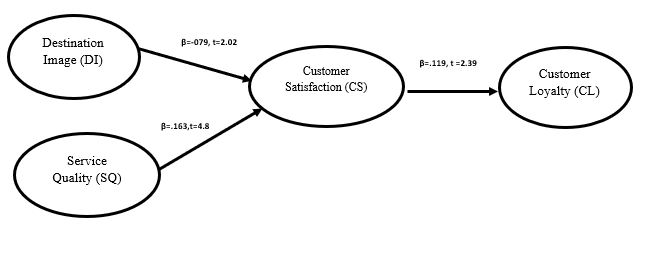
Consumers review each destination based on their previous experience. The role of customer satisfaction and loyalty is vital to discover. The study focused on destination marketing. Chennai, a metropolitan city with corporate-level hospitals, was covered for data collection by adopting a survey-based method covering participants (n 1050) were patients and attendees. Destination image and service quality are the independent variables; customer satisfaction is the moderator, and customer loyalty is the dependent variable. The researcher examined the moderating role of perceived risk; thus, the present study is based on a moderation and mediation approach. The study found that destination image and service quality directly impact customer satisfaction and loyalty. And perceived risk moderated the significant relationship between customer satisfaction and loyalty.
References
1) Ajzen, I. (1991) ‘The theory of planned behavior’, Organizational Behavior and Human Decision Processes, 50(2), pp. 179–211.
2) Baker, D.A. and Crompton, J.L. (2000) ‘Quality, satisfaction and behavioral intentions’, Annals of Tourism Research, 27(3), pp. 785–804.
3) Baloglu, S. and McCleary, K.W. (1999) ‘A model of destination image formation’, Annals of Tourism Research, 26(4), pp. 868–897.
4) Baloglu, S. (2000) ‘A path analytic model of visitation intention involving information sources, socio-psychological motivations, and destination image’, Journal of Travel & Tourism Marketing, 8(3), pp. 81–90.
5) Baron, R.M. and Kenny, D.A. (1986) ‘The moderator–mediator variable distinction in social psychological research’, Journal of Personality and Social Psychology, 51(6), pp. 1173–1182.
6) Bauer, R.A. (1960) ‘Consumer behavior as risk taking’, in Proceedings of the American Marketing Association Conference, Chicago.
7) Bigne, J.E., Sanchez, M.I. and Sanchez, J. (2001) ‘Tourism image, evaluation variables and after purchase behaviour’, Tourism Management, 22(6), pp. 607–616.
8) Bosque, I.R. and Martín, H.S. (2008) ‘Tourist satisfaction: A cognitive-affective model’, Annals of Tourism Research, 35(2), pp. 551–573.
9) Boulding, W., Kalra, A., Staelin, R. and Zeithaml, V.A. (1993) ‘A dynamic process model of service quality’, Journal of Marketing Research, 30, pp. 7–27.
10) Chan, W.C. et al. (2022) ‘Drivers influencing tourists’ satisfaction and revisit intention’, Journal of Ecotourism, 21(2), pp. 147–165.
11) Chaturvedi, P. et al. (2022) ‘Impact of sustainable practices on satisfaction and revisit intention’, Asia-Pacific Journal of Business Administration.
12) Chen, C.F. and Phou, S. (2013) ‘Destination image, personality, relationship and loyalty’, Tourism Management, 36, pp. 269–278.
13) Chen, C.F. and Tsai, D. (2007) ‘Destination image and behavioral intentions’, Tourism Management, 28(4), pp. 1115–1122.
14) Chi, C.G.Q. and Qu, H. (2008) ‘Destination image, satisfaction and loyalty’, Tourism Management, 29(4), pp. 624–636.
15) Cox, D.F. and Rich, S.V. (1964) ‘Perceived risk and consumer decision making’, Journal of Marketing Research, 1, pp. 32–39.
16) Crompton, J.L. (1979) ‘Motivations for pleasure vacation’, Annals of Tourism Research, 6(4), pp. 408–424.
17) Cronin, J.J. and Taylor, S.A. (1992) ‘Measuring service quality’, Journal of Marketing, 56, pp. 55–68.
18) Cronin, J.J., Brady, M.K. and Hult, G.T.M. (2000) ‘Effects of quality, value and satisfaction on behavioral intentions’, Journal of Retailing, 76(2), pp. 193–218.
19) Dowling, G.R. and Staelin, R. (1994) ‘A model of perceived risk’, Journal of Consumer Research, 21(1), pp. 119–134.
20) Echtner, C.M. and Ritchie, J.B. (1991) ‘Measurement of destination image’, Journal of Tourism Studies, 2(2), pp. 2–12.
21) Elgarhy, S.D. and Mohamed, L.M. (2022) ‘Marketing mix and loyalty’, Journal of Quality Assurance in Hospitality & Tourism.
22) Fornell, C. and Larcker, D.F. (1981) ‘Evaluating structural equation models’, Journal of Marketing Research, pp. 39–50.
23) Gallarza, M.G. et al. (2011) ‘Customer value’, Journal of Consumer Behaviour, 10, pp. 179–191.
24) Goodrich, J.N. (1978) ‘Preferences and perceptions of destinations’, Journal of Travel Research, 17(2), pp. 8–13.
25) Hair, J.F. et al. (2011) ‘PLS-SEM: A silver bullet?’, Journal of Marketing Theory and Practice, 19(2), pp. 139–152.
26) Hair, J.F. et al. (2014) A Primer on Partial Least Squares Structural Equation Modeling (PLS-SEM). SAGE.
27) Hayes, A.F. (2009) ‘Statistical mediation analysis’, Communication Monographs, 76(4), pp. 408–420.
28) Henseler, J., Ringle, C.M. and Sarstedt, M. (2015) ‘Discriminant validity in SEM’, Journal of the Academy of Marketing Science, 43(1), pp. 115–135.
29) Homburg, C. and Giering, A. (2001) ‘Moderators of satisfaction–loyalty relationship’, Psychology & Marketing, 18(1), pp. 43–66.
30) Howard, J.A. and Sheth, J.N. (1969) The Theory of Buyer Behavior. New York: Wiley.
31) Lee, H., Lee, Y. and Yoo, D. (2000) ‘Determinants of perceived quality’, Journal of Services Marketing, 14(3).
32) Maghrifani, D. et al. (2022) ‘Travel intentions and motivations’, Journal of Travel Research, 61(5), pp. 1121–1137.
33) Nilashi, M. et al. (2022) ‘Traveller satisfaction during COVID-19’, Journal of Retailing and Consumer Services, 64.
34) Oliver, R.L. (1993) ‘Service quality and satisfaction’, Advances in Service Marketing, 2, pp. 65–85.
35) Podsakoff, P.M. et al. (2003) ‘Common method bias’, Journal of Applied Psychology, 88, pp. 879–903.
36) Preacher, K.J. and Hayes, A.F. (2008) ‘Mediation analysis’, Behavior Research Methods, 40(3), pp. 879–891.
37) Ringle, C.M., Wende, S. and Becker, J.M. (2015) SmartPLS 3. Hamburg.
38) Sanchez, J. et al. (2006) ‘Perceived value of tourism product’, Tourism Management, 27(3), pp. 394–409.
39) Sweeney, J.C. and Soutar, G.N. (2001) ‘Consumer perceived value scale’, Journal of Retailing, 77(2), pp. 203–220.
40) Triandewo, M.A. et al. (2023) ‘Customer satisfaction and loyalty’, Bustechno Journal, 4(1), pp. 98–109.
41) Wang, L.H. et al. (2022) ‘TPB model and travel intention’, Tourism Review.
42) Wold, H. (1985) ‘Partial least squares’, in Encyclopedia of Statistical Sciences.
43) Woodside, A.G. and Lysonski, S. (1989) ‘Destination choice model’, Journal of Travel Research, 27(4), pp. 8–14.
44) Zeithaml, V.A., Berry, L.L. and Parasuraman, A. (1996) ‘Behavioral consequences of service quality’, Journal of Marketing, pp. 31–46.
Downloads
Published
Issue
Section
License
Copyright (c) 2026 Dr. Joseph Mary Rahila, Dr. Joshua Daniel Egan (Author)

This work is licensed under a Creative Commons Attribution 4.0 International License.