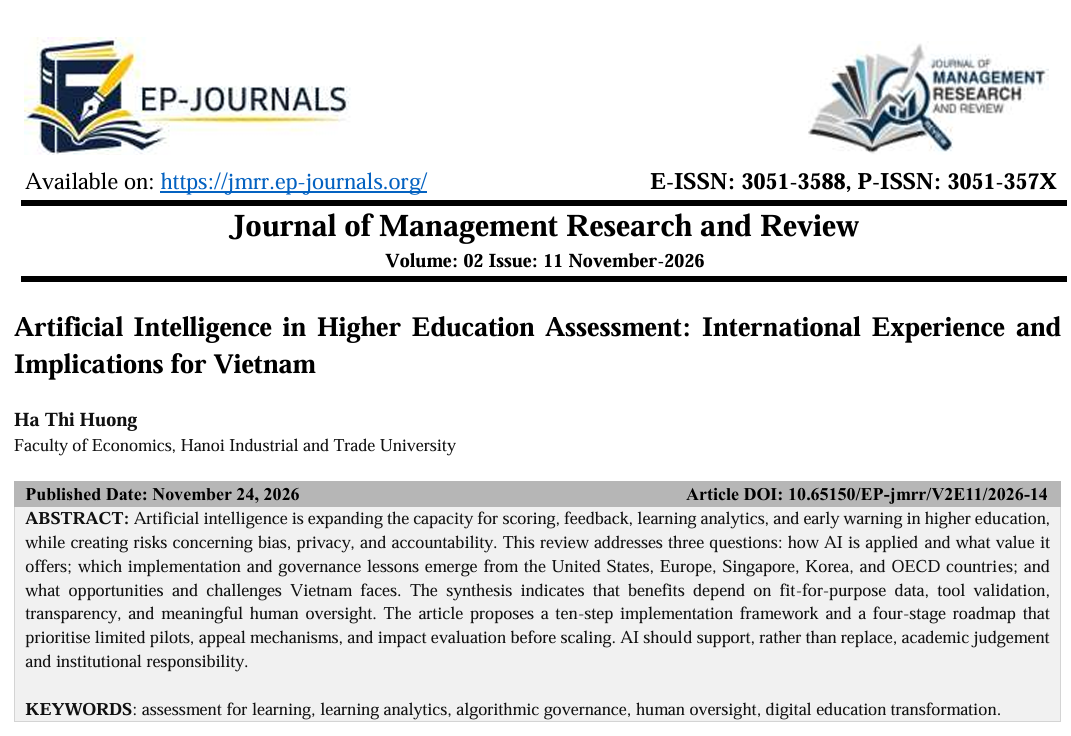
Artificial Intelligence in Higher Education Assessment: International Experience and Implications for Vietnam
DOI:
https://doi.org/10.65150/EP-jmrr/V2E11/2026-14Keywords:
assessment for learning, learning analytics, algorithmic governance, human oversight, digital education transformation.Abstract
Artificial intelligence is expanding the capacity for scoring, feedback, learning analytics, and early warning in higher education, while creating risks concerning bias, privacy, and accountability. This review addresses three questions: how AI is applied and what value it offers; which implementation and governance lessons emerge from the United States, Europe, Singapore, Korea, and OECD countries; and what opportunities and challenges Vietnam faces. The synthesis indicates that benefits depend on fit-for-purpose data, tool validation, transparency, and meaningful human oversight. The article proposes a ten-step implementation framework and a four-stage roadmap that prioritise limited pilots, appeal mechanisms, and impact evaluation before scaling. AI should support, rather than replace, academic judgement and institutional responsibility.
References
1) Black, P., & Wiliam, D. (2009). Developing the theory of formative assessment. Educational Assessment, Evaluation and Accountability, 21(1), 5–31. https://doi.org/10.1007/s11092-008-9068-5
2) Government of Vietnam. (2023). Decree No. 13/2023/ND-CP dated April 17, 2023 on personal data protection.
https://vanban.chinhphu.vn/?classid=1&docid=207759&pageid=27160
3) European Commission. (2022). Ethical guidelines on the use of artificial intelligence (AI) and data in teaching and learning for educators. Publications Office of the European Union. https://doi.org/10.2766/153756
4) Ifenthaler, D., & Yau, J. Y.-K. (2020). Utilising learning analytics to support study success in higher education: A systematic review. Educational Technology Research and Development, 68, 1961–1990. https://doi.org/10.1007/s11423-020-09788-z
5) Ministry of Education, Republic of Korea. (2023, June 9). Briefing on the plan for AI digital textbooks.https://english.moe.go.kr/boardCnts/view.do?boardID=254&boardSeq=95291&lev=0&m=0302&opType=N&page=4&s=english
6) Ministry of Education, Singapore. (2025, December 5). Artificial intelligence in education. https://www.moe.gov.sg/education-in-sg/educational-technology-journey/edtech-masterplan/artificial-intelligence-in-education
7) OECD. (2021). OECD digital education outlook 2021: Pushing the frontiers with artificial intelligence, blockchain and robots. OECD Publishing. https://doi.org/10.1787/589b283f-en
8) Prime Minister of Vietnam. (2020). Decision No. 749/QD-TTg dated June 3, 2020 approving the National Digital Transformation Program to 2025, with orientations to 2030. https://tulieuvankien.dangcongsan.vn/he-thong-van-ban/van-ban-quy-pham-phap-luat/quyet-dinh-so-749qd-ttg-ngay-0362020-cua-thu-tuong-chinh-phu-phe-duyet-chuong-trinh-chuyen-doi-so-quoc-gia-den-nam-2025-dinh-huong-6476
9) UNESCO. (2023). Guidance for generative AI in education and research. https://unesdoc.unesco.org/ark:/48223/pf0000386693
10) U.S. Department of Education, Office of Educational Technology. (2023). Artificial intelligence and the future of teaching and learning: Insights and recommendations. https://eric.ed.gov/?id=ED631097
Downloads
Published
Issue
Section
License
Copyright (c) 2026 Ha Thi Huong (Author)

This work is licensed under a Creative Commons Attribution 4.0 International License.