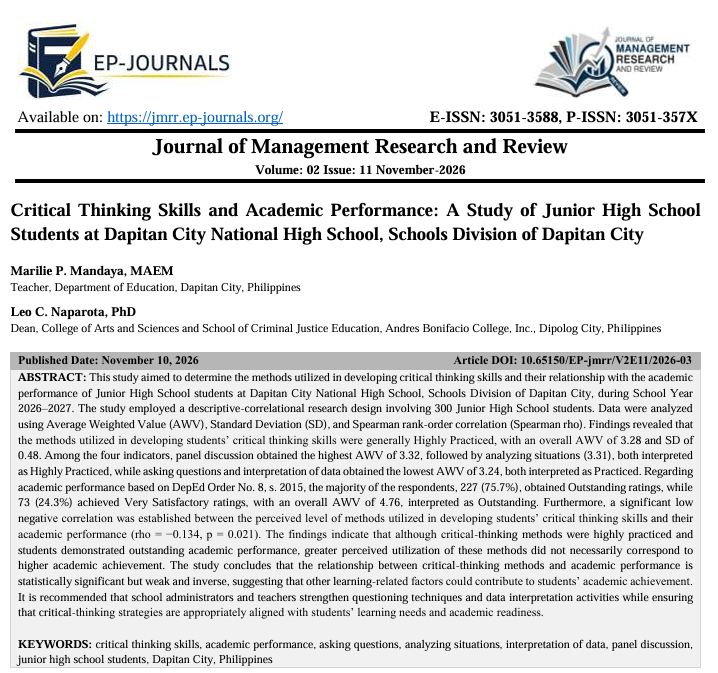
Critical Thinking Skills and Academic Performance: A Study of Junior High School Students at Dapitan City National High School, Schools Division of Dapitan City
DOI:
https://doi.org/10.65150/EP-jmrr/V2E11/2026-03Keywords:
critical thinking skills, academic performance, asking questions, analyzing situations, interpretation of data, panel discussion, junior high school students, Dapitan City, PhilippinesAbstract
This study aimed to determine the methods utilized in developing critical thinking skills and their relationship with the academic performance of Junior High School students at Dapitan City National High School, Schools Division of Dapitan City, during School Year 2026–2027. The study employed a descriptive-correlational research design involving 300 Junior High School students. Data were analyzed using Average Weighted Value (AWV), Standard Deviation (SD), and Spearman rank-order correlation (Spearman rho). Findings revealed that the methods utilized in developing students’ critical thinking skills were generally Highly Practiced, with an overall AWV of 3.28 and SD of 0.48. Among the four indicators, panel discussion obtained the highest AWV of 3.32, followed by analyzing situations (3.31), both interpreted as Highly Practiced, while asking questions and interpretation of data obtained the lowest AWV of 3.24, both interpreted as Practiced. Regarding academic performance based on DepEd Order No. 8, s. 2015, the majority of the respondents, 227 (75.7%), obtained Outstanding ratings, while 73 (24.3%) achieved Very Satisfactory ratings, with an overall AWV of 4.76, interpreted as Outstanding. Furthermore, a significant low negative correlation was established between the perceived level of methods utilized in developing students’ critical thinking skills and their academic performance (rho = −0.134, p = 0.021). The findings indicate that although critical-thinking methods were highly practiced and students demonstrated outstanding academic performance, greater perceived utilization of these methods did not necessarily correspond to higher academic achievement. The study concludes that the relationship between critical-thinking methods and academic performance is statistically significant but weak and inverse, suggesting that other learning-related factors could contribute to students’ academic achievement. It is recommended that school administrators and teachers strengthen questioning techniques and data interpretation activities while ensuring that critical-thinking strategies are appropriately aligned with students’ learning needs and academic readiness
References
1) Aiken, L. S., & Susane, G. (2001). West multiple progression. Sage Publishing, Inc.
2) Cohen, J., Cohen, P., West, S. G., & Aiken, L. S. (2014). Applied multiple regression/correlation analysis for the behavioral sciences (3rd ed.). Routledge.
3) Creswell, J. W., & Guetterman, T. C. (2019). Educational research: Planning, conducting, and evaluating quantitative and qualitative research (6th ed.). Pearson.
4) Davies, M. J., & Esling, S. (2020). The use of Quality Talk to foster critical thinking in a low socio-economic secondary geography classroom. The Australian Journal of Language and Literacy, 43, 109–122.
5) Department of Education. (2015). Policy guidelines on classroom assessment for the K to 12 basic education program (DepEd Order No. 8, s. 2015). https://www.deped.gov.ph/2015/04/01/do-8-s-2015-policy-guidelines-on-classroom-assessment-for-the-k-to-12-basic-education-program/
6) Department of Education. (2026). Revised guidelines on classroom assessment, grading system, and awards and recognition for the K to 12 basic education program (DepEd Order No. 015, s. 2026).https://www.deped.gov.ph/wp-content/uploads/DO_s2026_015r.pdf
7) Dimacangun, F. E., & Guillena, J. (2023). Social media usage and the academic performance of Filipino junior high school students. International Journal of Educational Management and Development Studies, 4(2), 187–206. https://doi.org/10.53378/352994
8) Farillon, L. M. F. (2022). Scientific reasoning, critical thinking, and academic performance in science of selected Filipino senior high school students. Utamax: Journal of Ultimate Research and Trends in Education, 4(1), 50–62.https://doi.org/10.31849/utamax.v4i1.8284
9) Glazewski, K. D., & Ertmer, P. A. (2020). Fostering complex problem solving for diverse learners: Engaging an ethos of intentionality toward equitable access. Educational Technology Research and Development, 68, 679–702.
10) Guevarra, J.-J. D., Marquez, J. A. V., & Pecson, R. R. (2017). Development of students’ critical thinking skills at public secondary schools, Dinalupihan District: An assessment. International Journal of Advance Research and Innovative Ideas in Education, 3(2), 1450–1458.
11) Kurnia, A. B., Lowrie, T., & Patahuddin, S. M. (2024). The development of high school students’ statistical literacy across grade level. Mathematics Education Research Journal, 36(Suppl. 1), 7–35. https://doi.org/10.1007/s13394-023-00449-x
12) Lansangan, R. V., & Orleans, A. V. (2024). Exploring Filipino students’ critical thinking skills: Basis for enhancement of science laboratory class delivery. Science Education International, 35(3), 281–290. https://doi.org/10.33828/sei.v35.i3.11
13) Leighton, J. P., Cui, Y., & Cutumisu, M. (2021). Key information processes for thinking critically in data-rich environments. Frontiers in Education, 6, Article 561847. https://doi.org/10.3389/feduc.2021.561847
14) Liang, W., & Fung, D. (2020). Development and evaluation of a WebQuest-based teaching programme: Students’ use of exploratory talk to exercise critical thinking. International Journal of Educational Research, 104, Article 101652.
15) Luna, R. L., Garcia, H. E., & Bernas, R. F. (2024). Peer study and individualized learning in academic performance of the selected junior high school learners. Psychology and Education: A Multidisciplinary Journal, 21(5), 580–589.https://doi.org/10.5281/zenodo.12600581
16) Refugio, C. N., Galleto, P. G., & Torres, R. (2019). Competence landscape of grade 9 mathematics teachers: Basis for an enhancement program. Cypriot Journal of Educational Sciences, 14(2), 241–256. https://doi.org/10.18844/cjes.v14i2.4125
17) Reyes, E. C. (2017). Infusion of the critical thinking in chemistry through selected teaching strategies. JPAIR Multidisciplinary Research, 29(1), 108–124. https://doi.org/10.7719/jpair.v29i1.517
18) Ruel, E. E. (2018). 100 questions (and answers) about survey research. SAGE Publications.
19) Salmon, A. K., & Barrera, M. X. (2021). Intentional questioning to promote thinking and learning. Thinking Skills and Creativity, 40, Article 100822. https://doi.org/10.1016/j.tsc.2021.100822
20) Santisteban, A. V., & Futalan, M. C. Z. (2024). The interplay among students’ social behavior, thinking skills, and academic performance in core subjects. Journal of Interdisciplinary Perspectives, 2(4), 130–137. https://doi.org/10.69569/jip.2024.0059
21) Saunders, M. N. K., Lewis, P., & Thornhill, A. (2019). Research methods for business students (8th ed.). Pearson.
22) Tapung, M. M., Maryani, E., & Supriatna, N. (2018). Improving students’ critical thinking skills in controlling social problems through the development of the emancipatory learning model for junior high school social studies in Ruteng City. Journal of Social Studies Education Research, 9(3), 162–176.
23) Tawfik, A. A., Graesser, A., Gatewood, J., & Gishbaugher, J. (2020). Role of questions in inquiry-based instruction: Towards a design taxonomy for question-asking and implications for design. Educational Technology Research and Development, 68(2), 653–678. https://doi.org/10.1007/s11423-020-09738-9
24) Wale, B. D., & Bishaw, K. S. (2020). Effects of using inquiry-based learning on EFL students’ critical thinking skills. Asian-Pacific Journal of Second and Foreign Language Education, 5, Article 9. https://doi.org/10.1186/s40862-020-00090-2
25) Wang, X. S., Pengelley, J., & Perry, L. B. (2026). Cultivating students’ critical thinking in K–12 schools: A scoping review of experimental studies. Prospects. Advance online publication. https://doi.org/10.1007/s11125-025-09749-5
Downloads
Published
Issue
Section
License
Copyright (c) 2026 Marilie P. Mandaya, MAEM, Leo C. Naparota, PhD (Author)

This work is licensed under a Creative Commons Attribution 4.0 International License.