Responsible Governance of Artificial Intelligence in the Design and Delivery of Higher Education Curricula in Vietnam
DOI:
https://doi.org/10.65150/EP-jmrr/V2E10/2026-07Keywords:
Artificial intelligence, AI governance, responsible AI, higher education, curriculum, data protection, Vietnam.Abstract
Purpose: This study examines the risks that artificial intelligence (AI) creates across the curriculum lifecycle in higher education and identifies the governance mechanisms required for its responsible adoption in Vietnam.
Design/methodology/approach: The study combines a literature review, qualitative document analysis, and comparative policy benchmarking of the UNESCO Recommendation on the Ethics of Artificial Intelligence, the OECD AI Principles, the European Union Artificial Intelligence Act, and Vietnam’s Law on Artificial Intelligence, Law on Personal Data Protection, and National Artificial Intelligence Ethics Framework.
Findings: AI can support needs analysis, learning outcome mapping, personalized learning pathways, instructional delivery, and assessment. However, its use gives rise to six groups of risks: personal data violations, algorithmic bias, lack of transparency and explicability, diffused accountability, unequal access, and the erosion of academic autonomy. Vietnam established a general legal and ethical foundation for AI governance in 2025–2026; the main remaining gap lies in translating these general provisions into operational procedures specific to higher education.
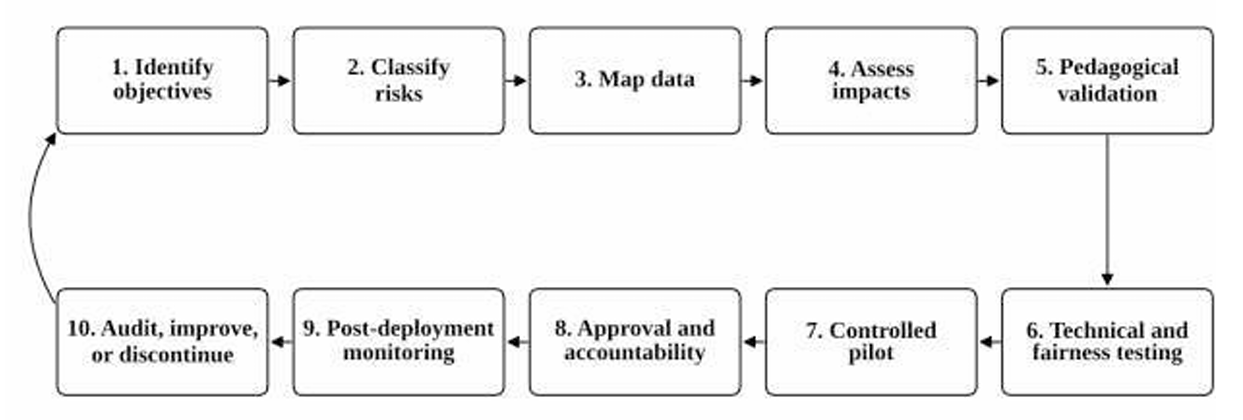
Practical implications: The study proposes a ten-step, lifecycle-based governance framework comprising problem definition, risk classification, data mapping, impact assessment, pedagogical validation, technical and fairness testing, controlled piloting, accountable approval, post-deployment monitoring, and audit or discontinuation, together with a tiered allocation of responsibilities and the evidence required at each step.
Originality/value: The framework links international principles and Vietnam’s newly enacted legal requirements to the concrete stages of curriculum design and delivery, providing higher education institutions and policymakers with a practical basis for transparent, fair, and accountable AI adoption that preserves academic integrity and learner autonomy.
References
1) Alderson, J. C., & Wall, D. (1993). Does washback exist? Applied Linguistics, 14(2), 115–129. https://doi.org/10.1093/applin/14.2.115
2) Baker, R. S., & Hawn, A. (2022). Algorithmic bias in education. International Journal of Artificial Intelligence in Education, 32(4), 1052–1092. https://doi.org/10.1007/s40593-021-00285-9
3) Bowen, G. A. (2009). Document analysis as a qualitative research method. Qualitative Research Journal, 9(2), 27–40. https://doi.org/10.3316/QRJ0902027
4) European Parliament & Council of the European Union. (2024). Regulation (EU) 2024/1689 of the European Parliament and of the Council of 13 June 2024 laying down harmonised rules on artificial intelligence (Artificial Intelligence Act). Official Journal of the European Union, L, 2024/1689.
5) Floridi, L., & Cowls, J. (2019). A unified framework of five principles for AI in society. Harvard Data Science Review, 1(1). https://doi.org/10.1162/99608f92.8cd550d1
6) Holmes, W., Porayska-Pomsta, K., Holstein, K., Sutherland, E., Baker, T., Buckingham Shum, S., Santos, O. C., Rodrigo, M. T., Cukurova, M., Bittencourt, I. I., & Koedinger, K. R. (2022). Ethics of AI in education: Towards a community-wide framework. International Journal of Artificial Intelligence in Education, 32(3), 504–526. https://doi.org/10.1007/s40593-021-00239-1
7) ISO/IEC. (2023). ISO/IEC 42001:2023 Information technology — Artificial intelligence — Management system. International Organization for Standardization.
8) Jobin, A., Ienca, M., & Vayena, E. (2019). The global landscape of AI ethics guidelines. Nature Machine Intelligence, 1(9), 389–399. https://doi.org/10.1038/s42256-019-0088-2
9) Ministry of Education and Training. (2021). Circular No. 17/2021/TT-BGDĐT on training program standards and the development, appraisal, and promulgation of training programs at all levels of higher education.
10) Ministry of Science and Technology. (2026). Circular No. 05/2026/TT-BKHCN promulgating the National Artificial Intelligence Ethics Framework.
11) Mittelstadt, B. (2019). Principles alone cannot guarantee ethical AI. Nature Machine Intelligence, 1(11), 501–507.
https://doi.org/10.1038/s42256-019-0114-4
12) National Assembly. (2025a). Law on Personal Data Protection No. 91/2025/QH15.
13) National Assembly. (2025b). Law on Artificial Intelligence No. 134/2025/QH15.
14) National Institute of Standards and Technology. (2023). Artificial Intelligence Risk Management Framework (AI RMF 1.0) (NIST AI 100-1). https://doi.org/10.6028/NIST.AI.100-1
15) OECD. (2024). Recommendation of the Council on Artificial Intelligence (OECD/LEGAL/0449). OECD Publishing.
16) Raji, I. D., Smart, A., White, R. N., Mitchell, M., Gebru, T., Hutchinson, B., Smith-Loud, J., Theron, D., & Barnes, P. (2020). Closing the AI accountability gap: Defining an end-to-end framework for internal algorithmic auditing. In Proceedings of the 2020 Conference on Fairness, Accountability, and Transparency (pp. 33–44). ACM. https://doi.org/10.1145/3351095.3372873
17) Slade, S., & Prinsloo, P. (2013). Learning analytics: Ethical issues and dilemmas. American Behavioral Scientist, 57(10), 1510–1529. https://doi.org/10.1177/0002764213479366
18) Snyder, H. (2019). Literature review as a research methodology: An overview and guidelines. Journal of Business Research, 104, 333–339. https://doi.org/10.1016/j.jbusres.2019.07.039
19) UNESCO. (2022). Recommendation on the ethics of artificial intelligence. UNESCO.
20) UNESCO. (2023). Guidance for generative AI in education and research. UNESCO.
21) Zawacki-Richter, O., Marín, V. I., Bond, M., & Gouverneur, F. (2019). Systematic review of research on artificial intelligence applications in higher education – Where are the educators? International Journal of Educational Technology in Higher Education, 16, Article 39. https://doi.org/10.1186/s41239-019-0171-0
Downloads
Published
Issue
Section
License
Copyright (c) 2026 Nguyễn Văn Thản (Author)

This work is licensed under a Creative Commons Attribution 4.0 International License.