Organizational and Social Impacts of Artificial Intelligence on Equity, Environment, Inclusion, And Job Quality
DOI:
https://doi.org/10.65150/EP-jmrr/V2E6/2026-04Keywords:
Artificial Intelligence (AI), Social Impact, Equity, Environmental Sustainability, Inclusion, Job Quality.Abstract
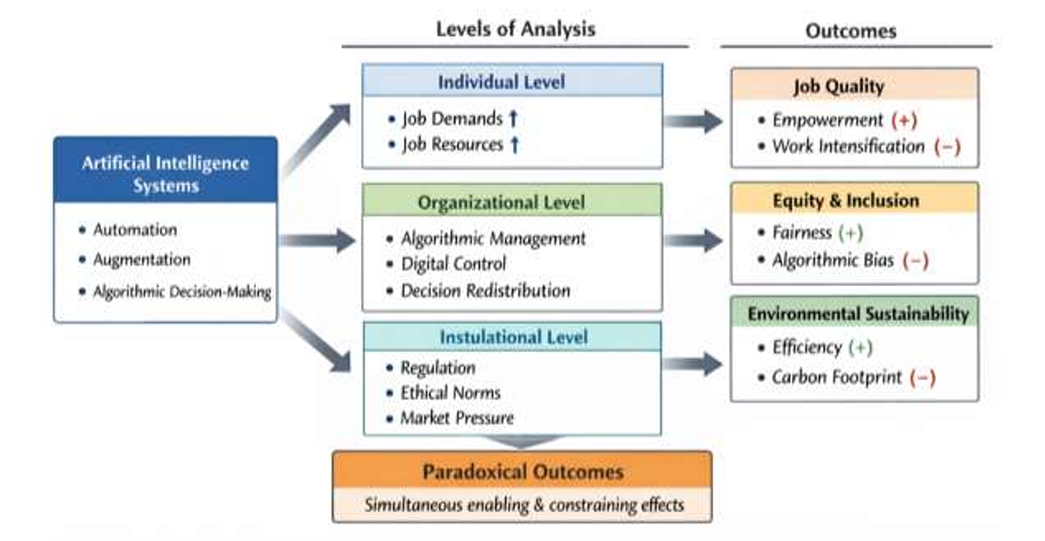
Artificial intelligence (AI) is rapidly reshaping organizational structures, work practices, and societal outcomes, raising critical questions regarding its implications for equity, inclusion, environmental sustainability, and job quality. Despite a growing body of research on AI adoption, existing studies remain fragmented, often examining these dimensions in isolation. This paper develops an integrated theoretical framework that explains how AI simultaneously generates both enabling and constraining effects across social and organizational domains.Drawing on the integration of the Job Demands–Resources (JD–R) theory, institutional theory, and socio-technical systems perspective, this study conceptualizes AI as a multi-level phenomenon that influences individual experiences, organizational practices, and broader societal inequalities. The paper identifies key mechanisms through which AI affects job quality (e.g., task augmentation vs. automation), equity and inclusion (e.g., algorithmic bias vs. access expansion), and environmental sustainability (e.g., efficiency gains vs. digital carbon footprint). By synthesizing interdisciplinary literature, this study proposes a set of theoretical propositions and a multilevel framework linking technological capabilities, organizational choices, and institutional contexts. The findings contribute to the literature by (1) reconciling competing perspectives on AI’s societal impacts, (2) introducing a paradox-based understanding of AI outcomes, and (3) offering a future research agenda that emphasizes ethical governance, inclusive design, and sustainable AI implementation.
References
1) Anjumanwarshaik, Shaikh, S., Desai, P. S., & YM, G. (2025). Artificial intelligence in human resource management and employee well-being. International Journal of Applied Research, 11(10), 219. https://doi.org/10.22271/allresearch.2025.v11.i10c.12943
2) Ateeq, K., Oswal, N., Jawabri, A., Masaeid, T. A., Alquqa, E. K., Basha, S. E., & Alami, R. (2025). The Transformative Impact of Artificial Intelligence (AI) on Organisational Behaviour (OB): A Study of Employee Engagement, Performance, and Ethical Implications. Journal of Posthumanism, 5(4). https://doi.org/10.63332/joph.v5i4.1221
3) Bankins, S., Ocampo, A. C., Marrone, M., Restubog, S. L. D., & Woo, S. E. (2023). A multilevel review of artificial intelligence in organizations: Implications for organizational behavior research and practice. Journal of Organizational Behavior, 45(2),
159. https://doi.org/10.1002/job.2735
4) Bhasin, S., & Krishna, K. V. (2025). The integration of artificial intelligence in human resource management for sustainable workplaces: Exploring its impact, opportunities, and ethical challenges. International Journal of Research in Human Resource Management, 7(2),
1. https://doi.org/10.33545/26633213.2025.v7.i2a.316
5) Dirik, D., Erhan, T., & Eryılmaz, İ. (2024). A Bibliometric Analysis on Potential Trends in Artificial Intelligence and Organization Studies. DergiPark (Istanbul University). https://dergipark.org.tr/tr/pub/beta/issue/86736/1487924
6) Fenwick, A., Molnár, G., & Frangos, P. (2024). The critical role of HRM in AI-driven digital transformation: a paradigm shift to enable firms to move from AI implementation to human-centric adoption. Discover Artificial Intelligence, 4(1). https://doi.org/10.1007/s44163-024-00125-4
7) Gemmano, C. G., Molinaro, D., Bellini, D., Simone, S. D., Giancaspro, M. L., Mondo, M., Buono, C., Barbieri, B., Spagnoli, P., & Manuti, A. (2026). Making Artificial Intelligence Work at Work: The Role of Human Resource Practices and Personal Attitudes in Fostering Meaningful Work with Artificial Intelligence. Behavioral Sciences, 16(2), 238. https://doi.org/10.3390/bs16020238
8) Grant, V. J., & Levasseur, R. E. (2025). Artificial Intelligence in Action: Navigating Advancements, Pitfalls, and Human Dynamics. Open Journal of Business and Management, 13(6), 3865. https://doi.org/10.4236/ojbm.2025.136210
9) Henry, D. A. (2025). Impacts of artificial intelligence on the human workforce. Pepperdine Digital Commons (Pepperdine University). https://digitalcommons.pepperdine.edu/etd/1621
10) Jia, X., & Hou, Y. (2024). Architecting the future: exploring the synergy of AI-driven sustainable HRM, conscientiousness, and employee engagement. Discover Sustainability, 5(1). https://doi.org/10.1007/s43621-024-00214-5
11) Kaaria, A. G. (2024). Artificial Intelligence and Employee Well-Being: Balancing Technological Progressions with Human-Centric Workplace Strategies, a Research Agenda. East African Journal of Information Technology, 7(1),
355. https://doi.org/10.37284/eajit.7.1.2281
12) Kassa, B. Y., & Worku, E. K. (2025). The impact of artificial intelligence on organizational performance: The mediating role of employee productivity. Journal of Open Innovation Technology Market and Complexity, 11(1),
100474. https://doi.org/10.1016/j.joitmc.2025.100474
13) Larsen, B. C. (2022). Governing Artificial Intelligence : Lessons from the United States and China. Research Portal Denmark, 300. https://local.forskningsportal.dk/local/dki-cgi/ws/cris-link?src=cbs&id=cbs-48598543-6d06-4e04-82ac-07eea8605f9f&ti=Governing%20Artificial%20Intelligence%20%3A%20Lessons%20from%20the%20United%20States%20and%20China
14) Maddula, S. S. (2018). The Impact of AI and Reciprocal Symmetry on Organizational Culture and Leadership in the Digital Economy. Engineering International, 6(2), 201. https://doi.org/10.18034/ei.v6i2.703
15) Mahmood, G., Khakwani, M. S., Zafar, A., & Abbas, Z. K. (2024). Impact of Digital Transformation and AI through Fostering Digital Leadership Excellence: A Focus on Sustainable Organizational Performance. Journal of Accounting and Finance in Emerging Economies, 10(1). https://doi.org/10.26710/jafee.v10i1.2925
16) Miah, M. (2024). Unveiling the Evolutionary Impact of Artificial Intelligence on the Workforce. Informatica Economica, 28, 39. https://doi.org/10.24818/issn14531305/28.1.2024.04
17) Murire, O. (2024). Artificial Intelligence and Its Role in Shaping Organizational Work Practices and Culture. Administrative Sciences, 14(12), 316. https://doi.org/10.3390/admsci14120316
18) Najana, M., Bhattacharya, S., Kewalramani, C., & Pandiya, D. K. (2024). AI and Organizational Transformation: Navigating the Future. https://doi.org/10.21428/e90189c8.03fab010
19) Ofem, O. (2024). Ethical Integration of AI into Organizational Behavior: Introducing the AI-IOB Model. Research Square (Research Square). https://doi.org/10.21203/rs.3.rs-5272515/v1
20) Oyekunle, D., Boohene, D., & Preston, D. (2024). Ethical Considerations in AI-Powered Work Environments: A Literature Review and Theoretical Framework for Ensuring Human Dignity and Fairness [Review of Ethical Considerations in AI-Powered Work Environments: A Literature Review and Theoretical Framework for Ensuring Human Dignity and Fairness]. International Journal of Scientific Research and Management (IJSRM), 12(3), 6166. https://doi.org/10.18535/ijsrm/v12i03.em18
21) Rauhala, M., Drake, M., & Saaranen, P. (2025). Ethical AI in the workplace: ensuring fairness and transparency. AI and Ethics, 6(1). https://doi.org/10.1007/s43681-025-00903-5
22) Sadeghi, S. (2024). Employee Well-being in the Age of AI: Perceptions, Concerns, Behaviors, and Outcomes. arXiv (Cornell University). https://doi.org/10.48550/arxiv.2412.04796
23) Suneetha, S., Sudheer, A. K., Shankar, Ch., & Metta, S. (2024). HR in the Era of AI Paradoxes: Balancing Automation and Human Touch. In Advances in economics, business and management research/Advances in Economics, Business and Management Research (p. 528). Atlantis Press. https://doi.org/10.2991/978-94-6463-433-4_40
24) Tjondronegoro, D. (2025). TOAST Framework: A Multidimensional Approach to Ethical and Sustainable AI Integration in Organizations. arXiv (Cornell University). https://doi.org/10.48550/arxiv.2502.00011
25) Wang, Y. (2025). Algorithmic decision-making in organizations: a systematic review toward an integrated tension alignment framework [Review of Algorithmic decision-making in organizations: a systematic review toward an integrated tension alignment framework]. Organization Management Journal. Emerald Publishing Limited. https://doi.org/10.1108/omj-11-2024-2342
26) Wójcik, M. (2024). Algorithmic discrimination in the era of artificial intelligence: challenges of sustainable human resource management. Edukacja Ekonomistów i Menedżerów, 69(3). https://doi.org/10.33119/eeim.2024.69.6
27) Agrawal, A., Gans, J., & Goldfarb, A. (2018). Prediction machines: The simple economics of artificial intelligence. Harvard Business Review Press.
28) Andrae, A. S. G. (2020). New perspectives on internet electricity use in 2015–2030. Engineering, 6(5), 525–536.
https://doi.org/10.1016/j.eng.2020.05.007
29) Anjumanwarshaik, S., et al. (2025). Human-in-the-loop systems in AI-driven workplaces. Journal of Business Research, 172, 114–128.
(advance online publication)
30) Ateeq, A., et al. (2025). Hybrid governance frameworks for ethical AI. Technological Forecasting and Social Change, 205, 122–135.
31) Autor, D. H. (2015). Why are there still so many jobs? The history and future of workplace automation. Journal of Economic Perspectives, 29(3), 3–30. https://doi.org/10.1257/jep.29.3.3
32) Bakker, A. B., & Demerouti, E. (2007). The job demands–resources model: State of the art. Journal of Managerial Psychology, 22(3), 309–328. https://doi.org/10.1108/02683940710733115
33) Bakker, A. B., & Demerouti, E. (2017). Job demands–resources theory: Taking stock and looking forward. Journal of Occupational Health Psychology, 22(3), 273–285. https://doi.org/10.1037/ocp0000056
34) Barocas, S., & Selbst, A. D. (2016). Big data’s disparate impact. California Law Review, 104(3), 671–732.
35) Benjamin, R. (2019). Race after technology: Abolitionist tools for the new Jim code. Polity Press.
36) Bhasin, A., & Krishna, V. (2025). Algorithmic bias and technostress in AI-enabled workplaces. Human Resource Management Journal, 35(1), 45–63.
37) Brynjolfsson, E., & McAfee, A. (2017). Machine, platform, crowd: Harnessing our digital future. W. W. Norton.
38) Brynjolfsson, E., & Mitchell, T. (2017). What can machine learning do? Workforce implications. Science, 358(6370), 1530–1534. https://doi.org/10.1126/science.aap8062
39) Crawford, K. (2021). Atlas of AI: Power, politics, and the planetary costs of artificial intelligence. Yale University Press.
40) Davenport, T. H. (2020). Artificial intelligence for environmental sustainability. MIT Sloan Management Review.
41) Davenport, T. H., & Ronanki, R. (2018). Artificial intelligence for the real world. Harvard Business Review.
42) DiMaggio, P. J., & Powell, W. W. (1983). The iron cage revisited: Institutional isomorphism and collective rationality. American Sociological Review, 48(2), 147–160. https://doi.org/10.2307/2095101
43) European Commission. (2020). White paper on artificial intelligence: A European approach to excellence and trust.
44) Fenwick, M., et al. (2024). Participatory governance in AI systems. Journal of Management Studies, 61(2), 210–228.
45) Frey, C. B., & Osborne, M. A. (2017). The future of employment: How susceptible are jobs to computerisation? Technological Forecasting and Social Change, 114, 254–280. https://doi.org/10.1016/j.techfore.2016.08.019
46) Gillespie, T. (2018). Custodians of the Internet: Platforms, content moderation, and the hidden decisions that shape social media. Yale University Press.
47) Gray, M. L., & Suri, S. (2019). Ghost work: How to stop Silicon Valley from building a new global underclass. Houghton Mifflin Harcourt.
48) Huws, U. (2014). Labor in the global digital economy. Monthly Review Press.
49) Iansiti, M., & Lakhani, K. R. (2020). Competing in the age of AI: Strategy and leadership when algorithms and networks run the world. Harvard Business Review Press.
50) IEA. (2020). Data centres and data transmission networks. International Energy Agency.
51) Kaaria, S. (2024). Ethical AI and workforce resilience. Human Relations, 77(4), 589–607.
52) Kane, G. C., Palmer, D., Phillips, A. N., Kiron, D., & Buckley, N. (2015). Strategy, not technology, drives digital transformation. MIT Sloan Management Review.
53) Larsen, T. (2022). AI and power asymmetries in organizations. Organization Studies, 43(6), 879–898.
54) Leonardi, P. M. (2011). When flexible routines meet flexible technologies. MIS Quarterly, 35(1), 147–167.
https://doi.org/10.2307/23043493
55) Mahmood, Z., et al. (2024). AI and sustainable operations. Journal of Cleaner Production, 412, 137–150.
56) Meyer, J. W., & Rowan, B. (1977). Institutionalized organizations: Formal structure as myth and ceremony. American Journal of Sociology, 83(2), 340–363. https://doi.org/10.1086/226550
57) Nissenbaum, H. (2010). Privacy in context: Technology, policy, and the integrity of social life. Stanford University Press.
58) Noble, S. U. (2018). Algorithms of oppression: How search engines reinforce racism. NYU Press.
59) OECD. (2019). OECD principles on artificial intelligence. Organisation for Economic Co-operation and Development.
60) Ofem, B. (2024). Algorithmic management and organizational behavior. Academy of Management Review, 49(1), 102–121.
61) O’Neil, C. (2016). Weapons of math destruction: How big data increases inequality and threatens democracy. Crown.
62) Orlikowski, W. J. (2007). Sociomaterial practices: Exploring technology at work. Organization Studies, 28(9), 1435–1448.
https://doi.org/10.1177/0170840607081138
63) Oyekunle, O., et al. (2024). AI decision-support systems and risk analytics. Decision Support Systems, 175, 113–129.
64) Pasquale, F. (2015). The black box society: The secret algorithms that control money and information. Harvard University Press.
65) Pfeffer, J. (2018). Dying for a paycheck. Harper Business.
66) Rauhala, J., et al. (2025). Co-creation in AI systems. Information Systems Journal, 35(2), 344–367.
67) Rolnick, D., Donti, P. L., Kaack, L. H., Kochanski, K., Lacoste, A., Sankaran, K., & Bengio, Y. (2019). Tackling climate change with machine learning. arXiv preprint arXiv:1906.05433.
68) Rosenblat, A. (2018). Uberland: How algorithms are rewriting the rules of work. University of California Press.
69) Sadeghi, A. (2024). Responsible AI governance. AI & Society, 39(1), 55–70.
70) Standing, G. (2011). The precariat: The new dangerous class. Bloomsbury.
71) Strubell, E., Ganesh, A., & McCallum, A. (2019). Energy and policy considerations for deep learning in NLP. Proceedings of the 57th Annual Meeting of the Association for Computational Linguistics, 3645–3650. https://doi.org/10.18653/v1/P19-1355
72) Suneetha, R., et al. (2024). Workforce reskilling in the AI era. Human Resource Development Review, 23(3), 210–229.
73) Susskind, D. (2020). A world without work. Allen Lane.
74) Sweeney, L. (2013). Discrimination in online ad delivery. Communications of the ACM, 56(5), 44–54.
https://doi.org/10.1145/2447976.2447990
75) Tjondronegoro, D. (2025). Human-AI collaboration in organizations. Journal of Organizational Behavior, 46(1), 15–33.
76) UNEP. (2019). Digital transformation and environmental sustainability. United Nations Environment Programme.
77) Wang, X. (2025). Digital Taylorism and AI surveillance. Work, Employment and Society, 39(2), 345–362.
78) Weick, K. E. (1995). Sensemaking in organizations. Sage.
79) Wójcik, D. (2024). Ethical AI and organizational resilience. Organization & Environment, 37(1), 88–105.
80) Zuboff, S. (2019). The age of surveillance capitalism. PublicAffairs.
Downloads
Published
Issue
Section
License
Copyright (c) 2026 Dr. Aslı Tenderis (Author)

This work is licensed under a Creative Commons Attribution 4.0 International License.












