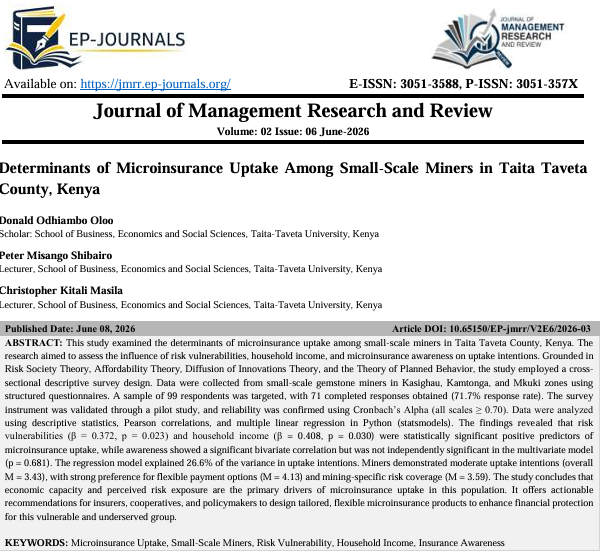
Determinants of Microinsurance Uptake Among Small-Scale Miners in Taita Taveta County, Kenya
DOI:
https://doi.org/10.65150/EP-jmrr/V2E6/2026-03Keywords:
Microinsurance Uptake, Small-Scale Miners, Risk Vulnerability, Household Income, Insurance AwarenessAbstract
This study examined the determinants of microinsurance uptake among small-scale miners in Taita Taveta County, Kenya. The research aimed to assess the influence of risk vulnerabilities, household income, and microinsurance awareness on uptake intentions. Grounded in Risk Society Theory, Affordability Theory, Diffusion of Innovations Theory, and the Theory of Planned Behavior, the study employed a cross-sectional descriptive survey design. Data were collected from small-scale gemstone miners in Kasighau, Kamtonga, and Mkuki zones using structured questionnaires. A sample of 99 respondents was targeted, with 71 completed responses obtained (71.7% response rate). The survey instrument was validated through a pilot study, and reliability was confirmed using Cronbach’s Alpha (all scales ≥ 0.70). Data were analyzed using descriptive statistics, Pearson correlations, and multiple linear regression in Python (statsmodels). The findings revealed that risk vulnerabilities (β = 0.372, p = 0.023) and household income (β = 0.408, p = 0.030) were statistically significant positive predictors of microinsurance uptake, while awareness showed a significant bivariate correlation but was not independently significant in the multivariate model (p = 0.681). The regression model explained 26.6% of the variance in uptake intentions. Miners demonstrated moderate uptake intentions (overall M = 3.43), with strong preference for flexible payment options (M = 4.13) and mining-specific risk coverage (M = 3.59). The study concludes that economic capacity and perceived risk exposure are the primary drivers of microinsurance uptake in this population. It offers actionable recommendations for insurers, cooperatives, and policymakers to design tailored, flexible microinsurance products to enhance financial protection for this vulnerable and underserved group.
References
1) Adero, J. (2025). Toxic tools, a poisoned ecosystem and the gender toll: Policy paper on Small-scale Gold Mining (ASGM) in Migori County, Kenya.
2) Ajzen, I. (1991). The theory of planned behavior. Organizational Behavior and Human Decision Processes, 50(2), 179–211.
https://doi.org/10.1016/0749-5978(91)90020-T
3) Association of Kenya Insurers (AKI). (2023). Insurance industry annual report 2023. Nairobi, Kenya: AKI.
4) Barreto, M. L., Schein, P., Hinton, J., & Hruschka, F. (2018). The impacts of artisanal and small-scale mining on sustainable livelihoods. International Institute for Environment and Development.
5) Beck, U. (1992). Risk society: Towards a new modernity. Sage Publications.
6) Bersales, L., & Mapa, D. (2020). Financial inclusion and microinsurance adoption among vulnerable communities. Asian Economic Review, 62(3), 245–261.
7) Britam Connect. (2025). Britam Connect to revolutionize insurance for low-income households, gig workers, and small businesses.
8) Buxton, A. (2021). Responding to the challenge of artisanal and small-scale mining. International Institute for Environment and Development.
9) Centre for Sustainable Mining. (2021). Taita Taveta sustainable mining action plan 2021–2025. University of Nairobi / Centre for Sustainable Mining.
10) Cia Jin, L., & Song, H. (2015). Determinants of insurance demand and uptake among vulnerable populations. Journal of Risk and
Insurance, 82(4), 879–901.
11) County Government of Taita Taveta. (2022). County integrated development plan implementation report. Voi, Kenya.
12) Creswell, J. W., & Creswell, J. D. (2018). Research design: Qualitative, quantitative, and mixed methods approaches (5th ed.). Sage Publications.
13) Delve. (2020). State of the artisanal and small-scale mining sector report. Delve Exchange.
14) Field, A. (2018). Discovering statistics using IBM SPSS statistics (5th ed.). Sage Publications.
15) Financial Sector Deepening Kenya (FSD Kenya). (2024). Financial inclusion and insurance access report. Nairobi, Kenya.
16) Fisher, E., Mwaipopo, R., Mutagwaba, W., Nyange, D., & Yaron, G. (2021). Microinsurance and financial inclusion among artisanal miners in East Africa. Resources Policy, 74, 102280.
17) Hilson, G., & Garforth, C. (2023). Poverty, livelihoods and artisanal mining in Africa. Resources Policy, 80, 103119.
18) Intergovernmental Forum on Mining, Minerals, Metals and Sustainable Development (IGF). (2021). Global trends in artisanal and small-scale mining. Ottawa, Canada: IGF.
19) International Journal of Research and Innovation in Social Science (IJRISS). (2025). Knowledge, financial literacy, and insurance uptake among rural households. International Journal of Research and Innovation in Social Science, 9(1), 1–15.
20) International Labour Organization (ILO). (2021). World employment and social outlook: Trends 2021. Geneva, Switzerland: ILO.
21) International Resource Authority (IRA). (2022). Microinsurance penetration and financial inclusion in Kenya. Nairobi, Kenya.
22) JMSR. (2025). Factors influencing the adoption of micro-insurance schemes: Evidence from low-income
23) Jose Miguel, M., et al. (2024). Subsidizing inclusive insurance to reduce poverty: Evidence from low-income households. Journal of Development Economics, 168, 103245.
24) Journal of Mining and Sustainable Resources (JMSR). (2025). Household income and microinsurance participation among informal workers. Journal of Mining and Sustainable Resources, 12(2), 45–61.
25) Kenya Artisanal and Small-Scale Gold Mining National Action Plan (Kenya ASGM NAP). (2022). National action plan for the artisanal and small-scale gold mining sector in Kenya. Nairobi, Kenya.
26) Kenya Chamber of Mines. (2023). Annual mining sector report 2023. Nairobi, Kenya.
27) Lahiri-Dutt, K. (2020). Informality, livelihoods and risk in artisanal mining communities. The Extractive Industries and Society, 7(4), 1235–1243.
28) Lange, S. (2021). Microinsurance adoption and informal sector resilience in Tanzania. African Development Review, 33(2), 298–311.
29) Magambo, J., et al. (2022). Determinants of microinsurance uptake among low-income households. African Journal of Economic and Management Studies, 13(3), 421–438.
30) Microinsurance Network. (2024). The landscape of microinsurance 2024. Luxembourg: Microinsurance Network.
31) Minerals Council of Australia. (2022). Australian mining industry insurance and safety report. Canberra, Australia.
32) Mining Association of Canada. (2021). Towards sustainable mining report 2021. Ottawa, Canada.
33) Ministry of Mining Kenya. (2025). Small-scale mining development report. Nairobi, Kenya: Government Printer.
34) Ministry of Petroleum and Mining. (2021). Kenya mining sector performance report. Nairobi, Kenya: Government Printer.
35) Musau, P. (2023). Financial inclusion and insurance uptake among artisanal miners in Kenya. African Journal of Finance and Development, 15(2), 85–101.
36) Mutembei, C. (2021). Challenges facing artisanal gemstone mining in Taita Taveta County. Journal of African Natural Resources, 8(1), 44–59.
37) Natural Resources Canada. (2020). Canadian mining and mineral statistics report. Ottawa, Canada.
38) Nyame, F. K., & Blocher, J. (2020). Influence of informal mining practices on financial inclusion in Africa. Resources Policy, 65, 101546.
39) Rogers, E. M. (2003). Diffusion of innovations (5th ed.). Free Press.
40) Salo, M., Hiedanpää, J., & Karlsson, T. (2021). Financial protection mechanisms among informal workers. World Development, 146, 105567.
41) Spiegel, S. J., Agrawal, S., Mikha, D., et al. (2020). Phasing out mercury? Ecological economics and artisanal mining. The Extractive Industries and Society, 7(2), 518–527.
42) Stone, M. E. (2006). What is housing affordability? The case for the residual income approach. Housing Policy Debate, 17(1), 151–184.
43) Taita Taveta County Integrated Development Plan (CIDP). (2018–2022). County integrated development plan 2018–2022. Voi, Kenya.
44) Tanzania Insurance Regulatory Authority (TIRA). (2021). Microinsurance market performance report. Dar es Salaam, Tanzania.
45) United Nations Environment Programme (UNEP). (2022). Global environmental outlook and artisanal mining report. Nairobi, Kenya.
46) World Bank. (2020). 2020 state of artisanal and small-scale mining sector report. Washington, DC: World Bank.
Downloads
Published
Issue
Section
License
Copyright (c) 2026 Donald Odhiambo Oloo, Peter Misango Shibairo , Christopher Kitali Masila (Author)

This work is licensed under a Creative Commons Attribution 4.0 International License.












