Corporate Governance, Market Structure, And Greenwashing: Evidence from A Two-Part Model in an Emerging Market
DOI:
https://doi.org/10.65150/EP-jmrr/V2E9/2026-03Keywords:
Greenwashing, Corporate Governance, Market Structure, ESG Disclosure, Climate Policy Uncertainty, Emerging MarketsAbstract
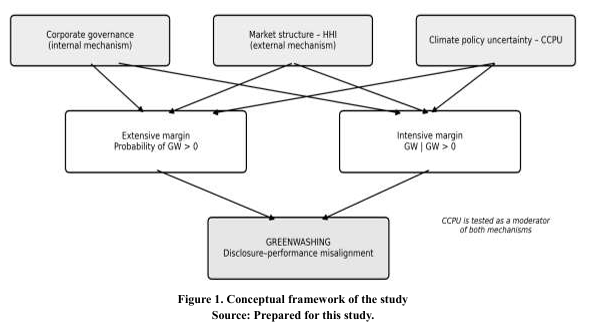
Objective: To examine whether corporate governance and product-market structure are associated with greenwashing among Brazilian firms and whether climate policy uncertainty conditions these relationships, distinguishing the occurrence of disclosure-performance misalignment from its conditional intensity. Methodology: We use a canonical panel of 970 firm-year observations from 105 firms over 2010–2023. Greenwashing is measured as the relative gap between Bloomberg® ESG Disclosure and LSEG Data & Analytics® environmental performance. The common sample includes 942 observations for the extensive margin and 516 observations with GW > 0 for the intensive margin. Preferred specifications use Logit and OLS with NAICS-3 and year fixed effects, NAICS-3 clustered standard errors, firm size measured as ln(total assets), a horse-race specification, and robustness tests. Findings: Corporate governance is not significant in the extensive margin (β = 0.007; p = 0.981) or intensive margin (β = -0.053; p = 0.683). HHI is likewise not significant (β = -0.350; p = 0.838; and β = -0.386; p = 0.354, respectively). Interactions with CCPU remain non-significant, and the inference is unchanged by winsorization, excluding market share from the HHI model, or reconstructing governance with seven empirically unique dimensions. Significance: The findings show that inferences about governance, competition, and greenwashing depend critically on simultaneous observability of disclosure and performance, sample comparability, and separation of occurrence from intensity.
References
1) Adams, R. B., Hermalin, B. E., & Weisbach, M. S. (2010). The role of boards of directors in corporate governance: A conceptual framework and survey. Journal of Economic Literature, 48(1), 58–107. https://doi.org/10.1257/jel.48.1.58
2) Baker, S. R., Bloom, N., & Davis, S. J. (2016). Measuring economic policy uncertainty. The Quarterly Journal of Economics, 131(4), 1593–1636. https://doi.org/10.1093/qje/qjw024
3) Berg, F., Kölbel, J. F., & Rigobon, R. (2022). Aggregate confusion: The divergence of ESG ratings. Review of Finance, 26(6), 1315–1344. https://doi.org/10.1093/rof/rfac033
4) Cameron, A. C., Gelbach, J. B., & Miller, D. L. (2011). Robust inference with multiway clustering. Journal of Business & Economic Statistics, 29(2), 238–249. https://doi.org/10.1198/jbes.2010.07136
5) Cho, C. H., Laine, M., Roberts, R. W., & Rodrigue, M. (2015). Organized hypocrisy, organizational façades, and sustainability reporting. Accounting, Organizations and Society, 40, 78–94. https://doi.org/10.1016/j.aos.2014.12.003
6) Christensen, H. B., Hail, L., & Leuz, C. (2021). Mandatory CSR and sustainability reporting: Economic analysis and literature review. Review of Accounting Studies, 26, 1176–1248. https://doi.org/10.1007/s11142-021-09609-5
7) Connelly, B. L., Certo, S. T., Ireland, R. D., & Reutzel, C. R. (2011). Signaling theory: A review and assessment. Journal of Management, 37(1), 39–67. https://doi.org/10.1177/0149206310388419
8) Cragg, J. G. (1971). Some statistical models for limited dependent variables with application to the demand for durable goods. Econometrica, 39(5), 829–844. https://doi.org/10.2307/1909582
9) Darrough, M. N., & Stoughton, N. M. (1990). Financial disclosure policy in an entry game. Journal of Accounting and Economics, 12(1–3), 219–243. https://doi.org/10.1016/0165-4101(90)90048-7
10) Deegan, C. (2002). Introduction: The legitimising effect of social and environmental disclosures. Accounting, Auditing & Accountability Journal, 15(3), 282–311. https://doi.org/10.1108/09513570210435852
11) Delmas, M. A., & Burbano, V. C. (2011). The drivers of greenwashing. California Management Review, 54(1), 64–87. https://doi.org/10.1525/cmr.2011.54.1.64
12) El Diri, M., Lambrinoudakis, C., & Alhadab, M. (2020). Corporate governance and earnings management in concentrated markets. Journal of Business Research, 108, 291–306. https://doi.org/10.1016/j.jbusres.2019.11.013
13) Fama, E. F., & Jensen, M. C. (1983). Separation of ownership and control. Journal of Law and Economics, 26(2), 301–325. https://doi.org/10.1086/467037
14) García-Sánchez, I. M., Martínez-Ferrero, J., & García-Benau, M. A. (2021). Integrated reporting and board monitoring. Corporate Social Responsibility and Environmental Management, 28(2), 649–666. https://doi.org/10.1002/csr.2071
15) Gavriilidis, K. (2021). Measuring climate policy uncertainty. SSRN Electronic Journal. https://doi.org/10.2139/ssrn.3847388
16) Ghitti, M., Gianfrate, G., & Palma, L. (2024). The agency of greenwashing. Journal of Management and Governance, 28, 905–941. https://doi.org/10.1007/s10997-023-09683-8
17) Giroud, X., & Mueller, H. M. (2010). Does corporate governance matter in competitive industries? Journal of Financial Economics, 95(3), 312–331. https://doi.org/10.1016/j.jfineco.2009.10.008
18) Greene, W. H. (2018). Econometric analysis (8th ed.). Pearson.
19) Healy, P. M., & Palepu, K. G. (2001). Information asymmetry, corporate disclosure, and the capital markets. Journal of Accounting and Economics, 31(1–3), 405–440. https://doi.org/10.1016/S0165-4101(01)00018-0
20) Hermalin, B. E., & Weisbach, M. S. (2003). Boards of directors as an endogenously determined institution. Economic Policy Review, 9(1), 7–26.
21) Holmström, B. (1979). Moral hazard and observability. The Bell Journal of Economics, 10(1), 74–91. https://doi.org/10.2307/3003320
22) Jensen, M. C., & Meckling, W. H. (1976). Theory of the firm: Managerial behavior, agency costs and ownership structure. Journal of Financial Economics, 3(4), 305–360. https://doi.org/10.1016/0304-405X(76)90026-X
23) Karuna, C. (2007). Industry product market competition and managerial incentives. Journal of Accounting and Economics, 43(2–3), 275–297. https://doi.org/10.1016/j.jacceco.2007.02.004
24) La Porta, R., Lopez-de-Silanes, F., Shleifer, A., & Vishny, R. W. (1998). Law and finance. Journal of Political Economy, 106(6), 1113–1155. https://doi.org/10.1086/250042
25) Lee, S. P., Isa, M., & Shaiban, M. S. (2025). Corporate governance and greenwashing: The moderating role of political connection and sensitive industries. SAGE Open, 15(3), 1–15. https://doi.org/10.1177/21582440251369200
26) Lyon, T. P., & Maxwell, J. W. (2011). Greenwash under audit threat. Journal of Economics & Management Strategy, 20(1), 3–41. https://doi.org/10.1111/j.1530-9134.2010.00282.x
27) Lyon, T. P., & Montgomery, A. W. (2015). The means and end of greenwash. Organization & Environment, 28(2), 223–249. https://doi.org/10.1177/1086026615575332
28) Lyon, T. P., Montgomery, A. W., Darnall, N., & Maxwell, J. W. (2023). Greenwash: Causes and consequences. Academy of Management Annals, 17(1), 356–389. https://doi.org/10.5465/annals.2021.0094
29) Ma, Y., & Ahmad, M. I. (2024). Do board characteristics impact greenwashing? Moderating role of CSR committee. Heliyon, 10(20), e38743. https://doi.org/10.1016/j.heliyon.2024.e38743
30) Marquis, C., Toffel, M. W., & Zhou, Y. (2016). Scrutiny, norms, and selective disclosure. Organization Science, 27(2), 483–504. https://doi.org/10.1287/orsc.2015.1039
31) Meyer, J. W., & Rowan, B. (1977). Institutionalized organizations: Formal structure as myth and ceremony. American Journal of Sociology, 83(2), 340–363. https://doi.org/10.1086/226550
32) Oster, E. (2019). Unobservable selection and coefficient stability: Theory and evidence. Journal of Business & Economic Statistics, 37(2), 187–204. https://doi.org/10.1080/07350015.2016.1227711
33) Spence, M. (1973). Job market signaling. The Quarterly Journal of Economics, 87(3), 355–374. https://doi.org/10.2307/1882010
34) Suchman, M. C. (1995). Managing legitimacy: Strategic and institutional approaches. Academy of Management Review, 20(3), 571–610. https://doi.org/10.5465/amr.1995.9508080331
35) Velte, P. (2023). The bidirectional relationship between ESG performance and earnings management. Journal of Global Responsibility, 14(3), 330–380. https://doi.org/10.1108/JGR-01-2022-0008
36) Verrecchia, R. E. (1983). Discretionary disclosure. Journal of Accounting and Economics, 5, 179–194. https://doi.org/10.1016/0165-4101(83)90011-3
37) Wooldridge, J. M. (2010). Econometric analysis of cross section and panel data (2nd ed.). MIT Press.
38) Wang, Y., Hu, F., & Wang, Y. (2026). Climate policy uncertainty and corporate greenwashing: Developing a new metric for selective investment practices. Research in International Business and Finance, 81, 103202. https://doi.org/10.1016/j.ribaf.2025.103202
39) Zhang, Z., & Ge, Z. (2024). Fishing in muddy water? Climate policy uncertainty and corporate greenwashing in environmental, social, and governance. Managerial and Decision Economics, 45(6), 4191–4207. https://doi.org/10.1002/mde.4254
40) Zhao, X., Huang, X., Liu, F., & Pan, L. (2024). Executive power discrepancy and corporate ESG greenwashing. International Review of Financial Analysis, 96, 103533. https://doi.org/10.1016/j.irfa.2024.103533
Downloads
Published
Issue
Section
License
Copyright (c) 2026 Sinara Silva Pinheiro Lopes (Author)

This work is licensed under a Creative Commons Attribution 4.0 International License.