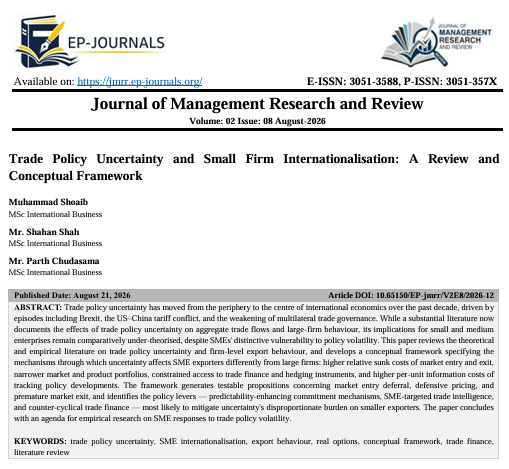
Trade Policy Uncertainty and Small Firm Internationalisation: A Review and Conceptual Framework
DOI:
https://doi.org/10.65150/EP-jmrr/V2E8/2026-12Keywords:
trade policy uncertainty, SME internationalisation, export behaviour, real options, conceptual framework, trade finance, literature reviewAbstract
Trade policy uncertainty has moved from the periphery to the centre of international economics over the past decade, driven by episodes including Brexit, the US–China tariff conflict, and the weakening of multilateral trade governance. While a substantial literature now documents the effects of trade policy uncertainty on aggregate trade flows and large-firm behaviour, its implications for small and medium enterprises remain comparatively under-theorised, despite SMEs' distinctive vulnerability to policy volatility. This paper reviews the theoretical and empirical literature on trade policy uncertainty and firm-level export behaviour, and develops a conceptual framework specifying the mechanisms through which uncertainty affects SME exporters differently from large firms: higher relative sunk costs of market entry and exit, narrower market and product portfolios, constrained access to trade finance and hedging instruments, and higher per-unit information costs of tracking policy developments. The framework generates testable propositions concerning market entry deferral, defensive pricing, and premature market exit, and identifies the policy levers — predictability-enhancing commitment mechanisms, SME-targeted trade intelligence, and counter-cyclical trade finance — most likely to mitigate uncertainty's disproportionate burden on smaller exporters. The paper concludes with an agenda for empirical research on SME responses to trade policy volatility.
References
1) Amiti, M., Redding, S.J., & Weinstein, D.E. (2019). The impact of the 2018 tariffs on prices and welfare. Journal of Economic Perspectives, 33(4), 187–210.
2) Bloom, N., Bunn, P., Chen, S., Mizen, P., Smietanka, P., & Thwaites, G. (2019). The impact of Brexit on UK firms. National Bureau of Economic Research Working Paper No. 26218.
3) Caldara, D., Iacoviello, M., Molligo, P., Prestipino, A., & Raffo, A. (2020). The economic effects of trade policy uncertainty. Journal of Monetary Economics, 109, 38–59.
4) Dixit, A.K., & Pindyck, R.S. (1994). Investment under uncertainty. Princeton University Press.
5) Handley, K., & Limão, N. (2017). Policy uncertainty, trade and welfare: Theory and evidence for China and the United States. American Economic Review, 107(9), 2731–2783.
6) Knight, G.A., & Cavusgil, S.T. (2004). Innovation, organizational capabilities, and the born-global firm. Journal of International Business Studies, 35(2), 124–141.
7) Melitz, M.J. (2003). The impact of trade on intra-industry reallocations and aggregate industry productivity. Econometrica, 71(6), 1695–1725.
8) OECD. (2021). OECD SME and entrepreneurship outlook 2021. OECD Publishing.
9) Roberts, M.J., & Tybout, J.R. (1997). The decision to export in Colombia: An empirical model of entry with sunk costs. American Economic Review, 87(4), 545–564.
10) Baker, S.R., Bloom, N., & Davis, S.J. (2016). Measuring economic policy uncertainty. Quarterly Journal of Economics, 131(4), 1593–1636.
11) Bernard, A.B., & Jensen, J.B. (2004). Why some firms export. Review of Economics and Statistics, 86(2), 561–569.
12) Bloom, N. (2009). The impact of uncertainty shocks. Econometrica, 77(3), 623–685.
13) Chauffour, J.P., & Malouche, M. (2011). Trade finance during the 2008–09 trade collapse: Key takeaways. World Bank Economic Premise, 66, 1–6.
14) Manova, K. (2013). Credit constraints, heterogeneous firms, and international trade. Review of Economic Studies, 80(2), 711–744.
Downloads
Published
Issue
Section
License
Copyright (c) 2026 Muhammad Shoaib, Mr. Shahan Shah, Mr. Parth Chudasama (Author)

This work is licensed under a Creative Commons Attribution 4.0 International License.












