Aftermath Effects of Mergers and Acquisitions on the Performance of Deposit Money Banks in Nigeria: Evidence from 2021–2026
DOI:
https://doi.org/10.65150/EP-jmrr/V2E8/2026-06Keywords:
mergers and acquisitions, Deposit Money Banks, banking consolidation, recapitalization, financial performance, Nigeria.Abstract
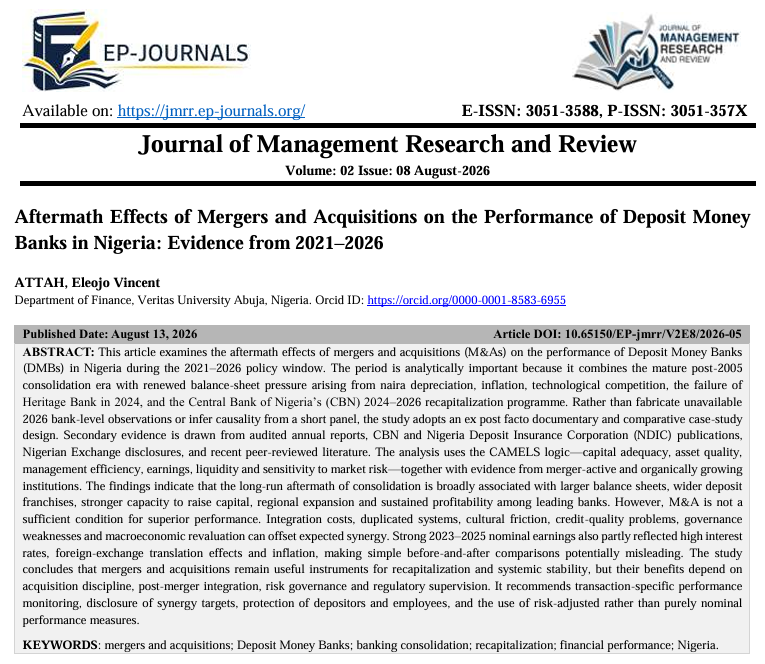
This article examines the aftermath effects of mergers and acquisitions (M&As) on the performance of Deposit Money Banks (DMBs) in Nigeria during the 2021–2026 policy window. The period is analytically important because it combines the mature post-2005 consolidation era with renewed balance-sheet pressure arising from naira depreciation, inflation, technological competition, the failure of Heritage Bank in 2024, and the Central Bank of Nigeria’s (CBN) 2024–2026 recapitalization programme. Rather than fabricate unavailable 2026 bank-level observations or infer causality from a short panel, the study adopts an ex post facto documentary and comparative case-study design. Secondary evidence is drawn from audited annual reports, CBN and Nigeria Deposit Insurance Corporation (NDIC) publications, Nigerian Exchange disclosures, and recent peer-reviewed literature. The analysis uses the CAMELS logic—capital adequacy, asset quality, management efficiency, earnings, liquidity and sensitivity to market risk—together with evidence from merger-active and organically growing institutions. The findings indicate that the long-run aftermath of consolidation is broadly associated with larger balance sheets, wider deposit franchises, stronger capacity to raise capital, regional expansion and sustained profitability among leading banks. However, M&A is not a sufficient condition for superior performance. Integration costs, duplicated systems, cultural friction, credit-quality problems, governance weaknesses and macroeconomic revaluation can offset expected synergy. Strong 2023–2025 nominal earnings also partly reflected high interest rates, foreign-exchange translation effects and inflation, making simple before-and-after comparisons potentially misleading. The study concludes that mergers and acquisitions remain useful instruments for recapitalization and systemic stability, but their benefits depend on acquisition discipline, post-merger integration, risk governance and regulatory supervision. It recommends transaction-specific performance monitoring, disclosure of synergy targets, protection of depositors and employees, and the use of risk-adjusted rather than purely nominal performance measures.
References
1) Abdulraheem, A. (2022). Performance indices of Deposit Money Banks: A post-consolidation trend analysis. NDIC Quarterly, 38(2), 59–81.
2) Ansoff, H. I. (1965). Corporate strategy. McGraw-Hill.
3) Barney, J. (1991). Firm resources and sustained competitive advantage. Journal of Management, 17(1), 99–120.
4) Central Bank of Nigeria. (2024). Bank recapitalisation: Review of minimum capital requirements for commercial, merchant and non-interest banks. Author.
5) Central Bank of Nigeria. (2024, June 3). Revocation of the banking licence of Heritage Bank Plc. Author.
6) Guaranty Trust Holding Company Plc. (2025). Annual report and financial statements 2024. Author.
7) Jensen, M. C., & Meckling, W. H. (1976). Theory of the firm: Managerial behavior, agency costs and ownership structure. Journal of Financial Economics, 3(4), 305–360.
8) Nigeria Deposit Insurance Corporation. (2023). Annual report and statement of accounts 2023. Author.
9) Nigeria Deposit Insurance Corporation. (2024). Annual report and statement of accounts 2024. Author.
10) Nigeria Deposit Insurance Corporation. (2024, June 3). NDIC commences liquidation of Heritage Bank. Author.
11) Roll, R. (1986). The hubris hypothesis of corporate takeovers. Journal of Business, 59(2), 197–216.
12) Unity Bank Plc. (2024, August 6). Notification of Central Bank of Nigeria approval of Unity Bank Plc/Providus Bank Limited merger. Nigerian Exchange Limited.
13) Access Holdings Plc. (2025). Annual report for the year ended 31 December 2024. Author.
14) United Bank for Africa Plc. (2025). Annual report and accounts 2024. Author.
15) Wernerfelt, B. (1984). A resource-based view of the firm. Strategic Management Journal, 5(2), 171–180.
16) Zenith Bank Plc. (2025). Annual report and accounts 2024. Author.
17) Zenith Bank Plc. (2026). Annual report and financial statements 2025. Author.
18) Okonkwo, J. J., Anachedo, C. K., Jeff-anyeneh, E. S., & Nnoje, I. A. (2022). The contribution of banking sector to the growth of the Nigerian economy. International journal of research, 9(3), 85-101.
19) Okpara, G. C. (2011). Bank reforms and the performance of the Nigerian banking sector: An empirical analysis. International Journal of Current Research, 2(1), 142-153.
20) Olasehinde, S. A., Solanke, F. T., Kukoyi, O. E., & Ogunsina, T. A. (2023). Effect of Merger and Acquisition on the Performance of Banking Industry in Nigeria. Fuoye Journal of Accounting and Management, 6(2).
21) Olayinka, T. T., & Farouk, M. A. (2014). The impact of consolidation on the performance of banks in Nigeria. Global Advanced Journal of Management and Business Studies, 3, 479-485.
22) Olugbenga, S. O., & Olankunle, A. P. (1998). Bank performance in Nigeria: analysing the transition to a deregulated economy.
23) Omoruyi, S. E. (1991). The Financial Section in Africa Overview and Reforms in Economic
24) Adjustment Programme. Central Bank of Nigeria Economic and Financial Review, 29.
25) Pesaran, M. H., Shin, Y., & Smith, R. J. (2001). Bounds testing approaches to the analysis of level relationships. Journal of applied econometrics, 16(3), 289-326.
26) Phillips, P. C., & Hansen, B. E. (1990). Statistical inference in instrumental variables regression with I (1) processes. The review of economic studies, 57(1), 99-125.
27) Pricewater House Coopers. (2022). https://www.pwc.com/ng/en/publications/fintech-and-the-banking-sector-in- nigeria.html
28) Racheal, D. (2013). Effects of Bank Consolidation on Key Stakeholders of Commercial Banks in Niger Delta Region, Nigeria. Doctoral Dissertation, University of Nigeria, Enugu Campus.
29) Sand, J. (2016). What is Bank Consolidation? eHOW Business Final Journal. www.ehow.com/facts_7183611_bank_consolidatio n_.html.
30) Sanusi, S. L. (2011). Global financial meltdown and the reforms in the Nigerian banking sector. CBN Journal of Applied Statistics (JAS), 2(1), 7.
31) Shuaibu, M., Yusufu, M., Abdullahi, S. I., Shehu, K. K., & Adamu, M. B. (2021). What explains economic growth in Nigeria in the last three decades?—A dynamic modelling approach. East African Scholars Multidiscip Bull, 4, 75-84.
32) Sinha, N., Kaushik, K. P., & Chaudhary, T. (2010). Measuring post merger and acquisition performance: An investigation of select financial sector organizations in India. International journal of Economics and Finance, 2(4), 190-200
33) Soyinbo, A., & Adekanye, F. (1992). The Nigerian Banking System in the Context of Policies of Financial Regulation and Deregulation, Africa Economic Research Consortium, Nairobi.
34) hendu, O. A. (2005). Banking Sector Reforms and Bank Consolidation: The Malaysian Experience. Central Bank of Nigeria Bullion, 29(2), 12-16.
35) Ugwu, K. E., Ohakah, I. O., & Kalu, A. S. (2016). Evaluation of the Effect of Commercial Bank Consolidation on Economic Growth (Evidence from Nigeria, 2006-2015). Management Studies and Economic Systems (MSES), 3(2), 61-75.
36) Ugwu, K. E., Ohakah, I. O., & Kalu, A. S. (2016). Evaluation of the Effect of Commercial Bank Consolidation on Economic Growth (Evidence from Nigeria, 2006-2015). Management Studies and Economic Systems (MSES), 3(2), 61-75.
37) Yakubu, Y. (2015). Banking Consolidation and Economic Growth in Nigeria: Dynamic Chain Transmission Evidence. IOSR Journal of Humanities and Social Science Ver. IV, 20(5), 27-33.
Downloads
Published
Issue
Section
License
Copyright (c) 2026 ATTAH, Eleojo Vincent (Author)

This work is licensed under a Creative Commons Attribution 4.0 International License.












